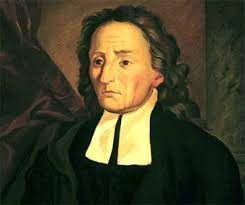
Giambattista Vico (1668 - 1744)
Open Vico's interactive page (graphs of influences, similar and opposing positions, and quotes)
Background
Giambattista Vico
Born: 23 June 1668 in Naples, Kingdom of Naples
Died: 23 January 1744 (aged 75) in Naples,
Kingdom of Naples
Alma mater: University of Naples (LL.D., 1694)
School: Historicism
Main interests: Rhetoric, political philosophy,
epistemology, philosophy of history, philology,
jurisprudence, relgion, history, culture, science
Influences: Plato, Aristotle, Cicero, Varro,
Tacitus, St. Augustine, Duns Scotus, Spinoza,
Aquinas, Dante, Machiavelli, Suárez, Polybius,
Hobbes, Malebranche, Francis Bacon, Hugo
Grotius, Lucretius, Leibniz, Herodotus
Influenced: Maistre, Coleridge, Marx, Quinet,
Gramsci, Joyce, Evola, Michelet, Croce, Dilthey,
McLuhan, Hillman, Goethe, Castoriadis, Preve,
Voegelin, Berlin, Sorel, Edward Said, Herder,
Coleridge, R. G. Collingwood, Horkheimer
From Wikipedia
Vico was an Italian philosopher, rhetorician, historian, and jurist during the Italian Enlightenment. He criticized the expansion and development of modern rationalism, finding Cartesian analysis and other types of reductionism impractical to human life, and he was an apologist for classical antiquity and the Renaissance humanities, in addition to being the first expositor of the fundamentals of social science and of semiotics. He is recognised as one of the first Counter-Enlightenment figures in history.
Introductory Comments
Vico taught rhetoric for 40 years, and unlike most men who spend a career on a subject, he never stopped asking what it was for. His answer was startling. Rhetoric is not a bag of tricks for dressing up a weak case. It is the discipline of humane discourse, the art by which a people deliberates and decides - and it gives us better purchase than logic does on the truths that matter in moral choice and public life. The target here is Descartes. Clear and distinct ideas, formal proof, deduction from indubitable premises: Vico thought the discipline disastrous. We are not calculating machines, nor are we thoroughly rational animals. Yet we must reason as best we can, usually about matters no proof can settle. For that work the Cartesian rules are worse than useless, since they teach us to distrust the very faculties we need.
This led Vico to a second, deeper claim. We do not passively receive a world that already makes sense; we actively conceive one, using metaphor, myth, and the resources of language and tradition. This is where his rhetoric shades into his philosophy of history. The first humans, lacking abstract concepts, thought in images - thunder was not a sign of Jove but Jove himself, in a temper - and every institution that followed grew from such figures. Rhetoric, then, is suited to a world that is historically contingent because it is we who made our world the way it is. Rhetoric may never give us that Truth we call Reality, but it remains the best tool we have for the lower-case truth of man.
Some of Vico's Key Positions
Descartes asks too much of reason. His ideal - clear and distinct ideas locked together by geometric proof - describes almost nothing people actually do when they argue or decide. Real reasoning runs on probabilities, analogy, and common sense. And a schooling that trains the young to doubt whatever cannot be demonstrated produces minds that are sharp but useless.
We fully know only what we have made. God comprehends nature because nature is his handiwork; we know mathematics because we construct it. Descartes therefore overlooked the one field where human knowledge might be complete - the civil world we created, with its languages, laws, and customs. History, not physics, is the proper science of humanity.
Read this way, history yields a surprise. The first humans were not failed philosophers but poets. Lacking abstract concepts, they thought in images: thunder was not evidence of Jove but Jove himself, angry. Myths are thus the earliest true histories, and scholars who dismiss them merely project their own refined categories onto minds that had none.
Civilization then moves through three ages, each with its own cast of mind. The divine age, ruled by fear of the gods, speaks in metaphor. The heroic age, with its feudal privileges, speaks in symbols, honor, and inherited rank. The human age brings popular government, equal laws, and irony.
Place in the History of Ideas
Vico's Place in History of Ideas
Cassirer: According to Vico, the true goal of our knowledge is not knowledge of nature but human self-knowledge. If, instead of restricting itself to this, philosophy claims divine and absolute knowledge, it oversteps its limits and allows itself to be enticed into dangerous error. For Vico, the highest law of knowledge is the statement that any being truly conceives and fathoms only that which it has itself produced.
H. Scott Gordon: Only God knows history in its totality, because he made the world, but the specific events of history can be understood by the human intellect, says Vico, because they are made by human actions. The historian shares the quality of humanity with those men, great and small, whose actions create the phenomena of history. This enables him to enter inside the historical process, thus achieving a subjective understanding of it that is more profound than the objective knowledge [of scientists].
Berlin: Over everything in Vico towers the [central idea] that what we call the nature of institutions is their history.... The world of primitives is literally a different world from that of the sophisticated, as the world of the rich differs from that of the poor, or the world of believers from that of unbelievers; it follows that no single language is ever wholly translatable without residue into any other, for each categorizes reality in different ways.
Random Thoughts on Vico
Debunking human rationality is now a growth industry. Cognitive scientists catalog our biases, sociologists trace our beliefs to our circumstances, and philosophers of every stripe explain why the Enlightenment oversold its product. What impresses is that Vico got there first, by about three centuries, and largely alone. He had studied rhetoric and history, and concluded we are not the rational creatures Aristotle bragged about. Rhetoric, not reason, shows how we actually persuade: not by proof but by appeal to what an audience already believes, feels, and half-remembers. History shows where those leanings came from - language, custom, myth, the accumulated sediment of centuries. Vico's insight was to treat this not as noise obscuring the signal but as the signal itself.
So while Descartes sought ideas so clear that doubt could not touch them, Vico pursued ideas thick with history and folklore. He judged Descartes' method not merely mistaken but impoverished - a way of knowing that purchased its certainty by discarding nearly everything worth knowing about human life. This is why Vico keeps getting rediscovered. Continental philosophers claimed him first, but the affinity runs wider: Berlin made him a founder of the counter-Enlightenment; Oakeshott and MacIntyre both travel a road Vico had mapped. Vico spent his career in relative obscurity in Naples, complaining that nobody read him. He was right about that, too - just early.
Influences
Vico was influenced by: Augustine, Bacon, Francis, Cicero, Dante, Duns Scotus, Grotius, Hobbes, Leibniz, Lucretius, Machiavelli, Malebranche, Plato, Spinoza, Tacitus
Vico influenced: Berlin, Coleridge, Collingwood, Croce, Dilthey, Evola, Goethe, Gramsci, Horkheimer, Maistre, Marx, Said
Similar and opposing positions
Thinkers with similar positions:
- Berlin (Human sciences differ in both standards & goals from natural sciences.)
- Burke (Laws and institutions emerge gradually. They are rooted in tradition.)
- Cassirer (No cultural creation of man can become entirely alien to man.)
- Collingwood (Methods of the humanities are not like those of science.)
- Dilthey (Natural sciences observe and explain. Human sciences understand.)
- Jacobi (Dogmatic systems in philosophy lead thinkers far away from the truth.)
- MacIntyre (Society relies on narratives that give coherence & meaning to life.)
- Oakeshott (Each intellectual discipline has it own perspective on the world.)
- Schlegel (There are no first principles that can guide us to the truth.)
- Strauss (To remove values from the science of man is a self-deluded project.)
- Weber (Cultural, not just economic, forces drive history and shape society.)
Thinkers with opposing positions:
- Ayer (Language that is not verifiable is not true or untrue but meaningless.)
- Comte (The study of society should be scientific, quantifiable, and objective.)
- Durkheim (Like all sciences, the human sciences must rely on quantifiable data.)
- Saint-Simon (A scientfic study of society can lead to social progress for all.)
- Wollstonecraft (Progress relies on reason & virtue - not tradition & custom.)
What others said about Vico
- William Turner: [Vico founded] modern Italian philosophy... and anticipated the historical method subsequently developed by Herder and Hegel.
- J. H. Randall: [Unlike the natural law theorists,] for Vico there is no perfect and unchanging reason save God's, and in all human affairs, law, rights, and authority must vary according to the stage of human enightenment reached.
- H. Scott Gordon: [Vico contended] that the science of history furnishes the most precise and most irrefutable form of human knowledge. Historians, and other social scientists, have no need to consider themselves inferior to natural scientists, or to try to mimic their methodology, for a categorically different, and superior, methodology is available to them.
- Timothy Costelloe: Although from a general point of view history reveals a progress of civilization through actualizing the potential of human nature, Vico also emphasizes the cyclical feature of historical development.
- Jules-Marie Chaix-Ruy: He discovered the irrational, the small flame that at certain times grows imperceptibly in the heart of reason.
- Copleston: Another point to notice in Vico's philosophy of history is his insistence on the complex unity of each cultural period. Each "age"... has its own types of religion, law, social organization, and economics.
- Berlin: Vico… said that only those who make things can truly understand their nature…. In this sense of understanding, only God can understand the universe, for he has made it, and we can understand only those finite things which we make. A watchmaker understands a watch as a novelist understands his characters.
- Alexander Bertland: Vico is often credited with the invention of the philosophy of history. Specifically, he was the first to take seriously the possibility that people had fundamentally different schema of thought in different... eras.
Schools: Antipositivism, Counter-Enlightenment, Empiricism, Historicism
Main interests: Cultural Studies, Epistemology, History, Jurisprudence, Language, Law, Literature, Metaphors, Mythology, Philology, Poetry, Political Philosophy, Progress, Religion, Rhetoric, Science
Vico's answers to philosophical questions
Art and Aesthetics
"The arts are the highest achievements of human ingenuity and creativity."
"Beauty is not just a subjective concept, but an essential aspect of the human experience."
"The most sublime labour of poetry is to give sense and passion to insensate things…."
Education
"Education should focus on fostering imagination and creativity, not just memorization."
Epistemology
Few things can be learned through strict deduction. To navigate our way through life we must rely more on probabilities.
Life is messy. "[T]o introduce geometrical method into practical life is 'like trying to go mad with the rules of reason'."
"Truth can only be reached through the combined efforts of history, philosophy, and language."
Knowledge is a mixed bag: "Knowledge is not limited to reason and logic; it also includes intuition and imagination."
"Common sense is judgment without reflection, shared by an entire class, an entire nation, or the entire human race."
History
In the course of time three ages constantly repeat themselves: the age of gods, the age of heroes, and the age of humans.
History shows that human reasoning is often confused and at times even foolish, yet over time real progress is made.
History repeats itelf: "The nature of peoples is first crude, then severe, then benign, then delicate, finally dissolute."
History is necessarily linked to character: "The course of events varies with the character of nations, races, and individuals."
"History provides valuable lessons for the present and guidance for the future."
Language
"Human language is a divine gift that allows us to communicate and understand one another."
"... whenever men can form no idea of distant and unknown things, they judge them by what is familiar and at hand."
"[W]ords are carried over from bodies & from the properties of bodies.... The order of ideas must follow the order of things."
Metaphysics
Metaphysics is possible: "The universe is governed by eternal laws that can be discovered through reason."
Mind
The mind must not be treated as something supernatural: "The mind is a natural thing, and its objects are natural things."
Nature
We are not rational beings: "[W]herever [the human mind] is lost in ignorance, man makes himself the measure of all things."
Philosophy
Philosophy must be approached holistically: "The true philosopher sees the world as a whole, where everything is connected."
Political Philosophy
"Monarchies conform best to human nature and therefore constitute the most durable form of state."
"Governments must be conformable to the nature of the governed; governments are even a result of that nature."
Psychology
"Men first feel necessity, then look for utility, next attend to comfort, still later amuse themselves with pleasure...."
Religion and Theology
"Religion is the foundation of all social order." And, ideally , social order is, like religion, moral in nature.
Science
Human behavior must be studied: "The nature of man is complex; he must be studied in order to be understood."
Science tells the story of human progress: "Science [is] a history of the ideas, the customs, and the deeds of mankind."
Society
"Peoples, like so many beasts, have fallen into the custom of each man thinking only of his own private interests…."
Men today live "in a deep solitude of spirit…, scarcely any 2 being able to agree since each follows his own pleasure & caprice."
Society is held together not thru reason, but thru culture: "Culture is the soul of a nation, and its preservation is essential."
As a society matures, so does its culture, leading to changes in language, folklore, economy and general understanding.
Society should improve us, though at times it does the opposite: "Civilization exists to perfect humanity, not to destroy it."
"Human society is a collective endeavor, and we all have a responsibility to contribute to its development."