Friedrich Schlegel (1772 - 1829)
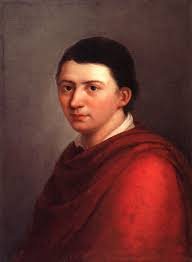
Open Schlegel's interactive page (graphs of influences, similar and opposing positions, and quotes)
Background
Friedrich Schlegel
Born: 10 March 1772 in Hanover, Gemany
Died: 12 January 1829 (aged 56) in Dresden,
Gemany
Alma mater: University of Göttingen
Schools: Jena Romanticism, Post-Kantian
transcendental idealism, Historicism, Romantic
linguistics
Main interests: Philology, philosophy of history,
poetry, literature, ethics, politics, aesthetics,
religion, language
Influences: Immanuel Kant, Johann Gottlieb
Fichte, J. G. Herder, Novalis, Ludwig Tieck,
Caroline Schelling, Wilhelm Heinrich
Wackenroder, Baruch Spinoza
Influenced: Franz Bopp, Ralph Waldo Emerson,
Samuel Taylor Coleridge, Adam Mickiewicz,
Kazimierz Brodziński, Friedrich Schleiermacher,
Goethe
From Wikipedia
Schlegel was a German poet, literary critic, philosopher, philologist, and Indologist. With his older brother, August Wilhelm Schlegel, he was one of the main figures of Jena Romanticism…. Schlegel was a promoter of the Romantic movement and inspired Samuel Taylor Coleridge, Adam Mickiewicz and Kazimierz Brodziński. The first to notice what became known as Grimm's law, Schlegel was a pioneer in Indo-European studies, comparative linguistics, and morpholog- ical typology….
Introductory Comments
The puzzle is hard to miss. The young Schlegel wrote a republican pamphlet, published a novel so frankly erotic that respectable Germany blushed, defended Fichte when he was hounded out of Jena for atheism, and made irony into a philosophical instrument for dissolving every fixed position. The older Schlegel knelt in a Cologne church in 1808, entered the Catholic Church, took a desk in Vienna, drafted anti-Napoleonic proclamations for the Habsburgs, and ended serving Metternich - the chancellor who prized thrones, treaties, and censorship above all else. Tillich's diagnosis is blunt: Schlegel's "courage to be as oneself" broke down, and he sought refuge in belonging.
But why did that courage break down? Existential loneliness may well have played a part, but probably not the most interesting part. More likely, Schlegel was caught in both an intellectual and a historical bind. He had always been driven by a hunger for a "new mythology" that would give a fragmented age something whole to stand on. But he also believed truth is fundamentally ironic - which is to say, he wanted both to build a new unity and to undercut it at the same time. The historical bind dripped with irony too: revolutionary ideals curdled into the Terror and Napoleon's armies. Perhaps, then, Schlegel's turn to Rome and Vienna was not a retreat from irony at all, but its logical terminus - the moment when undercutting every fixed position finally left him nothing to stand on but someone else's.
Some of Schlegel's Key Positions
As Herder showed that each culture has its own character, so too does each work of literature, Thus, each must be judged by the "individual ideal" at work within it - by the law it sets for itself, not by a rulebook handed down from outside. The critic's first task is to find that law.
The novel is the modern genre par excellence. It swallows everything: narrative, dialogue, song, criticism, philosophy. By opening multiple plots and perspectives, the novel awakens readers to the teeming richness of life - the beautiful confusion of the imagination.
The novel is also a philosophical genre. Juxtaposed plots and clashing perspectives expose the ironies that no single viewpoint can absorb - and philosophy is the true home of irony. Irony here is not sarcasm. It is the recognition that any finite statement falls short of an infinite subject, so the writer must both create and undercut what he creates.
Philosophy has no first principle and no self-evident propositions everyone can agree on. It must begin, like an epic, in the middle. At best it offers a series of approximations, which may grow more coherent and holistic without ever escaping skepticism. To have a system is fatal for the mind; to have none is equally fatal; somehow it must do both. Philosophy, like life, is an organic process that never ends.
Place in the History of Ideas
Schlegel's Place in History of Ideas
Frederick Beiser: Schlegel was the major aesthe- tician of the Romantic movement in Germany during its first formative period (1797–1802). In these years he developed his influential con- cepts of Romantic poetry and irony, created an original approach to literary criticism and edited the journal of the early Romantic circle, Athenäum.... [H]e was also a guiding spirit in the development of a Romantic metaphysics, ethics and politics. His metaphysics attempted to synthesize Fichte’s idealism and Spinoza’s naturalism. His ethics preached radical individ- ualism and love against the abstract formalism of Kant’s ethics. In his early politics Schlegel was very radical, defending the right of revolution and democracy against Kant. In his later years, however, he became much more conservative. His final works are a defence of his neo-Catholic mysticism.
Maurice Blanchot: [A]s a young man he is an atheist, a radical, and an individualist.… Some years pass: the same Schlegel, converted to Catholicism, a diplomat and journalist in the service of Metternich, surrounded by monks and pious men of society, is no longer anything but a fat philistine of unctuous speech, lazy, empty, his mind on food, and incapable of remembering the young man who had written: "A single absolute law: the free spirit always triumphs over nature." Which is the real one? Is the later Schlegel the truth of the first?
Random Thoughts on Schlegel
Schlegel's turn to Rome (see Introductory Comments) left his Romantic individualism behind but kept the hunger that had driven it: the yearning for unity, for transcendence, for the whole. The Church he entered was, in his eyes, a living organism rather than an institution - a body held together by ritual and symbol. Its ceremonies and its scriptures were a higher poetry, carrying truths that plain statement cannot carry. Which raises an obvious question. If what matters is the spiritual truth, why bother with the apparatus? Why not ascend to the oneness of all being directly and skip the incense?
Because Schlegel was human. Wordless thoughts (if such thing are possible) give the climber nothing to hold onto. What story is there to tell oneself on the way up to spiritual enlightenment? A ritual gives the mystic somewhere to stand, and a narrative gives him somewhere to go - a launching pad, if you like, for a flight that would otherwise never leave the ground. Nor is this a concession to human frailty. Humans are verbal creatures. And a creature that thinks in words thinks in symbols; there is no other equipment on offer. No other way to make sense of the world. Then there is the matter of names. "The oneness of all being" is not something a social animal can love. God is. Name the abstraction and it stops being a something and becomes a someone, toward which one can move and in whose love one can dwell. Juliet was wrong. There is a great deal in a name.
Influences
Schlegel was influenced by: Fichte, Herder, Kant, Novalis, Schelling, C., Spinoza, Tieck, Wackenroder, Winckelmann
Schlegel influenced: Bopp, Franz, Brodzinski, K., Coleridge, Emerson, Goethe, Mickiewicz, A., Schleiermacher
Similar and opposing positions
Thinkers with similar positions:
- Benjamin (The individual work of art should create its own criterion.)
- Bergson (Dynamic religion springs from creative emotion & mystical experience)
- Coleridge (Philosophy should reawaken us to our relationship with God.)
- Goethe (The true artist strives after a higher truth, not a mere naturalness.)
- Herder (Poetry helps to define, if not also create, the uniqueness of a nation.)
- Herder (Language helps shape the unique thinking & feelings of a people.)
- Kierkegaard (Philosophy must embrace subjectivity as an essential resource.)
- Nietzsche (There are no first principles that can guide us to the truth.)
- Shakespeare (Some things cannot be explained through reason & philosophy.)
Thinkers with opposing positions:
- Comte (All valid knowledge is scientific: Knowledge requires verification.)
- Dilthey (Our understanding depends on past worldviews and interpretations.)
- Fichte (Intuition gives our minds direct access to the ground & nature of reality.)
- Frege (Logical & philosophical problems can be solved by perfecting language.)
- Locke (Social practices should spring from universally accepted principles.)
- Plato (The highest form of understanding is through reason alone.)
- Seneca (We should be free of unruly emotions, as they disturb judgment.)
What others said about Schlegel
- Frederick C. Beiser: In his early politics Schlegel was very radical, defending the right of revolution and democracy against Kant.
- Matthew Gaetano: Schlegel was deeply devoted to divine revelation and to tradition. (And he appreciated counter-revolutionary Catholics like Joseph de Maistre, a point that must be explored further.)
- Allen Speight: [Schlegel's] notion of the individual work as giving itself its own criterion - a notion that appears later in the hermeneutic tradition and in Benjamin’s famous essay on the concept of criticism - is one of a number of distinctive new facets of romantic poetics and aesthetics.
- Said: [When Schlegel said] "it is in the Orient that we must search for the highest Romanticism," he meant the Orient of the Sakuntala, the Zend-Avesta, and the Upanishads.
- James Burton Robertson: Schlegel observes that the difference between strict law and equitable law is the most arduous problem in all jurisprudence.
- Berlin: Friedrich Schlegel..., the greatest herald and prophet of romanticism that ever lived, says there is in man a terrible unsatisfied desire to soar into infinity, a feverish longing to break through the narrow bonds of individuality.
- Tillich: In a man like... Schlegel the courage to be as an individual self, [ironically] produced, in reaction to the emptiness of this self-affirmation, the desire to return to a collective. Schlegel, and with him many extreme individualists..., became Roman Catholics. The courage to be as oneself broke down, and one turned to an [institution] to be as a part.
- Allen Speight: ... Schlegel’s philosophical interests were framed around a concern for somehow uniting Fichtean freedom of the subject with Spinozistic holism.
Schools: German Idealism, German Romanticism, Historicism, Mysticism, Post-Kantian Philosophy, Romanticism, Skepticism, Weimar Classicism
Main interests: Art and Aesthetics, Ethics, History, Language, Literature, Philology, Poetry, Politics, Religion
Schlegel's answers to philosophical questions
Art and Aesthetics
"To give the community of artists a particular purpose would mean… debasing the community of saints into a state. "
"Beauty is that which is simultaneously attractive and sublime."
True art leaves a mark: "The sole purpose of mankind is to engrave the thoughts of divinity onto the tablets of nature."
Art, at its best, is essentially spiritual, though most philosophers are blind to the spirituality of art.
A critic should assess a literary or artistic creation according to the individual ideal or criterion at work within it.
Economics
"Where there is politics or economics, there is no morality."
"Industry and utility are the angels of death who, with fiery swords, prevent man's return to Paradise."
Education
Poetry and philosophy are essential for our spiritual development: "Every uneducated person is a caricature of himself."
"Versatility of education can be found in our best poetry, but the depth of mankind should be found in the philosopher."
Ethics
Worldly pleasures in themselves are base: "[E]verything is base that has nothing of the world-spirit of philosophy and poetry."
"True love should be… both necessary and free…, both destiny and virtue and appear as a mystery and a miracle."
Though sensuality is good in itself, it "can delude bad persons for a short time into thinking they could love each other."
History
"The historian is a prophet looking backward."
Language
We should value and assess a literary creation according to the individual ideal or unique criterion at work within it.
Metaphysics
The best metaphysics is ironic: "Irony is a clear consciousness of an eternal agility, of the infinitely abundant chaos."
Philosophy
"Expect nothing more from philosophy than a voice, language & grammar of the instinct for Godliness that lies at its origin…."
A philosophy must be approached holistically: "It is a whole and the path to knowing it is not a straight line but a circle."
Philosophy is at best a series of approximations that over time may become more coherent, but never beyond question.
"Whatever can be done while poetry and philosophy are separated has been done…. So the time has come to unite the two."
"It is equally fatal for the spirit to have a system and to have none. One must thus decide to join the two."
Good Question. "About no subject is there less philosophizing than about philosophy."
Political Philosophy
A republic is the only form of government that fully respects the "majesty" of the people. Univeral suffrage is essential.
Psychology
"Within the family minds become organically one, and for this reason the family is total poetry."
Love is the purest form of aesthetic enjoyment. It is most fully realized when shared between two free and equal beings.
Religion and Theology
Religion is an impediment to morality. "Religion and morals are symmetrically opposed, just like poetry and philosophy."
"Eternal life and the invisible world are only to be sought in God. Only within Him do all spirits dwell."
"In the world of language, or in... the world of art & liberal education, religion necessarily appears as mythology or as Bible."
Science
Science should embrace art, and vice versa: "Every art should become science, and every science should become art..."
Sex and Gender
"Women have to remain prudish as long as men are sentimental, dense, & evil enough to demand of them eternal innocence."
"Women do not have as great a need for poetry because their own essence is poetry."
Society
Avoid conventional society: "What is called good society is usually nothing but a mosaic of polished caricatures."
"As it is with the individual, so with the masses. They eat, marry, produce children, become old, and so on to infinity."