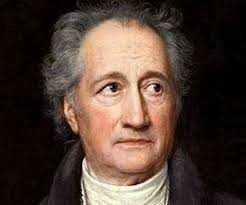
Goethe was a German polymath, who is widely regarded as the greatest and most influential writer in the German language. His work has had a profound and wide-ranging influence on Western literary, political, and philosophical thought from the late 18th century to the present day. A poet, playwright, novelist, scientist, statesman, theatre director, and critic, his works include plays, poetry and aesthetic criticism, as well as treatises on botany, anatomy, and color.
Introductory Comments
Ideas rarely catch fire alone. Now and then a handful of thinkers land in the same place at the same time and start striking sparks off one another until the whole era lights up. Athens in the fifth century BCE. Florence under the Medici. Edinburgh in the age of Hume and Smith. Vienna in the 1920s. Paris after WW2. The pattern holds: a sudden blaze, a bright burning, then embers, then ash - and afterward everyone agrees it was inevitable.
The Weimar Circle was one of these fires, and Goethe stood at the center. During the late 18th and early 19th centuries, this small German city became home to an extraordinary concentration of writers and thinkers, most famously Goethe, Schiller, Herder, and Wieland. What became known as Weimar Classicism sought a difficult balance: reason without aridity, emotion without surrender to emotion, individual freedom disciplined by form, and personal development pursued across an entire lifetime. Goethe stood at the center of this world largely because he seemed to contain several worlds himself. He was poet, novelist, dramatist, scientist, administrator, and sometime philosopher - a polymath whose curiosity wandered almost everywhere and usually found something worth bringing home. He encouraged other writers and artists, but more important was the sheer gravitational pull of his achievement. But the fire that was the Weimar Circle only lasted for a remarkable moment. Then Romanticism took over and swept away the ashes.
Some of Goethe's Key Positions
In the sensitive soul, great joy and profound sorrow may lie remarkably close together. Love in particular can elevate life to an almost unbearable intensity, as dramatized in The Sorrows of Young Werther. But intense feeling carries dangers as well as revelations. Werther's sensitivity gives his life richness and depth; his surrender to that sensitivity finally destroys him.
But passionate striving need not be confined to romantic love. Such striving can take place in many different domains - literature, government, science, exploration, public service, even engineering. What matters is not the domain nor even the success, but the striving: the restless effort to enlarge one's powers, test one's limits, and bring something into the world.
Yet striving brings no permanent satisfaction. Every accomplishment opens onto another possibility, and the restless self soon reaches again beyond whatever it has attained.We must therefore balance the urge toward activity with another, quieter vision.
As Spinoza explains, the individual is not a kingdom unto himself but a small part of an all-encompassing Nature. At moments, peace comes to the striving soul not from conquering or creating more, but from seeing oneself - and one's loves, ambitions, triumphs, and failures - as belonging to that larger whole.
Place in the History of Ideas
Goethe's Place in History of Ideas
Randall Collins: Goethe's life well fits the model that networks are the primary movers [in the history of ideas], and that individuals become filled with creative energies to the extent of their centrality when the networks reorganize around them.
Anthony K. Jensen: ... Goethe is certainly not a philosopher in the sense made popular in his day: a builder of self-grounding systems of thought. Neither is he a philosopher by today’s most common definitions: either a professional analyzer of arguments or a critic of contempo- rary cultural practices. The paradigm under which Goethe might be classified a philosopher is much older, recalling the ancient and then renaissance conception of the polymath, the man of great learning and wisdom, whose active life serves as the outward expression of his thinking.
Arnulf Zweig: [W]hen Goethe himself spoke of his relation to Spinoza, he emphasized the ethi- cal as much as the metaphysical doctrines of Spinoza and Spinoza's "all-harmonizing peace," which contrasted with his own restlessness. Spinoza's rejection of final causes and his de- fense of determinism and of the view that praise, condemnation, and regret are attitudes reflecting an inadequate understanding of inexorable natural processes were accepted by Goethe and given expression in Faust....
Random Thoughts on Goethe
The Weimar Classicists and the Jena Romantics might, at first glance, seem to have been kissing cousins. Weimar and Jena were barely a dozen miles apart, and around 1800 both were humming with intellectual activity. Writers and philosophers traveled constantly between them. But as each camp got a clearer sense of what it was, the two towns drifted apart. Weimar Classicism, above all in Goethe and Schiller, wanted self-perfection and universal ideals. It made room for beauty and feeling, but insisted on balance, restraint, and harmony, drawing on classical antiquity, Enlightenment reason, and Kant. Jena Romantics - Schlegel, Novalis, Tieck - wanted subjectivity, irony, and imagination, and looked instead to medieval mysticism, German idealism, Shakespeare, folk song, and the Renaissance. It prized the mysterious over the rational and the dynamic over the finished. And Jena won.
Here is the odd part: they won while losing. The Jena circle lasted roughly three years. Its journal, the Athenaeum, ran for two. Wackenroder died at twenty-five, Novalis at twenty-eight, and the rest scattered amid the usual academic quarrels and one very public change of husbands. What they left was not a finished body of work but a mood, a handful of fragments, and a set of unanswered questions - and those turned out to travel much farther than a system. Perhaps that is the way it usually goes. Perhaps the fires that burn out fastest are the ones that throw sparks the farthest.
Bergson (There's a vital force in the world that pushes evolution onward.)
Carlyle (Christianity is the noblest crown, but it is a crown of thorns.)
Coleridge (Loving Christianity more than truth harms both us and Christianity.)
Croce (More than even science or metaphysics, art edifies & enriches us.)
Herder (Culture springs from geography and represents the genius of a people.)
Humboldt, A. (Nature is dynamic and interdependent - not simple mechanics.)
Rand (Action and struggle are essential components of all great lives.)
Schlegel (The true artist strives after a higher truth, not a mere naturalness.)
Spinoza (Happiness is an inner, tranquil superiority over the troubles of life.)
Spinoza (God is not transcendent. Everything in Nature is part of God.)
Thinkers with opposing positions:
Al-Farabi (There can be no clear separation between Church and State.)
Augustine (God is transcendent. He is above everything in nature.)
Chrysippus (We should be free of unruly emotions, as they disturb judgment.)
Freud (The social realm plays a minimal role in shaping human psychology.)
Marcel (Science & technology threaten to destroy the mystery of being.)
Nicholas of C. (All the sciences are but the handmaids of theology.)
What others said about Goethe
Arnold: [Goethe is the] Physician of the Iron Age [and is] the clearest, the largest, the most helpful thinker of modern times.
Schweitzer: Goethe borrows nothing from any of the philosophies with which he is in contact. Thanks, however, to his conscientious study of the thought of others, he attains an ever clearer grasp of his own ideas.
Wilhelm Windelband: ... in antithesis to the rigorism of Kant, [an] aesthetic Humanism [developed in late eighteenth century Germany. In this movement] Goethe appeared as the mighty personality, who presented in living form [the] ideal height of humanity in the aesthetic perfection of his conduct of life, as well as in the great works of his poetic activity.
John Morley: All Goethe's work, whether poetry or prose, his plays, his novels, his letters, his conversations, are richly bestrewn with the luminous sentences of a keen-eyed, steadfast, patient, indefatigable watcher of human life.
Madame de Staël: [Goethe possessed] the chief characteristics of the German genius [and brought together] all that distinguishes the German mind.
Nietzsche: [Goethe had] a kind of almost joyous and trusting fatalism [that has] faith that only in the totality everything redeems itself and appears good and justified.
Alan O. Ebenstein: What Goethe apparently meant is that mind must first have a way of interpreting experience; next, experience is interpreted by mind. Thus, “all that is factual is already theory,” because the way that facts... are interpreted is mentally constructed. There are no atomistic facts in this perspective, because all experience is interpreted.
Randall Collins: Goethe became a wonder of creative longevity and far-flung virtuosity because his creations mirrored the modes of those around him in every phase of a proliferating movement.
Schools: German Romanticism, Humanism, Romanticism, Sturm und Drang, Weimar Classicism
Main interests: Architecture, Biology, Botany, Classics, Desire, Free/Unfree Will, Human Will, Immortality, Industrialism, Literature, Magic, Meteorology, Mineralogy, Nature, Optics, Personal Identity, Philology, Physics, Poetry, Politics, Progress, Psychology, Science, Semiotics, Theatre, Tragedy, Will