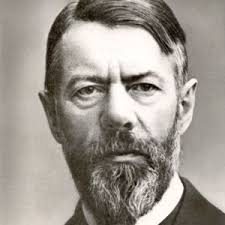
Weber was a German sociologist, historian, jurist, and political economist who was one of the central figures in the development of sociology and the social sciences more generally. His ideas continue to influence social theory and research…. One of Weber's main intellectual concerns was in understanding the processes of rationalization, secularization, and disenchantment. He formulated a thesis arguing that such processes were associated with the rise of capitalism and modernity.
Introductory Comments
Physicists enjoy one great advantage over sociologists: electrons have no opinions. A falling apple does not fall because it believes in gravity, nor does it resent the ground. People are another matter. They act for reasons, and their actions arrive already wrapped in meanings, intentions, and values. Strip those away and the phenomenon itself disappears. The Puritan merchant labored from dawn to dusk not merely to earn a living. He hoped his prosperity was a sign that God had chosen him for salvation. A riot may begin with hunger, but it is a sense of injustice that turns hungry people into a crowd at the barricades. To explain such behavior, Weber argued, the sociologist must first understand it, grasping what the action meant to the person performing it.
To critics who wanted social science modeled on physics, all this sounded suspiciously soft, like storytelling with footnotes. Weber disagreed. Interpretive understanding, he insisted, was not a mystical leap of empathy but a hypothesis, to be tested against evidence like any other. The sociologist’s own values inevitably shape which questions seem worth asking, but they must stay out of the answers. One can describe the Puritan’s austere faith, or the "iron cage" of rational routine it helped build, without praising or condemning either. Herein lies a neat paradox. A science that takes human subjectivity seriously, while disciplining its own, may see more objectively than one that pretends its subjects have no inner life.
Some of Weber's Key Positions
Ideas, not only material interests, shape history. Greed is as old as humanity, but modern capitalism required something new: a "spirit" that treated methodical, disciplined accumulation as a moral duty. That spirit owed a surprising debt to the ascetic Protestantism of the 16th and 17th centuries. Luther taught that ordinary work could be a "calling" from God. Calvinists and Puritans went further. Anxious to know whether they were among the elect predestined for salvation, they came to see sober, diligent, profitable labor as a sign of grace. Wealth was to be earned and reinvested, not enjoyed.
Here lies the irony: religion helped make the world less religious. Once established, capitalism no longer needed its religious props. The discipline remained while the faith drained away, leaving modern people bound to rational economic routine, an "iron cage" of their own making. This is one strand of a broader process of rationalization, the "disenchantment of the world," in which mystery and magic give way to calculation, technique, and bureaucracy. None of this makes religion the single cause of capitalism. Economic, political, and religious forces all shape history, and none can be reduced to the others.
The social sciences thus differ from the physical sciences. They study the meanings people give to their world, and how economic, religious, and other forces combine to create those meanings.
Place in the History of Ideas
Weber's Place in History of Ideas
Joachim Radkau: The affinity between capitalism and Protestantism, the religious origins of the Western world, the force of charisma in religion as well as in politics, the all-embracing process of rationalization and the bureaucratic price of progress, the role of legitimacy and of violence as the offspring of leadership, the "disenchantment" of the modern world together with the never-ending power of religion, the antagonistic relation between intellectualism and eroticism: all these are key concepts which attest to the enduring fascination of Weber's thinking.
Jürgen Habermas: What Weber depicted was not only the secularization of Western culture, but also and especially the development of modern societies from the viewpoint of rationalization. The new structures of society were marked by the differentiation of the two functionally intermeshing systems that had taken shape around the organizational cores of the capitalist enterprise and the bureaucratic state apparatus. Weber understood this process as the institutionalization of purposive-rational economic and administrative action. To the degree that everyday life was affected by this cultural and societal rationalization, traditional forms of life - which in the early modern period were differentiated primarily according to one's trade - were dissolved.
Random Thoughts on Weber
Once upon a time, every river had its god and every grove its nymphs. Thunder meant someone up there was annoyed, and a well-chosen sacrifice might calm him down. Weber traced how this enchanted world gave way to one run by timetables, account books, and the stock ticker. In his telling, the decisive break was not the move from many gods to one, but the rejection of magic. The Hebrew prophets refused to treat God as a force to be bribed or coaxed with rituals; he demanded righteous conduct instead. Centuries later, Puritanism finished the job. It stripped away sacraments, relics, and every other means of working on heaven. The believer stood alone before an inscrutable God, with nothing to show for his faith but a disciplined life.
Weber called this process "disenchantment." The modern commuter, he noted, knows far less about how a streetcar works than a hunter knows about his bow. What has changed is not knowledge but conviction: the belief that nothing is mysterious in principle, and that anything could be mastered by calculation if one cared to look into it. A broken transmission calls for a mechanic, not a prayer. The gains are obvious: longer lives, faster trains, smarter phones. So is the loss. Science can say how the world works but not how to live in it, and the cosmos no longer whispers back. Yet the old gods, Weber suggested, never quite died. They rose from their graves as rival values competing for our loyalty with no higher court to settle the quarrel.
Dewey (The social environment does much to shape the minds of people.)
Dilthey (Natural sciences observe and explain. Human sciences understand.)
Durkheim (Religion is a driving force in shaping society & the course of history.)
Durkheim (Sociology should study what motivates people, not mere social facts.)
Habermas (Modern society lacks cohesion and is broken into unrelated parts.)
Jaspers (World views are psychologically driven and often defensive in nature.)
Lewis, C.I. (Value statements are not merely expressive. They have meaning.)
Saint-Simon (A well-run society needs to be guided by an intellectual elite.)
Strauss (To remove values from the science of man is a self-deluded project.)
Vico (Human sciences require different methods from the natural sciences.)
Thinkers with opposing positions:
Comte (Like all sciences, sociology's objective analysis leads to general laws.)
Freud (The social realm plays a minimal role in shaping human psychology.)
Hitchens (Religion is violent, irrational, intolerant & allied to racism & sexism.)
Marx (Economic, rather than cultural, forces drive history and shape society.)
Schleiermacher (Religion is above all & essentially an intuition & a feeling.)
Tarski (Scientific knowledge can be reduced to a series of sense-data claims.)
What others said about Weber
Jaspers: [Weber was] the greatest German of our era. [When he died, it was] as if the German world had lost its heart.
C. Wright Mills: The prestige of Max Weber among European social scientists would be difficult to over-estimate. He is widely considered the greatest of German sociologists....
Sung Ho Kim: Weber's wide-ranging contributions gave critical impetus to the birth of new academic disciplines such as sociology and public administration as well as to the significant reorientation in law, economics, political science, and religious studies. [He was also] instrumental in establishing... modern social science as a distinct field of inquiry....
Michael Hardt & Antonio Negri: Max Weber and Vladimir Lenin say, in almost identical words, that with regard to the use of force the state is always a dictatorship.
Tillich: [Weber was] perhaps the greatest scholar in Germany of the nineteenth century.
Charles Perrow: At first, with his celebration of the efficiency of bureaucracy, [Weber] was received with only reluctant respect, and even with hostility. All writers were against bureaucracy. But it turned out... that managers were not.
Sung Ho Kim: ... Weber's philosophical worldview, if not coherent philosophy, was informed by the deep crisis of the Enlightenment project in fin-de-siècle Europe, which was characterized by the intellectual revolt against positivist reason, a celebration of subjective will and intuition, and a neo-Romantic longing for spiritual wholesomeness.
Michael Barnett: Weber also saw that a bureaucratic world contained risks. It produced increasingly powerful and autonomous bureaucrats who could be spiritless, driven only by impersonal rules and procedures....