Electric WebOpen the interactive pageAll thinkersAbout

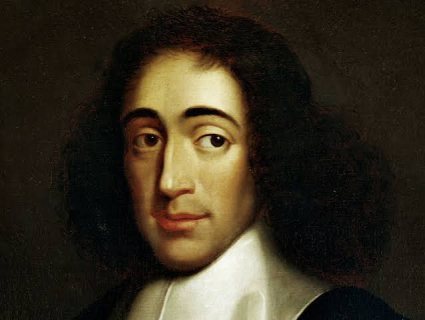
Baruch Spinoza (1632 - 1677)

Holland · 1600-1699 · Wikipedia

Baruch Spinoza

Open Spinoza's interactive page (graphs of influences, similar and opposing positions, and quotes)

Background

Baruch Spinoza
  Born:  24 November 1632 in Amsterdam
  Died:  21 February 1677 (aged 44) in The Hague
  Nationality:  Dutch
  Alma mater:  University of Leiden (no degree)
  Schools:  Rationalism, founder of Spinozism
  Main interests:  Ethics, Epistemology,
     Metaphysics, Hebrew grammar
  Notable ideas:  Pantheism, determinism,
     neutral monism, parallelism, intellectual and
     religious freedom, separation of church and
     state, criticism of Mosaic authorship of some
     books of the Hebrew Bible, political society as
     derived from power, not contract, affect,
     natura naturans/natura naturata
  Influences: Democritus, Aristotle, Lucretius,
     Avicenna, Maimonides, Hobbes, Machiavelli
  Influenced: Leibniz, Rousseau, Kant, Hegel,
     Nietzsche, Freud, Santayana, Wittgenstein
From Wikipedia
 
A forerunner of the Age of Enlightenment, Spinoza significantly influenced modern biblical criticism, 17th-century rationalism, and Dutch intellectual culture, establishing himself as one of the most important and radical philosophers of the early modern period. Influenced by Stoicism, Thomas Hobbes, René Descartes, Ibn Tufayl, and hetero- dox Christians, Spinoza was a leading philosopher of the Dutch Golden Age…. Rebecca Goldstein dubbed him "the renegade Jew who gave us modernity."
Introductory Comments
 
In July 1656 the Portuguese synagogue of Amsterdam pronounced its harshest ban on a 23-year-old member, in language so vehement it has never quite stopped echoing. The document names no specific charges - only "abominable heresies" and "monstrous deeds" - but by then the young Spinoza appears to have abandoned a personal God, doubted that the Hebrew Bible recorded events as they happened, and concluded that ritual observance bound no one. Not, one would think, a promising résumé for a Jewish ethicist. Yet many readers claim him as one anyway.
 
The Judaism Spinoza left behind ran on commandments  - 613 of them, by traditional count. Spinoza, again, said they bound no one. This does not mean he ever abandoned law itself. He changed its statute book. The commandments give way to the laws of nature, and blessedness arrives not through grace or a loving heart but through understanding: a discipline exacting and lifelong. Seen this way, the Ethics - marching through definitions, axioms, and propositions - earns its title and is indeeed a book of ethics. But of an odd sort. For, as Spinoza writes in another book, the laws that someone decrees from the plain necessity of nature are "laws" only by analogy. Nature issues no commands; it simply is. Whether an ethics whose laws command nothing still counts as ethics - and still counts as Jewish - is a question worth pressing. It is a question implicit in the very title of his most famous book.
Some of Spinoza's Key Positions
 
The Bible is a human book, not a divine one - written by many hands over many centuries, and best read as one reads any other ancient text, historically and in context. Its aim is not objective truth but obedience and moral practice: justice and charity. As for miracles, nothing happens contrary to the order of nature..
 
The traditional God - a person who deliberates, judges, and intervenes - is a projection of human hope and fear. There is one infinite substance, and everything that exists exists in it and follows from it. God, or if you prefer, nature. But we must be careful to distinguish between nature as generative power from nature as the system of things that power produces.
 
That nature is thoroughly intelligible. Everything follows from the divine nature as necessarily as a theorem follows from its premises, leaving no room for chance, purpose, or a world that might have gone otherwise. Free will is an illusion born of partial knowledge. Political freedom, however, is both possible and essential.
 
An even greater freedom remains: understanding things under the aspect of eternity, grasping why what happens must happen, including one's own pains. A passion understood through its causes loosens its grip. What follows is not resignation but blessedness. The path is steep, "but all things excellent are as difficult as they are rare."

Place in the History of Ideas

Spinoza's Place in History of Ideas
 
Hume: The fundamental principle of the athe- ism of Spinoza is the doctrine of the simplicity of the universe, and the unity of that sub- stance, in which he supposes both thought and matter to inhere. There is only one substance, says he, in the world; and that substance is perfectly simple and indivisible, and exists eve- rywhere, without any local presence. Whatever we discover externally by sensation; whatever we feel internally by reflection; all these are nothing but modifications of that one, simple, and necessarily existent being, and are not possessed of any separate or distinct existence.
 
Santayana: Nothing so well vindicates the genuine Hebraism of Spinoza as the fact that he avoided all Platonism (such as Philo... had adopted).... Pure Hebraism, when interpreted philosophically, inevitably becomes pantheistic. It suffices that we should attribute the fortunes of a single people, or of a single man, exclusively to God's providence and will (and to do so is the core of Hebrew piety) for God to become identical with the power, or, in Spinoza's language, with the substance, in all things.
 
Herder: He places all mankind's perfection, virtue and blessedness in the knowledge and love of God. And that this is not some sort of mask which he has assumed, but rather his deepest feeling, is shown by his letters, yes, I might even say,... by every line of his writings.
 
Einstein: I am fascinated by Spinoza's Panthe- ism. I admire even more his contributions to modern thought. Spinoza is the greatest of modern philosophers, because he is the first philosopher who deals with the soul and the body as one, not as two separate things.
 
Random Thoughts on Spinoza
 
What does Spinoza mean when he says there is only one Substance, which he calls God or Nature? And how can he say that mind and matter are not two realms of being but two ways of grasping one, Everything hinges on the definition. Substance, for Spinoza, is what exists in itself and is conceived through itself - it depends on nothing else either to be or to be understood. Put that way, the conclusion nearly follows on its own. Anything short of everything leans on something outside it; a chair needs a floor, a thought needs a thinker, and neither can be understood without reference to what it is not. Only the totality stands free. Mind and matter, then, cannot be substances in their own right. They are attributes: not parts of God, and not ingredients mixed to make God, but the whole of God as the intellect can grasp it, once as thought and once as extension.
 
At first this looks like mysticism. But the reasoning is almost pedestrian - of course nothing less than everything can be self-contained, since everything else requires context. Anything short of Everything must be defined by negation: mind is what isn't material, matter is what doesn't think. Spinoza simply refuses to grant that habit of contrast the status of a division in being. Yet the intent is reverential for all its dryness. Spinoza is claiming that to contemplate this Everything is stand face to face with the most vast and wondrous reality. Which may explain why a man condemned as an atheist spent his life writing about God.

Influences

Spinoza was influenced by: Averroes, Avicenna, Bruno, Democritus, Descartes, Epicurus, Hobbes, Lucretius, Machiavelli, Maimonides

Spinoza influenced: Althusser, Davidson, Deleuze, Fichte, Freud, Hegel, Kant, Leibniz, Lessing, Marx, Negri, Nietzsche, Rousseau, Santayana, Strauss, Wittgenstein

Similar and opposing positions

Thinkers with similar positions:

Thinkers with opposing positions:

What others said about Spinoza

Schools: Cartesianism, Determinism, Enlightenment, Holism, Intellectualism, Natural Law Theory, Naturalism, Rationalism, Secularism, Skepticism

Main interests: Biology, Causality, Chain of Being, Commerce, Desire, Epistemology, Ethics, Fate, Free/Unfree Will, Geometry, Government, Habits, Happiness, Health, Human Will, Immortality, Infinity, Jurisprudence, Justice, Law, Logic, Love, Mathematics, Metaphysics, Mind, Nature, Optics, Physics, Power, Psychology, Religion, Salvation, Science, Spirituality, Time, Virtue, War, Will, Wisdom

Spinoza's answers to philosophical questions

Art and Aesthetics

What is beauty? Is it completely subjective? If not, how can it be objectively assessed?
As with goodness, beauty is a completely subjective matter. We call something beautiful when it gives us pleasure.
Is the value and meaning of a work of art a completely subjective matter?
Artistic valuation is subjective: If the visual stimulus produced by an object gives us pleasure, we call that object beautiful.

Education

What is the personal value of an education? How does it aid or enrich the individual?
"The highest activity a human being can attain is learning for understanding, because to understand is to be free."

Epistemology

From what source or sources does knowledge spring? Sensation? Reason? Intuition? Or what?
Three levels of knowing exist: mere opinion, science or reason, and intuition where reason is mixed with well-being.
If perceptions are inherently subjective, can we ever prove the existence of an external world?
Sense perceptions are useful indicators, but they are inadequate for discovering truth, which requires the use of reason.
To what extent can we rely on empirical evidence? To what extent can we rely on science?
Sense-knowledge leads to scientific knowledge and then to philosophical intuition of all things "sub specie aeternitatis."
To what extent can we rely on logic or reason? To what extent should we rely on logic or reason?
We should perfect our ability to reason as much as possible, since reason allows us to see & love the world as it really is.
What is truth? Is it objective or relative or a bit of both? By what standard should it be judged?
Truth is a correspondence of idea with reality: "A true idea must agree with that of which it is the idea."
Is there one, ultimate way to approach the truth? If so, why is it better than other approaches?
When truth cannot be established with certainty, opinion along with its aid imagination search for what is likely true.

Ethics

Is morality relative and subjective? Can moral truths be objective in any sense? If so, how?
Depending on individual interests or perspectives, one and the same thing can be considered good, bad or indifferent.
If moral truths actually exist, how can we find them? Through reason? Faith? Intuition? How?
"If men were born free, they would, so long as they remained free, form no conception of good and evil."
What connection, if any, exists between virtue and happiness?
"Happiness is not the reward of virtue, but is virtue itself." That is, because we delight in virtue, we naturally become virtuous.
What connection, if any, exists between virtue and self-knowledge or knowledge in general?
Since nature is both purely rational and the highest good, a virtuous life is one in accordance to the natural law.
Is there a moral yardstick or ultimate good that can serve as a standard for judging our actions?
We do not desire or value something because it is good. Rather, we call something good because we desire or value it.
What moral obligations do we have towards others and how do these obligations vary?
"The good which every man, who follows after virtue, desires for himself he will also desire for other men…."
What is love? An ideal? An emotion? An independent force in nature?
The primary emotions are desire, joy & sorrow. Love is simply "joy with the accompanying idea of an external cause."
What is the moral significance, if any, of death? Should our mortality affect how we live?
"A free man thinks of nothing less than of death, and his wisdom is a meditation, not on death, but on life."
What is the moral significance of freedom? To what extent does morality require freedom?
We never act freely: "Men are conscious of their desire and unaware of the causes by which [their desires] are determined."

History

How does learning history help us as members of a society or enrich us as individuals?
"If you want the present to be different from the past, study the past."

Law

What is justice? And what connection, if any, exists between justice and law?
In a natural state nothing that can be called unjust. Only in a civil state with established laws can we speak of justice.

Metaphysics

What is substance? Or is the concept of substance inherently confused or mistaken?
Substance is a fundamental and completely independent reality. As such, there is only one substance: God.
What is being? What does it mean for something "to be"? Is being the same as existing?
As there is only one substance, God, it follows that whatever is, is in God. Being includes all perfections of being.
What is causation and does the "law" of causality imply universal determinism?
Nature has no ends or final causes. Even our human goals are just desires, and as such are efficient, not final, causes.
Does free will really exist? If so, how is it consistent with universal causality?
A rational necessity pervades the entire universe, leaving no room for any spontaneous, uncaused acts of free will.
Is the supposed dualism of mind and matter real or can the two "realms" be reduced to one?
Mind and body are simply two modes of being. They are not separate things, just two modes of one thing.
If mind and matter are in fact two distinct realms of being, how, if at all, can they interact?
There is no interaction: The succession of physical events is simply paralleled by a logical succession of ideas.
Are we living in a pluralistic world or is there an essential oneness to all being?
All seemingly separate things are part of the unity or oneness of being. The finite is but a mode of the Infinite.
What makes something an individual thing or being? Or is there no clear criteria here?
True individuation does not exist. Everything less than the whole is dependent on something else.
Is metaphysics actually possible or are the questions here beyond human understanding?
Metaphysics is possible because "the human mind possesses an adequate knowledge of the... eternal essence of God."

Mind

What is mind? Is it a substance or a process? Does it have parts? Does it serve a function?
The human mind is part of the infinite intellect of God. To say one perceives x or y is to say that God has the idea x or y.

Nature

What purpose, if any, is at work in nature? Or is nature unconcerned with its own workings?
Nature "does nothing for the sake of an end, for... God or Nature acts by the same necessity by which He exists...."
What place do humans have in nature? What, if anything, sets them above other animals?
"The human mind is part of the intellect of God." That is, we can see, if we try, the world in its true, essential nature.
What was life like for people living in a state of nature, before civilization and government?
"Again, in a natural state no one by common consent is the owner of anything..., but all things belong to all...."
Is there ranking within nature? Do living and nonliving things exist on a great chain of being?
We should not rank things according to how they delight or offend us, but by their nature and power alone.
How should humans use or approach the rich assortment of life forms on earth?
Though animals can feel, we have the right to use them for our pleasure and according to our convenience.

Philosophy

How should the discipline of philosophy be best approached and/or pursued?
Even regarding matters that have been deemed religious, the philosopher should rely on reason alone, not authority.
What connection, if any, exists between mathematics and philosophy?
"I should attempt to treat human vice and folly geometrically... as though I were concerned with lines, planes, and solids."

Political Philosophy

What are the basic functions of government? What should government not pursue?
"The ultimate aim of government is not to rule... by fear..., but contrariwise, to free every man from fear...."
When, if ever, is revolution justified? What are the inherent dangers of revolution?
The obligation to obey the sovereign is absolute: we have no right to rebellion, no matter how badly the sovereign rules.

Psychology

What are the major functions or forces at work in human psychology?
To understand human psychology we must explore both our reasoning and our emotions - both our mind and our will.
To what extent are we conscious of the various forces at work in human psychology?
The actions and passions of our body spring from the conscious, though often confused, workings of our mind.
To what extent does reason determine our actions? To what extent do impulse and desire rule?
"Desire is the very essence of man." However, with effort and discipline, we can tame desire enough to lead rational lives.
What is the will? What role does will play in human psychology? What are its constraints?
Since intellect and will are the same thing, the more we know, the better masters we are of our actions.
Is love just a feeling? If yes, what sort of feeling? If no, how is love more than a feeling?
"Love is nothing but Joy with the accompanying idea of an external cause."
How should one deal with normal distress, depression and other forms of emotional turmoil?
"I can control my passions and emotions if I can understand their nature."
What is the best approach to treating the most serious or desperate forms of mental illness?
"Emotion, which is suffering, ceases to be suffering as soon as we form a clear and precise picture of it."
What is the best approach to leading a productive and well adjusted life?
Too often we are in bondage to our passions. Only when our acts spring from reason are we are own masters.
Is happiness actually possible? If so, how is it achieved? If not, what is our alternative?
Happiness springs from seeing all things not only as they are in themselves, but also as rational, linked and necessary.

Religion and Theology

Does God exist? If so, can His existence be proven? And if it cannot, how do we know He exists?
We know God exists since his essence involves existence. That is, God as sole, universal Substance necessarily exists.
What are the essential attributes of God? Given our own limitations, what can we say of God?
God is both an extended and a thinking substance. God is single, independent, infinite and all-encompassing.
Is the benevolence and omnipotence of God consistent with there being evil in the world?
We are too nearsighted: "... things are not more or less perfect, according as they delight or offend human senses...."
Does God transcend nature or does He dwell or reside within nature?
Belief in a personal God who somehow transcends nature is not reasonable. God is immanent in nature.
Do souls or spirits exist after death? If so, in what manner and for what sort of creatures?
Though individuals are not immortal, we have a type of immortality through participating in the eternity of Nature.
What is the role of miracles in religion? How much credence, if any, should we give miracles?
"I am of opinion that the revelation of God can only be established by the wisdom of the doctrine, not by miracles."
What is salvation? And can it be achieved through faith or good works? Or is it predestined?
"[Salvation or] blessedness is not the reward of virtue, but virtue itself."
How should we approach the study of holy texts? What role does interpretation play here?
Religious texts should be studied critically as historical texts. Blind acceptance here can lead to cruelty and war.

Science

Is science compatible with religion? If they conflict, which one should we believe?
It's clear "that the Bible leaves reason absolutely free,... Revelation and Philosophy stand on totally different footings."

Society

What is the best way to eliminate or at least alleviate poverty in society?
"To give aid to every poor man is far beyond the... power of every man. Care of the poor is incumbent on society as a whole."