Nicolas Malebranche (1638 - 1715)
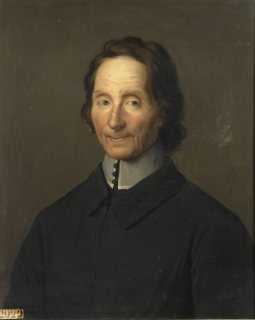
Open Malebranche's interactive page (graphs of influences, similar and opposing positions, and quotes)
Background
Nicolas Malebranche
Born: 6 August 1638 in Paris, Kingdom of France
Died: 13 October 1715 (aged 77) in Paris,
Kingdom of France
Alma mater: University of Paris
Schools: Cartesianism, Rationalism
Main interests: Metaphysics, Epistemology,
Theology
Notable ideas: Synthesis of the philosophy of St.
Augustine and Descartes, doctrines of
occasionalism, theodicy, vision in God
Influences: René Descartes, St. Augustine, St.
Aquinas, Plotinus
Influenced: David Hume, Leibniz, George
Berkeley, Giambattista Vico, Montesquieu, J.-J.
Rousseau, Joseph de Maistre, Louis Gabriel
Ambroise de Bonald, Louis Lavelle, Jacob
Bernoulli, Arthur Collier, Pierre Louis
Maupertuis
From Wikipedia
Malebrache was a French Oratorian Catholic priest and rationalist philosopher. In his works, he sought to synthesize the thought of St. Augustine and Descartes, in order to demonstrate the active role of God in every aspect of the world. Male- branche is best known for his doctrines of vision in God, occasionalism and ontologism…. He was... held in widespread high regard within his own lifetime and for some time afterwards, and the influence of certain of his ideas can be discerned in the works of several important figures.
Introductory Comments
Malebranche was born with a badly malformed spine and a sunken breastbone - not an affliction he acquired but a condition he never knew life without. It left him hunched, frail, and in frequent pain. His family kept him home under a private tutor rather than send him into the rough company of a college. He entered the Oratory (a community of secular priests bound by no vows) at 22 and stayed, more or less, for the rest of his life.
A tempting question then: Did the body shape the philosophy? The obvious guess is that suffering breeds doubt about a just and all-powerful God, and here the guess is simply wrong. Malebranche praised God's justice without flinching and made God's power more sweeping than nearly anyone had dared: God is not merely the greatest cause but the only cause, and every apparent interaction among created things is just the occasion on which God acts. A second guess - that a painful body bred detachment from bodies in general - fares little better. Malebranche spent many years working on optics and the laws of motion. Whatever he was detached from, it was not matter.
Yet even if no direct causal connection was at work between Malebrache's sickly body and his philosophy, the latter must have been wonderfully comforting. If God's presence and power extend everywhere and into everything - including the bent and suffering body of Malebranche himself - what greater comfort could there be?
Some of Malebranche's Key Positions
The causal interactions we seem to observe in the ordinary events of this world are illusions. God alone is the true cause of everything that happens. What we take to be interactions between physical objects are merely occasions for God to act in consistent ways. Because God's actions are regular and orderly, we mistakenly attribute them to independent causal laws operating within nature.
God's absolute sovereignty extends beyond the physical world to human salvation. Divine grace is not something people can earn or bring about through their own efforts. Salvation depends entirely on God's free and sovereign will.
Human knowledge likewise depends on God alone. Descartes was right to emphasize that knowledge is mediated by ideas, but these ideas do not originate in the human mind. Rather, all ideas exist eternally in God, and human beings know the world by perceiving them in God. The belief that ideas are creations of our own minds is therefore another illusion.
Because ideas exist only in God, they are eternal, universal, and immutable. Human understanding, however, is limited and imperfect. Individuals perceive these divine ideas only partially and often confuse or misapply them. The possibility of genuine knowledge ultimately rests on God, who is the source of both the ideas we perceive and our ability to perceive them.
Place in the History of Ideas
Malebranche's Place in History of Ideas
Anthony Gottlieb: In Malebranche’s universe, God also did rather more than that. Male- branche believed that God has a more intimate involvement in the physical world than Des- cartes ever got round to acknowledging. Every event, Malebranche argued, is really brought about by Him: “there is only one true cause because there is only one true God.” Descartes had said that matter is in itself inert and derives its power of motion from God, but Male- branche and others went further and inferred from this that when, for instance, one billiard ball hits another, it is God rather than the first ball which makes the second ball move. Accord- ing to this theory, the impact of the first ball is not the cause of the second one’s movement, but merely the “occasion” for God to nudge it into motion somehow.
Anthony Kenny: Malebranche accepted Carte- sian dualism: minds were thinking substances and the essence of matter was extension. But he tried to improve upon Descartes' account of the relationship between mind and body, long recognized as the weakest point in the Carte- sian system. More consistently than Descartes, Malebranche argued that if mind was pure thought, and matter was pure extension, nei- ther could act upon the other.... [But if] I do not move my arm, who does? God does, answers Malebranche.... From all eternity he has willed all that is to happen and when it is to happen.
Random Thoughts on Malebranche
Why would four such different philosophers - Malebranche, Leibniz, Berkeley, Edwards - each conclude, in his own way, that nothing in the world acts on its own account? The answer goes back to Augustine and the other Church Fathers, who had taught the West to see the created order as sustained moment by moment by a God without whom it would simply stop. Set against that pedigree, the 17th century's God-centered philosophy was just metaphysics as normal - one now equipped with Descartes' physics and a fresh problem, namely how an unextended mind could possibly nudge an extended arm. The four philosophers, though, were different enough. Malebranche kept matter real and denied it any power: bodies exist, but God alone acts. Berkeley dissolved matter yet let finite spirits genuinely will. Leibniz gave every monad its own internal spring. Edwards had God recreating the world at each instant. What unites them is not a doctrine but a shared refusal to let creatures be self-sufficient.
Yet none of the four thought he was describing a puppet show - not exactly, at least. Malebranche, for instance, insisted we still consent or withhold consent, and hung our responsibility for sin on that slender hinge. The others also carved out places for genuine agency, each in his own fashion. The strings, they insisted, were not attached to our wrists. Yet all four tied those strings to something else: the very existence of the stage, the actors, and the play itself depended entirely on God.
Influences
Malebranche was influenced by: Augustine, Descartes, Paul of Tarsus, Plotinus
Malebranche influenced: Berkeley, Bernoulli, Bonald, Collier, A., Edwards, Hume, Hutcheson, Lavelle, Leibniz, Maistre, Maupertuis, Montesquieu, Rousseau, Vico, Voltaire
Similar and opposing positions
Thinkers with similar positions:
- Al-Ghazali (Causation is due to God, not to the interactions of matter.)
- Anselm (God's existence is inferable from the mere idea of a Perfect Being.)
- Berkeley (What is immediately perceived are ideas in the mind, not things.)
- Edwards (God alone is the only real cause at work in the world - not matter.)
- Eriugena (God is both the ground of all things and the end or goal of all things.)
- Hutcheson (Mind & body are not causally linked. All causuality is due to God.)
- Leibniz (The intricate interactions of nature reflect a pre-established harmony.)
- Santayana (There's an explanatory gap between physical and mental realms.)
Thinkers with opposing positions:
- Dennett (Consciousness can be explained with empirical methods.)
- Descartes (Belief in the external world can be based on the veracity of God.)
- Humboldt, W. (Mind and body form a vital unity as seen in man's sensuality.)
- Leibniz (Since God created the best of all possible worlds, evil is not His fault.)
- Merleau-Ponty (Mind & body unite in a consciousness that is itself embodied.)
- Montaigne (When asking big questions, remain skeptical of all answers.)
- Reid (When philosophy contradicts common sense, it should be dismissed.)
- Stirner (All "sacred truths" in law, morality & religion are artificial concepts.)
What others said about Malebranche
- Schopenhauer: [Malebranche's religious account of human cognition] explains something unknown by something even more unknown.
- Voltaire: A single page of Locke contains more truths than all the volumes of Malebranche; but a single line of Malebranche reveals more subtlety, imagination, finesse, and genius, perhaps, than all of Locke's enormous book.
- Randall Collins: Malebranche sharpened the problem not just of the mind-body interaction but of how anything can act causally on anything. If we stick to observables, we find only a succession, never a causal force; Malebranche gives the very image of billiard balls moving on a table that one later associates with Hume.
- d'Alembert: I think that he is in all respects very inferior... as a philosopher; it even seems to me that he was less a great philosopher than an excellent writer on philosophy.... I see him as a good demolisher but a bad architect.
- Tad Schmaltz: Malebranche is known for his occasionalism, that is, his doctrine that... creatures merely provide the "occasion" for divine action.
- Anthony Kenny: Malebranche's teaching that God acts by general laws of nature, rather than by particular acts of providence, was what angered the theologians, who regarded it as incompatible with... the occurrence of miracles.
- Fontenelle: [In Malebranche's final days, his illness] adapted itself to his philosophy. The body, which he so much despised, was reduced to nothing; but like the mind, accustomed to supremacy, continued sane and sound. He remained throughout a calm spectator of his own long death, the last moment of which was such that it was believed he was merely resting.
- John Herman Randall Jr.: [For Malebranche the] realm of truth does not depend on God, it is God himself, directly accessible without shadow of intermediary to our minds, "for only the universal... Being can contain... universal... reason."
Schools: Augustinianism, Cartesianism, Christian Theology, Divine Illumination, Enlightenment, Mysticism, Occasionalism, Rationalism
Main interests: Epistemology, Free/Unfree Will, Mathematics, Metaphysics, Spirituality, Theology
Malebranche's answers to philosophical questions
Epistemology
Ways of knowing vary. A Christian knows through blind faith, whereas a philosopher knows by studying evidence.
If not excessive, doubt has a valid role in philosophy: "Doubt can be a valuable tool for truth-seeking."
Ethics
Being divine in origin, Christian ethics is the only absolutely true and sufficient ethics.
Life's meaning is apparent for all to see: "The purpose of life is to seek union with the divine."
Language
Like all other things, language is a gift of God: "God transforms, so to speak, this air into words, into various sounds."
Metaphysics
Because of original sin, man is naturally subject to sinful desires. We can prefer the good only through God's grace.
Bodies and minds act neither on themselves nor on each other. God alone arranges the order of phenomena.
Mind
"The mind is a powerful tool, capable of understanding the depths of reality."
We know external things only as ideas in the Mind of God - ideas ordered to correspond to bodily impressions.
Nature
"God's wisdom is imprinted in the laws of nature."
All creatures depend only upon God. Being all alike in this way, "they can't be in reciprocal dependence upon one another."
Religion and Theology
Reason is essential in grasping the ways of God: "Reason is the bridge between human understanding and divine truth."
God could have created a world with no evil, but this would have spoiled the simplicity & generality of its natural laws.
"Our soul is not united to our body in the ordinary sense of these terms. It is immediately and directly united to God alone."
"
Salvation comes through God's grace alone. We cannot earn salvation through faith, good works, or any other means.