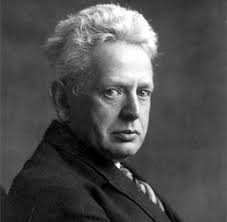
1899), University of Berlin (Dr.phil.habil., 1906)
School: Neo-Kantianism
Main intertests: Language, science,
epistemology, culture, politics, mythology
Notable ideas: Philosophy of symbolic forms,
Ontic structural realism
Influences: Immanuel Kant, Gottfried Wilhelm
Leibniz, Hermann Cohen, Johann Wolfgang von
Goethe, Friedrich Wilhelm Joseph Schelling,
Paul Natorp, Wilhelm Dilthey
Influenced: Leo Strauss, Wilbur Marshall Urban,
Susanne Langer, Arthur Pap, Peter Gay, Erwin
Panofsky, Arthur Lovejoy, Alexander Koyré,
Thomas Kuhn, Edwin Arthur Burtt
From Wikipedia
Cassirer was a German philosopher and historian of philosophy. Trained within the Neo-Kantian Marburg School, he initially followed his mentor Hermann Cohen in attempting to supply an idealistic philosophy of science. After Cohen's death in 1918, Cassirer developed a theory of symbolism and used it to expand the "logic and psychology of thought" into a more general "logic of the cultural sciences." ... His most famous work is the Philosophy of Symbolic Forms (1923–1929).
Introductory Comments
Try describing the world exactly as it is, with no words, no images, no numbers, and no stories, and see how far you get. For Cassirer, the silence that follows is the point. Human beings are symbol-making animals through and through, and we meet the world only through the forms we build to grasp it: myth, language, religion, art, history, and science. These "symbolic forms" are not a veil hiding reality from us. They are the means by which anything becomes a world for us at all. It follows that no form should be judged by another’s standards. Myth is not bad science. It runs on its own logic of feelings and powers. And science, for its part, delivers lawful regularity at a price, trading the felt quality of things for measurement. Each symbolic form is a different lens on the world, and together they make up the multifocal lens we call culture.
Among these lenses, Cassirer gives art special attention as a counterweight to science. Language and science abbreviate reality, compressing endless particulars into concepts and laws. Art intensifies it, lingering on this face, this chord, this light at this hour. Art is thus neither a rival to science nor a prettier substitute for it. It offers a different kind of understanding - one that does not explain away the world's richness but asks us to dwell on it. Nor is art merely feeling poured out onto canvas or page. The artist discovers forms, shapes that teach us to see what we have always looked at, and to understand what we have always felt.
Some of Cassirer's Key Positions
Kant was right that the mind does not passively receive the world but actively shapes it, through built-in forms of perception (space and time) and categories of understanding (such as causality). But Kant looked too narrowly, studying the mind chiefly as it works in science. Human beings make sense of the world in many ways: through language, myth, religion, art, history, and science. Each of these "symbolic forms" organizes experience by its own principles, so the critique of reason must widen into a critique of culture.
The human being is best defined not as the rational animal but as the symbolic animal (animal symbolicum). We never meet reality bare, only through a web of symbols of our own weaving. Each form has its own logic and its own kind of truth: a myth is not a failed scientific theory. Across history, though, thought tends to move from the vivid, emotional images of myth toward the abstract symbols of mathematics and physics.
The Enlightenment's faith in reason and science and its defense of individual rights remain a legacy worth defending. Yet no achievement is permanent. Myth is never fully conquered and can break out whenever crisis loosens reason's hold. The political myths of 20th-century totalitarianism were not primitive survivals but deliberate inventions, manufactured with modern technical skill. Philosophy cannot abolish such myths, but it can help us understand the adversary.
Place in the History of Ideas
Cassirer's Place in History of Ideas
Edward Skidelsky: Cassirer's enduring interest lies largely in the fact that he was the last great European philosopher to straddle both of the two cultures [Analytic philosophy with its quasi-scientific rigor and "Continental" philoso- phy with its 19th century revolt against rationalism] with equal assurance. Encyclope- dically learned in both the natural and human sciences, he could engage is serious argument… with Einstein and Moritz Schlick on the one side and Heidegger on the other. His philosophy is fundamentally an attempt at reconciliation. It understands the various branches of culture, scientific and nonscientific, as symbolic constructions, each with its own internal criterion of validity, rather than as attempts to represent a unique mind-independent reality.
Bryan Magee: The overriding vision [in Cassir- er's major books] is of man as a symbol-creating animal - not only those symbols that constitute language but symbols of multifarious kinds - the whole range and use of them being what more than anything else defines man and differenti- ates him from the rest of the animal kingdom.... Not only each one of the natural languages but also mathematics and logic, and each of the sciences, each one of the academic disciplines, each one of the arts, each one of the great religions, each one of the great ideologies..., presents us with a world, a whole way of looking at things....
Random Thoughts on Cassirer
Picture a cabinet full of eyeglasses. Put on myth’s pair, and the world comes alive with powers and portents, every storm a mood. Switch to science’s, and the same storm becomes pressure systems and equations. Try art’s, and it becomes this particular gray sky over this particular field. Cassirer himself might wince at the image. Eyeglasses imply a world already sitting there, waiting to be brought into focus, while he held that the forms help make the world rather than merely sharpen it. Still, the metaphor captures his mindset. No single pair shows everything, and each shows something the others cannot. A person or culture that can move among them doesn’t just collect more facts. It lives in a larger world, at once lawful and mysterious, universal and stubbornly particular.
Yet one wonders whether Cassirer, a man of formidable range and a lifelong admirer of Goethe, mistook his own temperament for humanity’s. Goethe could trade his poet’s spectacles for his scientist’s before lunch, but what about the rest of us? Wouldn’t constant switching bring on a kind of vertigo, a sense of having nothing solid underfoot? And what happens when two forms collide, as when science and religion both insist on explaining the same storm? Cassirer had an answer of sorts. Culture’s unity, he argued, is not a harmony of agreement but a harmony of tension. That may be true enough, but, still, if asked to keep several symbolic forms aloft at once, most of us would either drop all the balls or lose all our marbles.
Eriugena (Place and time are structures of the mind, not the matter world.)
Gadamer (We inevitably think and speak as part of cultural traditions.)
Kant (All knowledge is a mix of both the empirical and the conceptual.)
Levi-Strauss (Culture is fundamentally a system of symbolic communication.)
Peirce (Since all thought takes time, all thought is in signs or sign processes.)
Russell (Math provides an abstract structure to our understanding of the world.)
Saussure (We must study signs & symbols to understand how language works.)
Sellars (We should think of myths as useful or not, rather than true or false.)
Sorel (Social myths are powerful tools to mobilize a society for action.)
Vico (Society relies on narratives that give coherence and meaning to life.)
Thinkers with opposing positions:
Aristotle (Knowledge is simply empirical generalizations plus syllogistic logic.)
Ayer (Language that is not verifiable is not true or untrue but meaningless.)
Hume (The mind is simply a bundle of perceptions without autonomy or unity.)
Rorty (Language can't represent reality by "holding a mirror up to nature.")
Schlick (Outside logic & math, the truth of statements must rest on evidence.)
Tarski (Scientific knowledge can be reduced to a series of sense-data claims.)
What others said about Cassirer
Harry Slochower: Art and literature occupy a more pervasive location in the writings of Ernst Cassirer than they do in any other modern philosopher...
Donald Phillip Verene: [Cassirer embodied the] overall movement of spirit stretching from the Renaissance to the Enlightenment, and on to Herder’s conception of history, Goethe’s poetry, Wilhelm von Humboldt’s study of... language....
Bryan Magee: [Each type of language, science, art, religion and ideology] is a man-made world constructed and communicated in symbols; and in each case its chief purposes are to help us to represent, understand, interpret, come to terms with, and perhaps master our experience and our environment..., and to communicate with our fellow creatures about them.
James Gutmann: Viewing man as animal symbolicum, Cassirer seeks to understand human nature by exploring culture in terms of the specific character and structure of the various symbolic forms [language, religion, science, art, etc.]
Habermas: Cassirer trusts religious far more than scientific enlightenment as a counter-force to the violence of political myths.
Anthony K. Jensen: Cassirer marshaled the widest learning of human cultural expression - in myth, religion, language, philosophy, history, art, and science - for the sake of completing and correcting Kant’s transcendental program.
Langer: [Cassirer realized that a] conception is fixed and held only when it has been embodied in a symbol. So the study of symbolic forms offers a key to the forms of human conception. The genisis of symbolic forms - verbal, religious, artistic, mathematical, or whatever modes of expression there be - is the odyssey of the mind.
Helmut Kuhn: [Kant's Critique of Pure Reason] so powerfully influenced Cassirer's thinking that it determined his interpretation of culture throughout, from it principles down to the order of procedure....
Main interests: Anthropology, Art and Aesthetics, Cultural Studies, Epistemology, Free/Unfree Will, History of Ideas, History of Philosophy, Language, Literary theory, Logic, Metaphilosophy, Metaphors, Mythology, Perception, Philology, Politics, Religion, Science, Semiotics, Universals