Electric WebOpen the interactive pageAll thinkersAbout

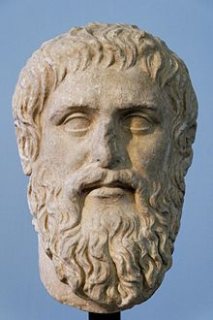
Plato (c. 427 BC - c. 348 BC)

Athens, Greece · 600 B.C. - 1 B.C. · Wikipedia

Plato

Open Plato's interactive page (graphs of influences, similar and opposing positions, and quotes)

Background

Plato
  Born:  428/427 or 424/423 BC in Athens
  Died:  348/347 BC (age c. 80) in Athens
  Ethnicity:  Greek
  School:  Platonism
  Main interests:
     Rhetoric, art, literature, epistemology, justice,
     ethics, politics, education, family, militarism,
     friendship, love, metaphysics, ontology
  Notable ideas:
     Theory of Forms, Platonic idealism, Platonic
     realism, Plato's tripartite theory of soul
  Influences: Socrates, Homer, Hesiod,
     Aristophanes, Aesop, Protagoras, Parmenides,
     Pythagoras, Heraclitus, Orphism
  Influenced: Most of Western philosophy,
     including Aristotle, Augustine, Plotinus,
     Aquinas, Goethe, Schelling, Emerson, Hegel,
     Husserl, Schopenhauer, Russell, Quine, Godel
 
 
From Wikipedia
 
Plato was an innovator of the written dialogue and dialectic forms in philosophy. He raised problems for what later became all the major areas of both theoretical philosophy and practical philosophy. His most famous contribution is the Theory of forms, which has been interpreted as advancing a solution to what is now known as the problem of universals.... Plato is a central figure in the history of philosophy. Unlike the work of nearly all of his contemporaries, Plato's entire body of work [has] survived intact for over 2,400 years.
Introductory Comments
 
Plato occupies the middle of the most influential threesome in the history of ideas - sandwiched between his teacher Socrates and his student Aristotle. Born into a wealthy and well-connected Athenian family, the young Plato somehow overcame his aristocratic upbringing and fell under the dialectical spell of poor, famously ugly Socrates. The class difference may itself have been part of the fascination: Socrates had an uncanny gift for questioning moral assumptions people of Plato's station had never been asked to examine. Yet master and student diverged at a crucial point. Socrates kept his feet on the ground. He was content to probe love, justice, and courage in their own terms, without reaching for a metaphysical safety net.
 
Plato, on the other hand, took those same questions and launched them skyward, to a higher realm of perfect, eternal Forms of which everything earthly is merely a faint and flickering copy. Aristotle, Plato's most brilliant student, accepted the ethical inheritance but declined the upward journey. He came back down to earth with a thud and turned to the observable world in all its stubborn particularity. The result is one of history's odder sandwiches: two thick slices of whole-grain thinking, with a few weightless, exquisitely thin slices of Platonic metaphysics in between. And yet this apparent nothingburger turned out to be the most nourishing meal Western thought has ever been served.
Some of Plato's Key Positions
 
The world is at once ceaselessly changing (as Heraclitus claimed) and wholly changeless (as Parmenides claimed). The trick is that each thinker described a different realm. The lower realm we know through the senses - material things and fleeting impressions - is unstable and transitory. The higher realm, grasped by thought alone, consists of nonphysical Forms that are changeless and eternal.
 
Pythagoras was right that mathematical and geometrical truths belong to a higher order of being - but so do all the Forms. Ideal and eternal, the Forms are the paradigms, the perfect originals of which sensible things are only poor copies.
 
Knowledge of the Forms, like knowledge of mathematics, demands a kind of ascent: a rising above ordinary perception toward a purer, more abstract grasp of reality. Those who, after years of guidance and training, have come to know the Forms are the wisest among us - and so they ought to rule.
 
To rule well above all requires knowledge of the Good, the highest of the Forms, which illuminates all the rest. Yet even those who will never be philosopher-kings owe themselves a self-examined life. As Socrates taught, that means addressing the basic questions: What is virtue? What is justice? What is love?

Place in the History of Ideas

Plato's Place in History of Ideas
 
W. T. Jones: [Plato] was an idealist who gave his allegiance to a vision of perfection, but he was also fully aware that men are men and that the good life for man is this side of the forms (the world outside is beautiful and good, but we must descend again into the cave). He was a rationalist who held that knowledge and truth at their highest and best transcend conceptual means of communication. He believed there is an absolutely valid knowledge in science and in conduct, but was unwilling to deny a kind of reality to this changing world of sense experience.
 
Will Durant: What Plato lacks above all, perhaps, is the Heracleitean sense of flux and change; he is too anxious to have the moving picture of this world become a fixed and still tableau. He loves order exclusively, like any timid philosopher; he has been frightened by the democratic turbulence of Athens into an extreme neglect of individual values; he arranges men in classes like an entomologist classifying flies; and he is not averse to using priestly humbug to secure his ends. His state is static..., ruled by inflexible octogenarians hostile to invention and jealous of change. It is mere science without art; it exalts order, so dear to the scientific mind, and quite neglects that liberty which is the soul of art; it worships the name of beauty, but exiles the artists who alone can make beauty or point it out.
Random Thoughts on Plato
 
What led Plato to the strange metaphysics that would shape so much of Western thought? How did he arrive at the idea that Forms are the ultimate reality: perfect, eternal archetypes existing in a realm of their own, untouched by the countless imperfect copies we encounter in everyday life? Was it a misunderstanding of common nouns? (The thought being that if the word horse applies to many individual horses, it must somehow refer to a single, immaterial Horse itself.) Or did Greek mythology help prepare the ground? After all, the Olympian gods often embodied general qualities and powers - love, war, wisdom, beauty - in personal form. Perhaps Plato simply took the next step, relocating such abstractions from Mount Olympus to a more philosophical address.
 
Other influences may also have played a role: The Pythagoreans treated mathematical truths as timeless realities. The mystery religions promised access to a higher realm beyond ordinary existence. Plato was familiar with both traditions, but perhaps the deepest explanation was more personal. Part of Plato may, at times, have wanted out. Out of his cave, out of his body, out of a world that met neither his needs nor his standards. Perhaps Plato devised his strange metaphysics of intangible Forms floating about forever in a realm of their own because he, like others, sometimes preferred being lost in the clouds to being trapped in his skin.

Influences

Plato was influenced by: Aesop, Heraclitus, Hesiod, Homer, Parmenides, Protagoras, Pythagoras, Socrates

Plato influenced: Aquinas, Aristotle, Augustine, Boethius, Descartes, Emerson, Ficino, Godel, Goethe, Hegel, Husserl, Jung, Plotinus, Quine, Russell, Schelling, Schiller, Schopenhauer

Similar and opposing positions

Thinkers with similar positions:

Thinkers with opposing positions:

What others said about Plato

Schools: Divine Illumination, Essentialism, Innatism, Intellectualism, Metaphysical Idealism, Mysticism, Objective Idealism, Platonism, Pythagoreanism, Rationalism, Skepticism, Virtue Ethics

Main interests: Art and Aesthetics, Beauty, Chain of Being, Communication, Cosmology, Death, Democracy, Desire, Education, Epistemology, Equality, Eroticism, Eschatology, Ethics, Family, Friendship, Geometry, Government, Habits, Health, Human Will, Immortality, Jurisprudence, Justice, Language, Law, Literature, Love, Mathematics, Memory, Metaphysics, Music, Perception, Poetry, Political Philosophy, Power, Property, Psychology, Punishment, Rhetoric, Sexuality, Social Criticism, Social Theory, Spirituality, Theatre, Time, Tragedy, Universals, Utopia, Virtue, Will, Wisdom

Plato's answers to philosophical questions

Art and Aesthetics

What is art? How does it differ from other human endeavors? How is it similar?
Art copies material things which themselves are copies of the Forms. Therefore, art is a mere copy of a copy.
What function does art play in our individual lives? In what sense does it enrich our lives?
Poetry "waters the passions," though they should "be controlled, if mankind are ever to increase in happiness & virtue."
What function does art play in the general culture or larger community?
Art is powerful & therefore should be regulated. Only when it strengthens moral & civic behavior should it be allowed.
On what grounds, if any, should the state regulate or censor works of art, including fiction?
When poetry and the arts undermine or interfere with rational and manly pursuits, they must be censored.
What is beauty? Is it completely subjective? If not, how can it be objectively assessed?
A thing is beautiful because of its relation to the Form Beauty - not because of its shape, color or other quality.
Does our conception and/or appreciation of beauty differ according to subject matter?
From body to soul to the Form of Beauty itself - our conception of beauty is purified as it becomes more contemplative.
What role does emotion play in creating and appreciating art? Does art transform our emotions?
Though it is manly to endure misfortune with quiet patience, we "delight in giving way to sympathy" at stirring poetry.

Economics

Is class struggle inevitable? If so, how should it be pursued? If not, how should it be resolved?
"All men are by nature equal… and however we deceive ourselves, as dear unto God is the poor peasant as the mighty prince."
What is the basis for property rights? What limitations should be placed on property rights?
By abolishing all property rights for the guardian class, the guardians will act selflessly in the general interest of the state.

Education

What is the personal value of an education? How does it aid or enrich the individual?
"There is nothing more divine than education. It is only through education that one truly becomes man."
What is the social or societal value of an education? How does it aid or enrich society?
Education both constrains and directs youth so that they learn to behave rationally and as the law requires.
What subjects are essential to a good education? Does this depend on the individual or society?
A liberal education starts with music, literature & gymnastics and then progresses to mathematics, science & dialectics.
What methods are most effective or productive in educating the young?
"The most effective kind of education is that a child should play amongst lovely things."
What methods, arrangements or emphases in education should be avoided or replaced?
"[E]nforced learning will not stay in the mind. So avoid compulsion, and let your children's lessons take the form of play."
What motivation is most relevant to education: self-actualization, societal rewards, what?
"The object of education is to teach us to love what is beautiful."
To what extent, if at all, should education be inner-directed? Does this differ according to age?
Since all our ideas are innate, teaching is largely a process of helping students remember what they already know.
What, philosophically speaking, should be the emphasis or goal of a liberal education?
A liberal education aims at excellence, not wealth or power. Any subject becomes illiberal if pursued for personal gain.
To what extent, if any, should education encourage the morals and mores of a given society?
"Education is teaching our children to desire the right things."

Epistemology

Are perceptions direct and unmediated representations of the world around us?
Being in continual flux, our sense perceptions can't capture what is true, changeless and eternal.
Are sensations written on a "blank slate" or does experience rely on a set of innate assumptions?
Since before birth the soul had perfect knowledge of the Forms, learning is a form of remembering.
If we are born with a set of predetermined mental categories, how do they shape experience?
Sense experiences trigger certain ideas innate in the human mind. These innate ideas in turn shape our understanding.
To what extent can we rely on logic or reason? To what extent should we rely on logic or reason?
Only the dialectics of reason, not the flux of sense perceptions, can reveal the reality of things.
What is truth? Is it objective or relative or a bit of both? By what standard should it be judged?
That which is perceived through reason is more stable and more true than that which is perceived through sensation.
Is there one, ultimate way to approach the truth? If so, why is it better than other approaches?
The pursuit of truth requires not only the use of logic & dialectics, it also requires renunciation of all shallow sophistry.
To what extent can memory really represent the past? To what extent can we rely on memory?
Memory is not only essential to holding onto our personal history, all learning is in a sense a process of remembering.

Ethics

Should ethical decisions be based on moral principles or practical consequences? Or what?
The only result relevant to ethics is a virtuous character - one that acquires eternal virtues such as justice and courage.
What connection, if any, exists between virtue and happiness?
A man who acts unjustly injures not only another man, but also himself, since he thereby destroys his own equanimity.
What connection, if any, exists between virtue and self-knowledge or knowledge in general?
Virtue is a form of knowledge. No one does evil knowingly. Evil acts always spring from an ignorance of what is good.
What is love? An ideal? An emotion? An independent force in nature?
Love at its lowest level is merely sex, but step by step love rises until at last it reaches the contemplation of absolute Beauty.
Should we forgo bodily pleasures in order to better pursue activities of the mind or spirit?
Though pleasures of the body may properly be indulged in, we must remember that they represent our lower nature.

History

Is the course of history in any sense cyclic? If so, what is the nature of these cycles?
The cyclic nature of the world can be seen in natural disasters from which civilizations disappear, but then reemerge.

Language

What is the role of language in our thought? To what extent does thinking rely on language?
"Thought & speech are the same, [except] that what is called thought is the unuttered conversation of the soul with itself."
How does a word gain or create meaning? How do words link together to make sense?
Language is the weaving together of Forms and as such points to a higher realm of being.
Is language an outgrowth of reason, an instinctive development, or a cultural acquirement?
Language and thought are inextricably linked, even when thought is the unspoken conversation of the soul with itself.
Can language or the misuse of language at times pose a danger to an individual or to a group?
Beware the sophist's clever use of language: He juggles words in order to win arguments, rather than discover truth.
Does rhetoric have a valid role in discourse or is it inherently an obstacle to clear thinking?
Though rhetoric has a valid role in discourse, it too often is used to enchant people with beguiling and flattering lies.
Are there matters that transcend or go beyond the limits of what language can express?
The highest philosophical matters and the first principles of things often defy our limited powers or exposition.

Law

Why are laws needed? And when are laws not needed or inappropriate?
"Good people do not need laws to tell them to act responsibly, while bad people will find a way around the laws."
What is justice? And what connection, if any, exists between justice and law?
Justice is a universal ideal. It is not shaped by the power of the state nor the interests of men. It is transcendent.
How is punishment justified? As retribution? Rehabilitation? Deterrence?
Punishment should not be done to retaliate for crimes, but rather to correct those who commit crimes & to deter others.
How should punishment be measured out? What determines excessive punishment?
If a man commits a crime in a state of madness or disease, he shall simply pay for the hurt done - unless blood was spilt.

Metaphysics

What is the source of all things? From what or from whom do all things originally spring?
The Forms by which we conceive things are in fact universal and eternal paradigms upon which all things are based.
What is being? What does it mean for something "to be"? Is being the same as existing?
Only eternal Ideas or Forms truly and fully exist. Everything else are copies of these Forms and therefore less real.
What, if anything, is becoming? What forces are at work within it? How is it related to being?
That which is apprehended through reason never changes. Only things perceived by our senses become and perish.
Do "forms" or universals exist? If so, do they exist independent of material things?
Ideas or Forms are eternal archetypes that exist in a realm of their own, above all mere particulars.
What is time? Is it something absolute that can exist on its own or is it inherently relative?
The Maker "resolved to have a moving image of eternity..., while eternity itself rests in unity; and this image we call time."
What is space? Can it exist independent of matter? If not, how is it related to matter?
Space "never departs from her own nature, [nor] assumes a form like that of any of the things which enter into her."
What is more real or fundamental: change or permanence? And how are they related?
The eternal Forms never change. What changes are the temporal and imperfect copies of the Forms we see around us.
Are we living in a pluralistic world or is there an essential oneness to all being?
Any type of thing is both one and many: One in its eternal, ideal Form, but one of many in its temporary, material particularity.
Is metaphysics actually possible or are the questions here beyond human understanding?
Insofar as we can transcend the seduction of sense perceptions, we will be able to see the true and transcending Forms.

Mind

What is the intellect? How does it differ from other aspects of mind? What are its functions?
"Thinking is the talking of the soul with itself."

Nature

What place do humans have in nature? What, if anything, sets them above other animals?
"Man is a being in search of meaning."

Philosophy

What is philosophy anyway? And what function does it serve?
Philosophy is a type of love. As such, the philosopher tries to become one with the object of his love - wisdom.
How should the discipline of philosophy be best approached and/or pursued?
As Socrates's approach to teaching showed us, "the right question is usually more important than the right answer."
What is the difference between philosophy and science? What, if any, are their connections?
Unlike the empirical observer, the dialectician relies on ideas alone in his search for the first principles of things.
What connection, if any, exists between mathematics and philosophy?
The purely rational, transcendent and universal quality of mathematics should be the aim or ideal of philosophy herself.
What is the value of studying philosophy? How can philosophy enrich your life? Or can it?
"For this feeling of wonder shows that you are a philosopher, since wonder is the only beginning of philosophy."

Political Philosophy

What are the basic functions of government? What should government not pursue?
"Our object in the construction of the state is the greatest happiness of the whole, and not that of any one class."
What is the best form of government - democracy, aristocracy, monarchy, something else?
"There will be no end to the troubles of states, or of humanity itself, till philosophers become kings in this world."
Is democracy simply rule by the majority? If not, what else does it entail? And with what risk?
"Democracy [is] full of variety and disorder; and dispenses a sort of equality to equals and unequals alike."
When, if ever, should freedom of speech be restricted to protect the greater good?
The state must censor writing that is harmful & corrupting, especially if it glorifies immoral behavior or spreads false beliefs.

Psychology

What are the major functions or forces at work in human psychology?
Three distinct and at times opposing forces are at work within us: passion (desire, appetite), spirit (will) and reason.
To what extent are we conscious of the various forces at work in human psychology?
We humans are often completely in the dark as to why we do what we do: "The worst of all deceptions is self-deception."
To what extent does reason determine our actions? To what extent do impulse and desire rule?
Being our most real & eternal part, reason should rule over our desire for pleasure - though the two will at times be in sync.
What is the will? What role does will play in human psychology? What are its constraints?
The will is directly linked to the intellect: To know what is good is at the same time to will what is good.
What irrational or instinctive forces determine (at least in part) human behavior?
"There is in every one of us, even those who seem to be most moderate, a type of desire that is terrible, wild, and lawless."
How should parents guide and discipline their children? What should be the goal of parenting?
"Let parents bequeath to their children not riches, but the spirit of reverence."
Is love just a feeling? If yes, what sort of feeling? If no, how is love more than a feeling?
Romantic love is a type of madness, but "the madness of love is the greatest of heaven's blessings."
Is happiness actually possible? If so, how is it achieved? If not, what is our alternative?
Happiness is spiritual well-being - a harmony of the soul in which all its parts are in proper balance with one another.

Religion and Theology

Does God exist? If so, can His existence be proven? And if it cannot, how do we know He exists?
The poet's descriptions of the gods should be dismissed when they drag the gods down to our very flawed human level.
Do souls or spirits exist after death? If so, in what manner and for what sort of creatures?
Since the Ideas are eternal, so must the soul that knows them. However, one's morality determines one's afterlife.

Science

What exactly is scientific truth? How reliable are such truths? How objective are they?
Insofar as the sciences deal with the physical world (contingent and in flux), their conclusions are, at most, likely stories.

Sex and Gender

What is the connection between sexual attraction and romantic love?
Sexual love is the lowest form of love, because it's largely bodily in nature, involving little of our higher & nobler attributes.
Should females be given all the rights and opportunities of males?
The state is harmed when women cannot follow the same pursuits as men do, "for thus, the state... is reduced to half."
Should females be given the same education and upbringing as males?
"If women are expected to do the same work as men, we must teach them the same things."

Society

What role does family play in the larger community? What are its strengths and limitations?
Though families offer many benefits, political leaders should forgo families to better focus on the common good.
What are the main benefits of living in a society? What are the main dangers?
High culture is a blessing here & hereafter: "The soul takes nothing with her to the next world but her education & culture."