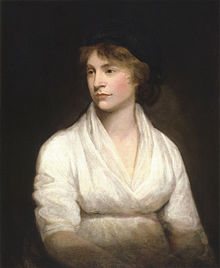
Wollstonecraft was an English writer and philoso- pher best known for her advocate of women's rights. Until the late 20th century, Wollstonecraft's life, which encompassed several unconventional (at the time) personal relationships, received more attention than her writing. Wollstonecraft is regarded as one of the founding feminist philoso- phers, and feminists often cite both her life and her works as important influences. During her brief career she wrote novels, treatises, a travel nar- rative, a history of the French Revolution....
Introductory Comments
Wollstonecraft told women to give up their childish dependence on men and learn to stand on their own. Yet she herself could be dependent to an alarming degree, and possessive besides. "I am a little singular in my thoughts of love and friendship," she wrote as a young woman; "I must have the first place or none." That reads less like a preference than a treaty demand. What she called her romantic nature produced wild swings between rapture and desperation, and the occasional scheme that beggars belief. Smitten with the painter Henry Fuseli - and, she said, with the grandeur of his soul - she proposed moving in with Fuseli and his wife on strictly platonic terms. Mrs. Fuseli declined. So, in the end, did Mr.
Worse followed. In Paris she fell in love with an American speculator with a genius for absence, who left her with a daughter and no intention of returning. Twice she tried to end her life, the second time by walking in the rain until her skirts were heavy and throwing herself off a bridge. How could the great advocate of female self-reliance be so thoroughly undone by a man? Something did, though, shift near the end. "Affliction," wrote her husband Godwin, "had tempered her heart to a softness, almost more than human." Like Marianne in Sense and Sensibility, Wollstonecraft married a man she had once found dry and contentious - and now finds him principled and dependable. Her "sensibility" did not weaken though. As Godwin seems to suggest, it just gained perspective.
Some of Wollstonecraft's Key Positions
Some assume women should not be educated as well as men because women are less intelligent. This gets the causation backwards. If women appear less intelligent, it is because they have been denied a serious education - the wound is being offered as its own justification.
Reason is a human faculty, not a male one; the soul has no sex. Open education and occupations to women and society gains what it currently wastes. Families gain too. A woman trained only to charm has nothing to fall back on when a husband dies or deserts her, and her children sink with her.
Even a woman securely supported suffers a further injury, one to her dignity. When society values women for their beauty and their pleasing presence at gatherings, it makes them ornaments. Women then learn to see themselves as the world sees them, and the world takes the resulting shallowness as proof of its original verdict. The social indictment is against the system, not its victims.
Worse, girls are trained in sentiment - taught to feel finely rather than think clearly, and to treat delicacy of emotion as an accomplishment. Coupled with a poor education, this leaves their rational powers undeveloped. The cost is lifelong, because virtue itself rests on reason. A woman denied the exercise of reason is denied the chance to become genuinely good.
Place in the History of Ideas
Wollstonecraft's Place in History of Ideas
Claudia L. Johnson: Even though Mary Wollstonecraft had little or no presence in history or literature curricula as recently as a generation ago, she has never exactly been a minor figure. Some, certainly, have wished her so. A dauntless advocate of political reform, Wollstonecraft was one of the first to vindicate the "rights of man," but in her own - brief - lifetime and ever since, she achieved notoriety principally for her championship of women's rights. And while some of this notoriety took the particular form of scandal of the sort that often attends women directly involved in public affairs, some of it she directly sought in her writing and in her conduct. Controversy always inspired Wollstonecraft, always sharpened her sense of purpose.
Camilla Jebb: Mary Wollstonecraft's reputation has suffered vicissitudes which, even in the his- tory of genius, are unusual. Her name, during her lifetime, was lauded to the skies by one half of the reading public, and - in exactly propor- tional measure - vituperated by the other half. Then, for more than half a century, it was whol- ly forgotten, or remembered only as suggesting certain vague associations of a grotesque and not altogether decorous kind. Within the last forty years, the mists have been gradually lifting, and she stands revealed for what she was - a woman singularly original in thought and noble in character.
Random Thoughts on Wollstonecraft
In Wollstonecraft's lifetime, "female accomplishments" were very much in vogue, and Jane Austen's Caroline Bingley supplies the checklist: "A woman must have a thorough knowledge of music, singing, drawing, dancing, and the modern languages, to deserve the word; and besides all this, she must possess a certain something in her air and manner of walking, the tone of her voice, her address and expressions...." Darcy raises the bar further, adding the improvement of the mind by extensive reading. Elizabeth Bennet, having heard enough, replies that she is no longer surprised he knows only six accomplished women - she now wonders that he knows any. Austen laughs at the standard. Wollstonecraft indicts it.
An accomplishment practiced only to charm a drawing room or secure an eligible man is, in her account, not an achievement but a self-imposed confinement. Taught that beauty is her scepter, a woman roams her gilt cage and thinks only how to decorate her prison. Even gallantry - that flattering deference, all bows and offered arms - Wollstonecraft read as contempt in fine dress, since it honors a woman precisely as an ornament. But surely men do the same? They too perform to expectation, never more so than when courting. True enough, except that the symmetry breaks where it matters. A gentleman's accomplishments - Latin, law, a profession - could be converted into independence, while a lady's could not.
Wollstonecraft influenced: Anthony, S.B., Blake, Browning, E.B., de Beauvoir, Eliot, George, Fawcett, M.G., Goldman, Hirsi Ali, Moran, Caitlin, Mott, L., Sen, Amartya, Shelley, Mary, Stanton, Stone, Lucy, Woolf, V.
Similar and opposing positions
Thinkers with similar positions:
Bentham (As rational beings women must be given the same rights as men.)
Condorcet (Patriarchal norms that oppress & marginalize women must end.)
de Beauvoir (Men are not the ideal toward which women should aspire.)
Humboldt, W. (A vibrant, liberal society requires universal public education.)
Locke (Education is more than memorization. Children must learn to reason.)
Montaigne (Education is crucial to the emancipation of all individuals.)
Nussbaum (The claim that gender is just a cultural construct is not plausible.)
Seneca (The best way to establish virtue is through a liberal education.)
Sidgwick (As equally rational, girls and boys should be educated in same way.)
Thinkers with opposing positions:
Burke (Radical changes in govt. are dangerous & undermine social stability.)
Butler, Judith (Terms "gender" and "sex" are socially and culturally constructed.)
Evola (Women are by nature completely subordinate to men & must remain so.)
Fichte (Active citizenship and civic freedom should be withheld from women.)
Freud (Penis envy explains much about the psychology of girls and women.)
Irigaray (Many problems are due to the misuses of language regarding women.)
Kristeva (Cultures come into being by excluding the maternal & the feminine.)
What others said about Wollstonecraft
Lucretia Mott: All honor to Mary Wollstoncraft. Her name was cast out as evil, even as that of Jesus was cast out as evil….
Sally R. Munt: According to the liberal tradition outlined by Mary Wollstonecraft in A Vindication of the Rights of Woman, education is the key to social improvement, allowing a woman to develop her rational and moral capacities.
Godwin: If ever there was a book calculated to make a man in love with its author, this appears to me to be the book. She speaks of her sorrows, in a way that fills us with melancholy, and dissolves us in tenderness, at the same time that she displays a genius which commands all our admiration. Affliction had tempered her heart to a softness, almost more than human….
Ayaan Hirsi Ali: I was inspired by Mary Wollstonecraft, the pioneering feminist thinker who told women they had the same ability to reason as men did and deserved the same rights.
Steven Kreis: She was truly a child of the French Revolution and saw a new age of reason and benevolence close at hand.
Godwin: [on Wollstonecraft's death:] I firmly believe there does not exist her equal in the world.... I have not the least expectation that I can now ever know happiness again.
Sylvana Tomaselli: One of the reasons her pronouncements on the [condition of women in modern society] remain challenging is that her reflections on the status of the female sex were part of an attempt to come to a comprehensive understanding of human relations within a civilization increasingly governed by acquisitiveness and consumption.
Janet Todd: She strove to reconcile integrity and sexual desire, the duties and needs of women, motherhood and intellectual life, domesticity and fame.
Schools: Classical Liberalism, Enlightenment, Feminism, Liberalism, Republicanism, Social Liberalism
Main interests: Civil Rights, Communication, Democracy, Desire, Education, Equality, Ethics, Freedom, Journalism, Justice, Law, Literature, Love, Personal Identity, Political Activism, Politics, Power, Social Criticism, Virtue
Wollstonecraft's answers to philosophical questions