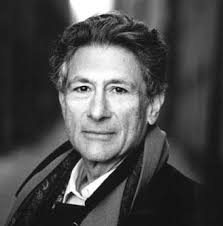
Main interests: Colonialism, politics, literature,
cultural criticism, music
Influences: Schopenhauer, Joseph Conrad,
Derrida, Foucault, Fanon, Deleuze, Lukács,
Aimé Césaire, Vico, Chomsky, Adorno, Gramsci,
Marx, Nietzsche, Sartre, Russell, Shakespeare,
Eqbal Ahmad, Raymond Williams, Steven
Marcus, Gerard Manley Hopkins, Merleau-Ponty
Influenced: Homi K. Bhabha, Gayatri Chakravorty
Spivak, Hamid Dabashi, Robert Fisk, Christopher
Hitchens, Rashid Khalidi, R. Radhakrishnan,
Mahmood Mamdani, Angana P. Chatterji
From Wikipedia
Said was a Palestinian-American professor of literature at Columbia University, a public intel- lectual, and a founder of the academic field of postcolonial studies…. Said applied his education and bi-cultural perspective to illuminating the gaps of cultural and political understanding between the Western world and the Eastern world…. As a cultural critic, Said is known for the book Orientalism, a critique of the cultural representations that are the bases of Orientalism - how the Western world perceives the Orient.
Introductory Comments
Said's central argument in Orientalism (1978) is that the West did not simply discover the East - it invented it. FromFlaubert's Egypt to Lawrence of Arabia's shimmering dunes, the Orient was painted as exotic, sensual, and mysterious - and, in the same brushstroke, as irrational, despotic, and frozen in time. These portrayals were often beautiful and alluring - all silks, deserts, mina-rets, and moonlight - yet beneath the romance lurked a flattening logic that reduced hundreds of cultures into one timeless and vaguely per- fumed "Orient." The East became less a real place than a theatrical backdrop onto which Europe projected its fantasies, fears, and imperial ambitions. The Eastern subject was rarely allowed the dignity of being a unique, thoughtful, and self-describing human.
But has Said overstated the case? After all, not every romantic vision of another culture is a sin against accuracy. When Keats dreamed of an- cient Greece or when Hokusai's woodprints enchanted Parisian artists, something genuinely valuable passed between cultures - a sense of wonder, of human possibility enlarged. Romanticizing the unfamiliar can open minds as well as distort them, and a little enchantment has never been entirely without virtue. Said's reply would probably be that enchantment built on a fantasy still talks past the actual person - which is to say, you can be charmed by a mirage, but you cannot shake its hand.
Some of Said's Key Positions
It is not surprising that different cultures have often distorted perceptions of one another. What is perhaps surprising, though, is that these distortions can be systematic and institutionalized rather than merely accidental. A classic example is Orientalism, the body of knowledge the West has constructed about the Middle East through academic disciplines, literature, art, and journalism.
Whatever charm this construction may have for the West - think of those beautiful images in "Lawrence of Arabia" - it remains a series of caricatures presenting the Islamic world as exotic, irrational, and backward, in ways that have historically served to justify military and political domination of the region.
Which is to say, Orientalism does not attempt to capture the reality of Middle Eastern cul- tures but instead defines the Orient as the West's inferior opposite, thereby affirming Western superiority and rationalizing imperial power. Crucially, this discourse denies Middle Eastern peoples' right to represent themselves. And because a culture's art and literature are never politically innocent, literary and cultural studies bear a responsibility to expose and criti-cally examine the power relations embedded in all such cultural knowledge. Until we do, we will have neither a clear understanding of other cul-tures nor an accurate conception of our own.
Place in the History of Ideas
Said's Place in History of Ideas
Pankaj Mishra: Orientalism proved to be perhaps the most influential scholarly book of the late twentieth century; its arguments helped expand the fields of anti-colonial and post-colonial studies.… What made Orientalism distinctive was its immense panoply of Western learning - the fruits of Said’s Ivy League training - and its audacious crossing of disciplinary boundaries: history, philology, anthropology, literary studies. It was also strik- ing that Said, avowedly indebted to Foucault, concerned himself with representations rather than with the represented - with the discourse of imperialism rather than with its actual workings or its manifestation in social and economic inequality.
Dominic Green: [Bernard] Lewis was an Orientalist before Edward Said made that a term of abuse. Said was not a scholar of the Middle East, but a polemicist from the Middle East. He was also an intellectual impostor. Ever since Orientalism came out in 1978, proper historians have concluded that it would be a masterpiece, if only it were true. The only people who take Edward Said’s books seriously are, in no particular order of irrelevance, academic poseurs, chippy lefties, and the legions of chippy academic lefty poseurs churned out by the departments of Middle Eastern Studies.
Random Thoughts on Said
Malise Ruthven's claim that Said's Orientalism "exposed an unholy alliance between the En-lightenment and colonialism" gets at his deep- est provocation. The same Enlightenment that proclaimed universal reason also produced the philological institutes, ethnographic surveys, and imperial bureaucracies that catalogued the colonized in order to govern them. Reason, in this telling, didn't arrive in the colonies neutral- ly; it arrived with ledgers, gunboats, and a con- fident sense of who needed civilizing. Said's achievement was to show that knowledge and power had been quietly holding hands all along - and to make the "enlightened" arts and sciences blush at the company they kept.
Yet the story is more complicated than a simple morality play with powdered wigs as villains. Enlightenment ideals also supplied many of the intellectual weapons later used against colonial-sm itself: universal human rights, constitutional government, secular education, modern sci- ence, the principle that authority should justify itself before reason rather than merely tradi- tion. Gandhi quoted Mill; Fanon read Hegel; and the"Declaration of the Rights of Man" echoed through every independence movement of the 20-th century. The West's record in the Third World is, to put it mildly, a mixed inheritance - a gift basket that arrived with both penicillin and the Maxim gun, and whose recipients have been sorting the contents ever since.
Berlin (Different cultures should not be measured against one another.)
Buber (Morals improve along with our improved perspective on people.)
Fanon (Colonization is an attack on the dignity and self-worth of the colonized.)
Gramsci (Overthrowing unjust regimes requires overthrowing their worldviews)
Herder (National identity is a good thing but not when it glories over others.)
Herder (Different cultures should not be measured against one another.)
Horkheimer (Cultural, not just economic, forces drive history & shape society.)
Orwell (Colonialism is despotic, even when it pretends to be democractic.)
Spivak (Western culture has either dismissed or marginalized those outside it.)
Thinkers with opposing positions:
Arendt (Only rights granted by the state matter, not "inalienable human rights.")
Bataille (Literature has no moral purpose. It's best when disrupting morals.)
Bentham (Talk of natural rights is mere rhetoric - just "nonsense upon stilts.")
Evola (Mixing with inferior non-European races leads to cultural decline.)
Fanon (Like colonization itself, decolonization is inherently a violent process.)
Locke (Social practices should spring from universally accepted principles.)
Stirner (Humans are always motivated by self-interest and selfishness.)
What others said about Said
Terry Eagleton: [Said showed how the] demeaning images of the East, and imperialist incursions into its terrain, have historically gone hand in hand.
Malise Ruthven: His most influential book, "Orientalism", is credited with helping to change the direction of several disciplines by exposing an unholy alliance between the enlightenment and colonialism.
Yoav Gelber: As an Egyptian of Palestinian origin teaching English literature at an American university, who had built his scholarly career on a Polish sailor that became an English writer (Joseph Conrad), Said's assertion that western orientalists could not comprehend the East and easterners because they were born into a different culture, seems somewhat bizarre.
N. Keddie: Orientalism, for many..., is a word that substitutes for thought, and enables people to dismiss certain scholars and their works. ... It may not have been what [Said] meant..., but the term has become a kind of slogan.
Dominic Green: Ever since "Orientalism" came out in 1978, proper historians have concluded that it would be a masterpiece, if only it were true.
Stanley Kurtz: Said has dismissed the very idea of American democracy as a farce. Yet Edward Said is the most honored and influential theorist in academic area studies today.
Timothy Brennan: Indeed, Said’s specific critique of orientalism cannot be separated from the general assault on the established institutions and protocols of knowledge production that accompanied the mass movements of the 1960s and ’70s globally. Campuses erupted into the streets... in the midst of endless war and underdevelopment.
Robert Irwin: He has made it difficult for Westerners to say anything critical about Islam and the Muslim world. You cannot do that because then you run the risk of getting denounced as an orientalist, i.e. a racist, an imperialist….
Main interests: Alienation, Civil Rights, Colonialism, Communication, Community, Cultural Criticism, Cultural Studies, Democracy, Freedom, Freedom of the press, History, History of Ideas, Ideology, Language, Literary theory, Literature, Metaphors, Music, Philology, Political Activism, Politics, Popular Culture, Racism, Social Criticism