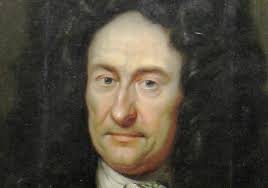
Leibniz was a German polymath active as a mathematician, philosopher, scientist and diplomat who is disputed with Sir Isaac Newton to have invented calculus in addition to many other branches of mathematics, such as binary arithmetic, and statistics. Leibniz has been called the "last universal genius" due to his knowledge and skills in different fields and because such people became much less common after his lifetime with the coming of the Industrial Revolution and the spread of specialized labor.
Introductory Comments
Leibniz ranks among the great logicians, which is also a cautionary tale. Start from an unassailable premise, follow it without flinching, and you may end up somewhere very strange indeed. His premise was a piece of grammar: A substance is what other things get said about - always the subject, never the predicate. Push on that and something remarkable follows. The complete notion of an individual must contain every predicate true of him: the concept of Julius Caesar already includes crossing the Rubicon, along with everything else he ever did or suffered. From that seed grew the doctrine of monads - the simple, partless, and powerless substances Leibniz called the true atoms of nature, each with a pre-established future waiting to unfold.
Leibniz's illustration is a city, which looks like several different cities depending on the road one takes toward it. Reality turns out to be a matter of points of view, countless of them, each mirroring the universe from a position no other occupies. But these are not points of view floating free of any viewer. Monads perceive, and whatever perceives is closer kin to a soul than to a stone. And each soul is not built out of the smaller souls - monads have no parts and cannot be stacked. But they are arranged according to a ladder of sorts - held up by a Supreme Monad that sees from everywhere and all at once. Not bad for a bit of grammar: begin with the subject of a sentence, end with a universe of mirrors, no two angled alike.
Some of Leibniz's Key Positions
The universe is extraordinarily complex, yet also perfectly rational, with all its innumerable parts unfolding in complete harmony. This order, however, does not arise from ordinary causal interaction between things. What appears to be cause and effect is, at bottom, something quite different.
A dropped glass shatters when it hits the ground, but not because the impact itself causes the break. Rather, both the fall of the glass and its shattering unfold according to their own internally programmed courses. The appearance of interaction is an illusion.
The key to this remarkable system is the monad - a simple, indivisible substance that is the ultimate unit of reality. Monads have no parts, occupy no space, and cannot causally affect one another. Instead, each develops according to its own internal principle, its changing states perfectly in sync with those of every other monad. Each is a unique "mirror of the universe," reflecting the whole of reality from its own point of view.
Such perfect correspondence is possible only because God wound every monad at creation, and they run together like a roomful of clocks keeping perfect time without ever touching. And because God is omnipotent, omniscient, and perfectly good, we must conclude that this coordinated system is the best of all possible worlds.
Place in the History of Ideas
Leibniz's Place in History of Ideas
Cassirer: [I]n Leibniz's system every individual substance is not only a fragment of the universe, it is the universe itself seen from a partic- ular viewpoint. And only the totality of these unique points of view gives us the truth of reality…. The central thought of Leibniz's philosophy is therefore to be looked for neither in the concept of individuality nor in that of univer- sality. These concepts are explicable only in mutual relationship; they reflect one another, and in this reflection they beget the fundamen- tal concept of harmony which constitutes the beginning and end of the system.
Matthew Stewart: Leibniz's apparent coreless- ness stands for a fundamental philosophical problem, a quandary that reaches to the foun- dations of his system of philosophy. In the met- aphysics he... presented to the world, Leibniz claimed that the one thing of which we can all be certain is the unity, permanence, immateriality, and absolute immunity to outside influence of the individual mind. In identifying the mind as a "monad" - the Greek word for "unity" - he positioned himself in direct opposition to Spinoza, whose allegedly materialist philosophy of mind he adamantly rejected. And yet the philosopher who made the unity of the individual the fundamental principle of the universe was himself incomparably fragmented, multiplicitous, exposed to the influence of others, and impossible to pin down.
Random Thoughts on Leibniz
Monads are notoriously wrap to get one's head around, but a thought experiment helps: imagine Democritus crossed with Berkeley. Take the atomism - a world built from indivisible units - and fuse it with idealism, a world of minds and their contents. What comes out looks a good deal like the monadology. Here the Berkeley half comes in, with an adjustment. Berkeley kept minds and dispensed with matter: God furnishes our perceptions directly, and the world's orderliness is the orderliness of what God supplies. Leibniz reaches the same coherence by another route. Every monad perceives, most without a flicker of awareness, each mirroring the whole universe from a vantage point no other occupies. The monads never coordinate with one another. They were coordinated in advance.
Hence the two theologies. Berkeley's God is a Puppeteer, working the strings from above, moment by moment, forever. Leibniz's God is a Programmer, who wrote each monad's entire career into it at creation and has not touched the keyboard since. Neither, though, would call the physical world an illusion. Berkeley thought he was defending common sense - the apple is as real as it seems, it simply consists of ideas. Leibniz called bodies well-founded appearances: space and matter are how an infinity of monads must show up to a finite perceiver. Rather like a rainbow. No arch hangs in the sky, but something is out there, and one is not hallucinating.
Al-Ghazali (Though evil exists, God created the best of all possible worlds.)
Chalmers (There's an explanatory gap between physical & phenomenal realms)
Chomsky (Certain ideas must be innate, since no empirical origin is possible.)
Chrysippus (Apparent evils actually spring from nature's goodness.)
Ficino (A hierarchy of substances descends from God down to lowly matter.)
Pinker (Mental instincts help shape us. The mind at birth is not a blank slate.)
Thinkers with opposing positions:
Bayle (God's causal relation to sin and suffering has never been explained.)
Bolzano (Simple substances are not "windowless" - that is, they interact.)
Camus (We seek clarity and meaning within a world that offers neither.)
Collingwood (Metaphysics is just heuristic principles helping us grasp reality.)
Deleuze (Philosophy is the creation of concepts, not the discovery of truths.)
Gassendi (Understanding relies on our senses, not on our deductive reasoning.)
Heraclitus (The fairest universe is but a heap of rubbish piled up at random.)
Humboldt, W. (Mind and body form a vital unity as seen in man's sensuality.)
Kant (The existence of God cannot be deduced from the definition of God.)
Pyrrho (Given our human limitations, we can never be sure of what is true.)
What others said about Leibniz
John Stillwell: Often he seemed to lack not only the technique but also the patience to develop the ideas conceived by his wide-ranging imagination.
Berlin: Leibniz seems to have believed not only in the possibility of constructing a logically perfect language, which would reflect the structure of reality, but in something not unlike a general science of discovery.
Russell: In Leibniz, a vast edifice of deduction is pyramided upon a pin-point of logical principle. In Leibniz, if the principle is completely true and the deductions are entirely valid, all is well; but the structure in unstable, and the slightest flaw anywhere brings it down in ruins.
Norbert Wiener: Leibnitz, dominated by ideas of communication, is, in more than one way, the intellectual ancestor of the ideas of this book, for he was also interested in machine computation and in automata.
J. M. Child: The main ideas of his philosophy are to be attributed to his mathematical work, and not vice versa.
Cassirer: Leibniz was the first great modern thinker to have a clear insight into the true character of mathematical symbolism and immediately elicit fruitful and comprehensive consequences.
Franklin Perkins: Substances do not interact. Every substance is eternal. Bodies are phenomena, not independently real. Choices are determined but free. This is the best possible world. I first encountered Leibniz in [college] and the image of him as a philosopher so enthralled with his reasoning as to deny the reality in front of him stuck with me for a long time.
Diderot: When one compares the talents one has with those of a Leibniz, one is tempted to throw away one's books and go die quietly in the dark of some forgotten corner.