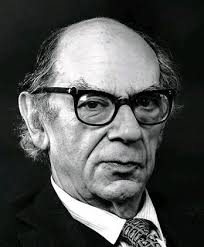
Berlin was a Russian-British social and political theorist, philosopher, and historian of ideas. Berlin is known for his inaugural lecture, "Two Concepts of Liberty."… Berlin defined "negative liberty" as absence of coercion or interference of private actions by an external political body.... "Positive liberty" Berlin maintained, could be thought of as self-mastery, which asks not what we are free from, but what we are free to do…. [Berlin was also known for] his advocacy of an irreducibly pluralist ethical ontology.
Introductory Comments
Perhaps Berlin's most fundamental goal was to thread the needle between moral monism's iron-fisted certainty - one true hierarchy of val- ues, often enforced with a self-righteous vio- lence - and relativism's anything-goes abyss, where cultures float off in their own subjective bubbles with no common ground for critique. Berlin instead insisting that human values, though wildly plural and often tragically at odds, remain objective because they are rooted in a generic human nature: the shared emotion- al, cognitive, and social wiring that makes us recognizable as humans at all. Values, on this view, are like languages: endlessly varied, yet all recognizably doing the same work, because they arise from the same kind of creature.
Yet Berlin's elegant threading of the needle leaves several loose threads. First, there is the nagging worry that what we dignify with the title "human nature" may sometimes be little more than the historically conditioned preju- dices we absorbed before we were old enough to argue back. Even granting that a genuine human nature exists, a calibration problem remains: Berlin needs it to be thick enough to ground objective moral claims yet thin enough to permit the very pluralism he celebrates. Finally, and most pressingly, what happens when two perfectly objective values - liberty and equality, say - collide head-on with no common metric to referee the bout?
Some of Berlin's Key Positions
Much can be learned from the history of ideas. For instance, in studying both the proponents of the Enlightenment (particularly in England and France) and its many critics (particularly in Germany), we see an irreducible battle between two sets of values. On one side is a belief in the value of reason, science, education, social progress, moral and cultural universalism. On the other side is a belief in passion, artistic genius, historical uniqueness, distinctive evolution, political and cultural nationalism.
As this historic battle itself illustrates, funda- mental values are themselves usually irreduc- ible, and conflicting worldviews are not easily mediated or reconciled. The critics of the Enlightenment acknowledge as much when they emphasize historical and cultural unique- ness. It is tempting, then, to consider these critics as wiser than the Enlightenment thinkers, given their "enlightened" emphasis on intel- lectual and moral universalism.
The problem is that the critics of the Enlighten- ment often went too far in their praise of individual and cultural "genius." As history later proved, particularly during World War II, an emphasis on heroic figures and national great- ness is, when taken too far, a very dangerous thing. From this perspective, advocates for the Enlightenment have been proven saner and sounder than many of their critics.
Place in the History of Ideas
Berlin's Place in History of Ideas
Joshua Cherniss: Isaiah Berlin was a naturalised British philosopher, historian of ideas, political theorist, educator, public intellectual and moralist, and essayist. He was renowned for... his defence of liberalism and pluralism, his opposition to political extremism and intellec- tual fanaticism, and his accessible, coruscating writings on people and ideas. His essay "Two Concepts of Liberty" (1958) contributed to a revival of interest in political theory in the English-speaking world, and remains one of the most influential and widely discussed texts in that field: admirers and critics agree that Berlin's distinction between positive and negative liberty remains, for better or worse, a basic starting point for discussions of the meaning and value of political freedom.
Roger Hausheer: … Berlin's entire philosophical oeuvure may be seen as a long battle, now overt, now covert, but always subtle, resourceful and determined, against the facile application of inadequate models and concepts in the field of human studies. Men should never be blinded by the distorting spectacles of theory to what they know immediately to be true of themselves. Many of his essays offer a sensitive and subtle investigation of the impingement, for example, of our increasingly exact and sophisticated knowledge of the natural, external world upon the inner, moral and spiritual worlds of human experience.
Random Thoughts on Berlin
Berlin's engagement with the history of philoso- phy was itself a philosophical method - argua- bly his primary one. He rarely constructed form-al arguments in the manner of analytic philoso- phers. Instead, he would inhabit a thinker's worldview with extraordinary empathy, recon- struct it vividly, and then show what followed from it. His famous essays on Vico, Herder, Machiavelli, and the Counter-Enlightenment were not antiquarian exercises; they were ways of excavating ideas he believed the mainstream tradition had buried or undervalued. His plural-ism didn't emerge from a set of premises and deductions - it emerged from noticing a pattern across centuries of thought: that the most honest thinkers kept stumbling over the same irreducible conflicts between genuine goods. The history of philosophy was, for Berlin, a way of thinking in public with the dead.
The underlying principle is this: the history of philosophy is not a prerequisite you complete before you start thinking. It is the conversation you are joining. Berlin understood this instinc- tively - he never treated past thinkers as settled authorities but as living interlocutors whose best insights and deepest errors were equally instructive. The goal is not to master the canon and then, finally, offer your own view. The goal is to let your own view take shape through the encounter, the way a sculptor discovers the form by working the stone.
Berlin influenced: Azurmendi, Gray, John N., Ignatieff, Rawls
Similar and opposing positions
Thinkers with similar positions:
Feyerabend (A pluralistic society should avoid being too influenced by science.)
Herder (Different cultures should not be measured against one another.)
Herzen (Humans should never be sacrificed on an altar of glorious abstractions)
Hume (Values are neither discovered nor deduced: They are human creations.)
Mill (Freedom is not something we find in the state, but in ourselves.)
Oakeshott (Each intellectual discipline has it own perspective on the world.)
Putnam (There are multiple descriptions of reality that are equally true.)
Schlegel (There are no first principles that can guide us to the truth.)
Strauss (To remove values from the science of man is a self-deluded project.)
Vico (Human sciences require different methods from the natural sciences.)
Thinkers with opposing positions:
Comte (All valid knowledge is scientific: Knowledge requires verification.)
Einstein (Free will isn't compatible with determinism. Our wills are determined.)
Fichte (Freedom springs from submerging individuality into a larger group.)
Hegel (Freedom springs not from within, but from our belonging to a state.)
Rousseau (Liberty is self-rule & self-rule is obedience to the "general will.")
Sade (To be free means to be unrestrained by any chains of morality.)
What others said about Berlin
Johnny Lyons: Berlin believed that moral conflict is compatible with the objectivity of morals.
Marilyn Berger: His was an exuberant life crowded with joys - the joy of thought, the joy of music, the joy of good friends.... The theme that runs throughout his work is his concern with liberty and the dignity of human beings.
Perry Anderson: [Berlin believed] that however diverse or incompatible cultures may be, "their variety cannot be unlimited, for the nature of men... must possess some generic nature if it is to be called human at all." Values can thus be plural and conflictual, yet at the same time perfectly objective, because, despite everything, a common human nature does exist….
Henry Hardy: Philosophy... was for Berlin concerned with questions which not only could not at present be answered, but for which no clearly proper method of discovering an answer was known.
Oakeshott: Listening to him you may think that you are in the presence of one of the great intellectual virtuosos of our time: a Paganini of ideas.
John Gray: Isaiah was an incredibly tolerant person - and I believe that tolerance is an essential part of liberalism, because tolerance means... everyone can become happy in his or her own way, as long as it does not bother others.
Henry Hardy: Isaiah Berlin was often described, especially in his old age, by means of superlatives: the world's greatest talker, the century's most inspired reader, one of the finest minds of our time. There is no doubt that he showed in more than one direction the unexpectedly large possibilities open to us at the top end of the range of human potential.
Alan Ryan: …. there are moments in his work that make the reader wonder whether it is Montesquieu speaking or Berlin, or whether Machiavelli would have recognized the causes for which Berlin recruited him.
Schools: Analytic Philosophy, Humanism, Liberalism, Pluralism, Secularism, Social Liberalism
Main interests: Biography, Democracy, Equality, Ethics, Fact–value distinction, Free/Unfree Will, Freedom, Freedom of the press, Government, History, History of Ideas, Law, Literature, Metaphilosophy, Political Philosophy, Political Theory, War