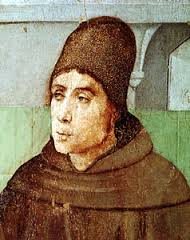
Duns Scotus was a Scottish Catholic priest and Franciscan friar, university professor, philoso- pher and theologian. He is one of the four most important Christian philosopher-theologians of Western Europe in the High Middle Ages, together with Thomas Aquinas, Bonaventure and William of Ockham…. Duns Scotus was given the scholastic accolade Doctor Subtilis ("the subtle doctor") for his penetrating and subtle manner of thought. He was beatified by Pope John Paul II in 1993.
Introductory Comments
Despite the etymological tie between the man and the insult, Duns Scotus was no dunce. On the contrary, his writings were so finely wrought that he earned the nickname "the Subtle Doctor." (The slur came later: Renaissance humanists, impatient with Scotus's hairsplitting followers - the "Dunsmen" - turned a great name into a term of abuse.) And yet the link between the subtle thinker and the insulting word is, in one respect, apt. Scotus had a certain respect for the dunce. Unlike Aquinas, who held that the intellect reigns supreme and can even reason its way toward the mysteries of God, Scotus gave the crown to the will. God is not shackled by the laws of reason; he is free to do as he pleases. As is the dunce.
And this, for Scotus, is exactly as it should be. Were we bound hand and foot by the laws of the intellect, we would not be free - and neither would God. Our powers of course pale beside God's, but the free will is common ground. The difference lies in what that will accomplishes. When God freely willed the world into being, he thereby defined what is good and just; his will does not follow a moral order but establishes one. We humans, by contrast, must lean on the intellect to work out what is moral and what is not. Yet even after the intellect delivers its verdict, the will still calls the shots: we remain free to ignore the ruling. And it is precisely this freedom of the will, rather than any brilliance of intellect, that stamps us as creatures made in God's image. Even the dunce.
Some of Duns Scotus's Key Positions
The concept of "being" applies in the same sense to God and to creatures. Though God infinitely surpasses every creature, when we call God "good" or "wise" the words carry the same core meaning they do when applied to anything else - otherwise, we could form no genuine concept of God at all.
On the relation between what a thing is and that it is, we should not draw too sharp a line. Unlike those who treat existence as a separate ingredient added to essence, there is no distinction between the two in creatures: a thing's existence is not a further component bolted onto what the thing is.
To handle the many aspects we discern within a single being, we need formal distinctions - distinctions less than real distinctions between separate things, yet more than merely mental ones. They let us distinguish genuinely different aspects within one thing (say, God's mercy and God's justice) as grounded in the thing itself, and not just in how we happen to think about it.
Finally, what makes an individual thing individual? Two round, white, three-pound snowballs share every describable quality - snowball-ness, whiteness, roundness - yet remain two, not one. The answer was haecceity (from the Latin haec, "this"): a positive principle of individuation, not itself a further describable quality, that turns a common nature into an unrepeatable particular. It is what makes this snowball uniquely itself.
Place in the History of Ideas
Duns Scotus's Place in History of Ideas
William Turner: Scotus is frequently described as the Kant of Scholastic philosophy. He certain- ly resembles Kant in his refusal to accept with- out criticism any theory, no matter how univer- sally received or how strongly supported by the authority of great names. The resemblance is accentuated by the fact that both Scotus and Kant are voluntarists, both maintaining that will is superior to intellect, and that human rea- son cannot demonstrate the truths which most vitally affect the destiny of man. But, remark- able as the resemblance is, no less striking is the contrast between the two philosophers. Kant appeals to the moral consciousness to prove the truths which reason cannot demonstrate: Scotus, on the contrary, appeals to revelation. Scotus places the supernatural order of truth above all philosophical knowledge....
Johannes Hirschberger: [Scotus] knew... that a thing can be willed only if the intellect has singled out a purpose for it. But in the case of man, Scotus placed a greater value on the will than on reason, because love unites us more intimately with God [than does reason]. This we can appreciate without too much difficulty from the fact that hatred of God is much more terrible than ignorance of Him. The will should furthermore be free under all circumstances. According to Scotus, nothing can determine it, not even the Supreme Good Itself. The will alone is the cause of all its actions.
Random Thoughts on Duns Scotus
Like Aquinas with his Necessary Being, Scotus held that there is one being whose essence necessarily entails its existence - God, of course. But here the two part company. Aquinas maintained that God exists in a different sense than the beings and things of this world; Scotus insisted that being is univocal - a single concept applying in one and the same sense to Creator and creation alike. When we say that God is and that a stone is, the word carries the same core meaning in both cases. This does not, for Scotus, collapse the distance between them: God is infinite being and creatures finite being, and that difference of intrinsic "mode" preserves an unbridgeable gulf between them. But Scotus, unlike Aquinas, insisted that since we can learn God's nature only by studying his creation, that creation must share a common concept of being with God - otherwise the inference from world to God would have nothing to run along.
From one angle, this one-sense-fits-all conception of being can look both degrading and absurd. How could God - omniscient, omnipotent, omnipresent - "be" in the same sense that you and I are? But from another angle, Scotus is not shrinking God down to our size; he is enlarging the world up toward God. We things and creatures are not God, and we are certainly not his equals. Yet we exist along the same scale of being he does - not as rivals but as his manifestations. We make manifest a divinity that would otherwise have stayed hidden.
Duns Scotus influenced: Alexander VI, Alnwick, W. of, Andreas, A., Deleuze, Descartes, Ferreira, M., Fuetscher, L., Heidegger, Hopkins, G.M., Leibniz, Luther, Mayrone, F. of, Ockham, Peirce, Pickstock, C., Sixtus IV, Suarez, Vico
Similar and opposing positions
Thinkers with similar positions:
Aquinas (Universals are "embedded" in particular objects as their "whatness.")
Aristotle (Form & matter are intimately united in the objects of this world.)
Bergson (Freedom is a fundamental component within life and duration.)
Fichte (Intuition gives our minds direct access to the ground & nature of reality.)
Heidegger (The question of existence or being is fundamental to all philosophy.)
Peirce (We perceive the singular with the senses & the universal thru intellect)
Suarez (In metaphysics the individual remains the fundamental reality.)
Thinkers with opposing positions:
Abelard (Universals don't exist independent of concrete, individual things.)
Aquinas (Except for God, the essence of a thing is distinct from its existence.)
Augustine (Being overwhelmed by sinfulness, we aren't free to choose good.)
Averroes (The individual's soul ends when he or she dies. It is not eternal.)
Hobbes (Since the will is causally determined, it is not free in its choices.)
Ockham (Universals are just concepts. Only concrete individual things are real.)
Russell (No empricial evidence nor rational argument proves God's existence.)
Sartre (Existence precedes essence: Humans GIVE meaning & purpose to life.)
Spinoza (Everything that exists is a modification or mode of one substance.)
What others said about Duns Scotus
Randall Collins: Dun's universe seems rather existentialist.... [T]he fundamental reality... is volition and [the contingent particularity of being].
William Turner: ... while [Scotus] excelled even the greatest of the schoolmen in critical acumen, he was wanting in that synthetic power which St. Thomas possessed in so preeminent a degree....
Ralph McInerny: Like the majority of medieval thinkers, Scotus was conscious of the limits of human reason and of the necessity of revelation. As a theologian he considered the teachings of the philosophers from the vantage point of his faith and, not surprisingly, found them inadequate on a number of crucial points.
Russell: [Duns Scotus] was mainly interested in... the kinds of things that can be known without proof. Of these there are three kinds: (1) principles known by themselves, (2) things known by experience, (3) our own actions.
Anthony Kenny: Scotus is not widely read outside professional circles: he is a philosophers' philosopher.
Johann Erdmann: Duns is a most decided indeterminist. The intellect according to him only furnishes the material, while the will shows itself free, that is, able to choose either of two opposites.
Copleston: ...Scotus was a metaphysician who argued as a metaphysician. It is true that he was, like other mediaeval metaphysicians, a logician; but the logician had not, with him, begun to take the place of the metaphysician: his system belongs to the group of thirteenth-century metaphysical syntheses.
W. Windelband: [Scotus taught] that blessedness is a state of the will, and that, too, of the will directed toward God alone; he sees man's last glorification, not in contemplation, but in love, which is superior to contemplation....
Schools: Christian Theology, Neoplatonism, Nominalism, Personalism, Platonism, Scholasticism, Voluntarism
Main interests: Epistemology, Ethics, Faith, Free/Unfree Will, History of Ideas, Immortality, Logic, Metaphysics, Religion, Spirituality, Theology, Universals