Auguste Comte (1798 - 1857)
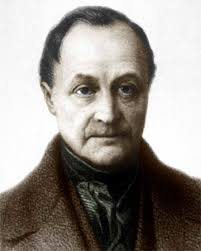
Open Comte's interactive page (graphs of influences, similar and opposing positions, and quotes)
Background
Auguste Comte
Born: 19 January 1798 in Montpellier, France
Died: 5 September 1857 (aged 59) in Paris,
France
Alma mater: École Polytechnique
Main interests: Sociology, religion, epistemology,
science, social sciences, ethics
School: Positivism
Influences: Francis Bacon, M. F. X. Bichat,
Condorcet, Descartes, Saint-Simon, Diderot,
Rousseau, Hume, Adam Smith, Jean-Baptiste
Say, Benjamin Franklin, Thomas à Kempis
Influenced: Émile Littré, Marx, Mill, Nietzsche,
H. Spencer, Durkheim, Charles Maurras, H.
Martineau, P. Laffitte, George Eliot, E. Dühring,
Bakunin, R. Congreve, Frederic Harrison, G. H.
Lewes, Thomas Hardy, Alexander Bain, Saul
Alves Martins, Edward Burnett Tylor
From Wikipedia
Comte was a French philosopher, mathematician and writer who formulated the doctrine of positivism. He is often regarded as the first philosopher of science in the modern sense of the term. Comte's ideas were also fundamental to the development of sociology, with him... treating the discipline as the crowning achievement of the sciences…. Comte's work attempted to remedy the social disorder caused by the French Revolution, which he believed indicated an imminent transition to a new form of society.
Introductory Comments
Few thinkers have had their subject so rudely thrust upon them. Comte was born in 1798, under the First Republic, and died in 1857, under the Second Empire. In between, France went through an empire, a restoration, Napoleon's Hundred Days, a second restoration, the July Monarchy, and a second republic. That's seven changes of regime in one lifetime, several of them announced by gunfire. France, it seemed, changed governments the way other nations changed seasons. Comte drew a lesson from all this. What France lacked, he decided, was not the right king or the right constitution but the right science. Astronomers had found the laws that govern the planets, and chemists the laws that govern the elements. Why not find the laws that govern society?
That science, which Comte eventually named "sociology," would crown all the others and reveal the laws of social order and progress. Once it knew them, humanity could foresee social events and so guide them, leaving revolutionary turmoil behind for an era of rational harmony. The way forward, then, lay neither in a return to the old authoritarian order nor in yet another revolution. Put down the sword, pick up the pen, and observe, compare, analyze. But Comte had no patience for mere fact-collecting. Observation without theory, he insisted, gives you a heap of facts, not knowledge. What society needed, to put it more pungently, was fewer guillotines and more laws: the kind that are discovered, not decreed.
Some of Comte's Key Positions
The turmoil after the French Revolution is convincing evidence that social reform should rest on science, not on passion or prejudice. We call this general approach "positive" philosophy: knowledge limited to what can be observed and checked. And when this method is applied to society, we call it "sociology." Its task is to reconcile order and progress.
The "law of three stages" holds that all knowledge, and society with it, passes through three stages. In the theological stage, people explain events by gods or spirits, starting with fetishism (the belief that objects themselves are alive), then polytheism, then monotheism. In the metaphysical stage, the gods give way to abstractions such as "Nature" or the "rights of man." This stage can tear down an old order, as the Revolution did, but it can't build a new one. Hence its turbulence.
The positive stage stops asking why things happen and asks how: what regular laws link observable events. Social truths come not from authority or abstract ideals but from observation and analysis.
Given its importance, sociology is the queen of all the sciences, since the facts, forces, and principles it discovers allow us, for the first time in history, to intelligently analyze and fix our social problems. Sociology brings together all other sciences into a cohesive whole - all in the service of improving our lives.
Place in the History of Ideas
Comte's Place in History of Ideas
Ashley Crossman: Comte lived during one of the most turbulent periods in European history. As a philosopher, therefore, his aim was not only to understand human society but to prescribe a system by which we could make order out of the chaos, and thus change society for the better. He eventually developed what he called a "system of positive philosophy," in which logic and mathematics, combined with sensory experience, could better assist in understanding human relationships and action, in the same way that the scientific method had allowed an understanding of the natural world.
Leo Tolstoy: The only true and scientific method according to Comte is therefore the inductive method.... Secondly, the aim and apex of science is the new science of the imaginary organism of humanity or of the super-organic being - humanity: this new imaginary science being sociology. From this view of science in general it appeared that all former knowledge was false, and the whole history of humanity's knowledge of itself fell into three, or really two, periods: The theological and metaphysical periods, lasting from the commencement of the world until Comte and the present period of true science - positivism - which began with Comte. This was all very nice; there was only one error, namely, that the whole edifice was built on the sand - on the arbitrary assertion that humanity is an organism.
Random Thoughts on Comte
Comte arranged the sciences like the floors of a building. Mathematics, the most general and abstract, is the foundation. Above it rise astronomy, physics, chemistry, and biology, each more complex than the one below and each resting on those beneath. Sociology sits at the top, studying the most tangled facts of all and holding the structure together. It's a handsome building, and Comte, not surprisingly, kept the penthouse for the science he had founded. But look at what's missing from the floor plan: psychology. Comte saw no route to a science of the individual mind. Introspection was hopeless, he argued, because a thinker can't split in two, one half reasoning while the other watches. The workings of the brain went to biology. Everything else went to sociology: language, customs, beliefs, the whole inherited stock of human thought. And so the real subject of history is Humanity, the vast collective that accumulates and moves forward - with individuals, it seems, going along just for the ride.
And yet, when Comte later founded a "Religion of Humanity" (despite his earlier dismissing religion as part of the first stage of human development), he gave it a calendar with every month and day named after one or two great individuals or groups: Moses, Homer, Aristotle, Dante, Descartes, and on and on. The total came to 558 honorees. For someone who thought individuals went along with the history of Humanity just for the ride, Comte spent a lot of time listing the drivers.
Influences
Comte was influenced by: Bacon, Francis, Bichat, M.F.X., Condorcet, Descartes, Diderot, Franklin, Hume, Kempis, T., Rousseau, Saint-Simon, Say, Jean-B., Smith, Adam
Comte influenced: Bakunin, Congreve, R., Durkheim, Eliot, George, Hardy, Thomas, Laffitte, P., Littre, Emile, Martineau, H., Marx, Maurras, C., Mill, Nietzsche, Spencer, Sumner
Similar and opposing positions
Thinkers with similar positions:
- Bacon, Francis (All real knowledge rests upon observed facts & scientific method)
- Bentham (Govt. should play an assertive role in improving general welfare.)
- Dawkins (Religion teaches us to be satisfied with our lack of understanding.)
- Durkheim (Society shapes individuals more than individuals shape society.)
- Jefferson (The ideal government should be made up of an intellectual elite.)
- Lukács (Our social existence determines or shapes our consciousness.)
- Saint-Simon (A scientfic study of society can lead to social progress for all.)
- Spencer (History shows that, like reason & science, societies progress over time.)
Thinkers with opposing positions:
- Dilthey (Natural sciences observe and explain. Human sciences understand.)
- Freud (The social realm plays a minimal role in shaping human psychology.)
- Goodman (There's no sharp divisions between art, science & normal experience)
- Horkheimer (The study of society calls for cultural, not quantifiable, analysis.)
- Huxley (Science should not serve the end of perfecting a new social order.)
- Strauss (To remove values from the science of man is a self-deluded project.)
- Vico (Human sciences require different methods from the natural sciences.)
- Weber (In sociology there's no purely objective analysis & no universal laws.)
What others said about Comte
- Steven Kreis: The dominant motive of Comte’s positivism was not speculative but practical. His purpose was... the reformation of the social order.
- Tony Davies: [Comte's new religion was a] complete system of belief and ritual, with liturgy and sacraments, priesthood and pontiff, all organized around the public veneration of Humanity.
- Mill: M. Comte, in particular, whose social system, as unfolded in his Systeme de Politique Positive, aims at establishing (though by moral more than by legal appliances) a despotism of society over the individual, surpassing anything contemplated in the political ideal of the most rigid disciplinarian among the ancient philosophers.
- Mary Pickering: ... Comte considered the pursuit of both liberty and equality to be absurd. Both had been useful tools in the battle against the ancient regime but now their "natural incompatibility" had become more apparent.
- Tomáš Masaryk: Comte began, like Hume, with the rejection of religion, but subsequently relapsed into fetichism.
- Michel Bourdeau: Before [WWI], Comte’s movement was active nearly everywhere in the world. The best known case is that of Latin America: Brazil, which owes the motto on its flag "Ordem e Progresso" to Comte….
- Sartre: An existentialist will never take man as the end, since man is still to be determined. And we have no right to believe that humanity is something to which we could set up a cult, after the manner of Auguste Comte. The cult of humanity ends in Comtian humanism, shut-in upon itself, and - this must be said - in Fascism. We do not want a humanism like that.
- Mill: We think M. Comte as great as either of these philosophers [Descartes and Leibniz], and hardly more extravagant. Were we to speak of our whole mind, we should call him superior to them....
Schools: Determinism, Empiricism, Positivism, Secular Humanism, Utilitarianism
Main interests: Chemistry, Epistemology, Ethics, Perception, Progress, Religion, Salvation, Science, Social Theory
Comte's answers to philosophical questions
Economics
"The errors of Communism must be rectified; but there is no necessity for giving up the name [& its focus on] Social Feeling."
Epistemology
"All good intellects [know, since Bacon,] that there can be no real knowledge but that which is based on observed facts. "
Ethics
Altruistic feelings make society possible. Completely selfish beings could never form a society.
History
Societies gradually progress in stages towards a final positive stage based on science and industry.
"[K]nowledge passes [thru 3] stages: the theological, or fictitious; the metaphysical, or abstract; and the scientific, or positive."
"Ideas govern the world, or throw it into chaos... [i.e.,] all social mechanism rests upon Opinions."
"No science can be really understood apart from its special history, which again cannot be separated from general history."
Language
"Language forms a kind of wealth, which all can make use of at once without causing any diminution of the store…."
Law
We should stop talking about natural rights. It is a metaphysical concept and leads to unclear and even subversive thinking.
"Social positivism only accepts duties, for all & towards all. Its constant social viewpoint cannot include any notion of rights."
Metaphysics
We cannot know what nature is in itself or why it is. But science can teach us how nature works.
Philosophy
"The object of all true Philosophy is to frame a system which shall comprehend human life under every aspect…."
Despite its display of logic and argument, philosophy can never achieve the objective certainty of empirical science.
Political Philosophy
"The word 'right' should be excluded from political language, as the word 'cause' from the language of philosophy."
Religion and Theology
"Religion is an illusion of childhood, outgrown under proper education."
Science
Unlike philosophy, which is merely speculative, science results in objective, measurable and confirmable knowledge.
The more we know, the more able we are: "Man's study of nature must furnish the only basis of his action upon nature."
"[S]cience consists in the coordination of facts; if the different observations were entirely isolated, there would be no science."
Social sciences are just as rigorous as the natural sciences and use the same objective methodologies.
"Mathematical Analysis is... the true rational basis of the whole system of our positive knowledge."
"Our intellectual resources are too narrow, and the universe is too complex, to leave any hope [for] scientific perfection...."
For social sciences: "The sacred formula of positivism: love as a principle, the order as a foundation, and progress as a goal."
Society
As in the physical sciences, the science studying society must be based on careful observations and rigorous analysis.
The double-edged power of ideas: "Ideas govern the world or throw it into chaos."
Societies progress in three stages: theological (authority), metaphysical (abstraction) and positive (science).
"The only real life is the collective life of the race; individual life has no existence except as an abstraction."