Hugo Grotius (1583 - 1645)
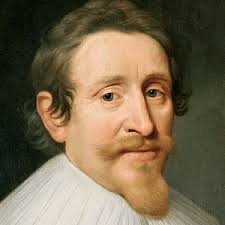
Open Grotius's interactive page (graphs of influences, similar and opposing positions, and quotes)
Background
Hugo Grotius
Born: 10 April 1583 in Delft, Holland, Dutch
Republic
Died: 28 August 1645 (aged 62) in Rostock,
Swedish Pomerania
School: Natural law
Main interests: Philosophy of war, International
law, Political philosophy, Religion, Ethics
Influences: Alberico Gentili, Jean Bodin,
Francisco Suárez, Aristotle, Cicero, Desiderius
Erasmus, Jacobus Arminius, Aquinas
Influenced: Gustav II Adolf, Milton, John Selden,
Hobbes, R. Cumberland, S. Pufendorf, Locke,
Kant, Rousseau, Vico, C. Bynkershoek, Jean
Barbeyrac, Proudhon, Emer de Vattel, C.
Thomasius, Jefferson, Madison, Ben Franklin, A.
Hamilton, John Adams, Gershom Carmichael,
Francis Hutcheson, Hume, Adam Smith, Pierre
Bayle, Spinoza, Thomas Reid, Leibniz
From Wikipedia
Grotius was a Dutch humanist, diplomat, lawyer, theologian, jurist, statesman, poet and playwright. A teenage prodigy, he was born in Delft and stud- ied at Leiden University…. Grotius was a major figure in the fields of philosophy, political theory and law during the 16th and 17th centuries. Along with the earlier works of Francisco de Vitoria and Alberico Gentili, his writings laid the foundations for international law, based on natural law in its Protestant side…. Grotius has also contributed sig- nificantly to the evolution of the notion of rights.
Introductory Comments
Grotius was a leading light of the Remonstrants, the party within Dutch Calvinism that pushed for a gentler reading of predestination. Their guiding spirit, Jacobus Arminius, taught that God's foreknowledge of who would be saved didn't cancel human freedom: we still choose, in the end, whether to accept His grace. Salvation, in other words, remained partly up to us. The Counter-Remonstrants disagreed, and disagreed forcefully. When they won the political fight, the leader of the Remonstrants, Johan van Oldenbarnevelt, lost his head, quite literally, while Grotius was sentenced to life at Loevestein Castle .
Enter his wife, Maria van Reigersberg - one of history's great supporting characters. By 1621 Maria had spent two years charming the guards and had noticed something useful: a large chest, used to ferry Grotius's books in and out of his cell, came and went without much scrutiny. So one day the books came out, and Grotius went in. The guards did remark that the chest seemed awfully heavy for books. Maria, unbothered, assured them it was simply a lot of books he no longer needed - and perhaps a smile went with the explanation. The chest passed. Grotius climbed out, disguised himself as a stonecutter, and slipped away to France, a free man thanks to his wife's nerve. Or to put it in theological terms: The Counter-Remonstrants insisted that a man's fate is settled in advance and beyond his power to alter. Maria van Reigersberg begged to differ.
Some of Grotius's Key Positions
Law and morality rest on natural law: unchanging moral principles built into human nature itself. Scripture confirms these principles, but reason alone can discover them. Yes, God authored nature, but once authored, its moral order stands on its own and binds believer and unbeliever alike. Also, from natural law flow natural rights, affirmed equally by God, nature, and reason.
Natural law condemns murder, yet not all killing is murder. War is justifiable on three grounds: self-defense, recovery of what is rightfully one's own, and punishment of wrongdoing. Even a just war, however, must be waged justly - moderation in means, restraint toward noncombatants. And war must remain a last resort.
The surer path to peace runs through international law. Just as national law preserves order and justice within a state, a law of nations can preserve order and justice among states. It can also secure free trade and free navigation of the seas, which serve the interest of all.
But law is idle unless applied to actual quarrels between nations. Application requires an international society - not a world government towering over its members, but a community of nations. Each nation retains full sovereignty; each nonetheless acknowledges norms and rules binding on all. Herein lies the tension at the heart of the modern international order.
Place in the History of Ideas
Grotius's Place in History of Ideas
John Dalberg-Acton: Upon this foundation [of universal reason] Grotius drew the lines of real political science. In gathering the materials of International law, he had to go beyond national treaties and denominational interests, for a principle embracing all mankind. The principles of law must stand, he said, even if we suppose that there is no God. By [this] he meant that they must be found independently of Revela- tion. From that time it became possible to make politics a matter of principle and of conscience, so that men and nations differing in all other things could live in peace together....
Hedley Bull: The Grotian tradition describes international politics in terms of a society of states.... The Grotians contend that states are not engaged in simple struggle, like gladiators in an arena, but are limited in their conflicts with one another by common rules and institutions. [However,] the Grotians accept the Hobbesian premise that sovereigns or states are the principal reality in international politics [and that] international politics... expresses neither complete conflict of interest between states nor complete identity of interest....
Andrew Dickson White: [Grotius tried to free] civilization from the main cause of all that misery; [he] thought out for Europe the precepts of right reason in international law [and then] made them heard....
Random Thoughts on Grotius
The idea of a human right no longer strikes anyone as strange. Butc onsider what it asks us to believe: that every person arrives in the world holding an invaluable promise, one that cannot be seen, touched, or weighed, yet can be invoked in times of trouble - and, remarkably, sometimes works. Bentham found the notion so groundless that he dismissed natural rights as "nonsense upon stilts." Other skeptics simply asked for the evidence and were handed none. Perhaps it is no surprise, then, that the first thinkers to argue at length for natural rights were neither politicians nor lawyers but theologians. Medieval canonists and Spanish Scholastics such as Vitoria and Suárez tied rights to natural law, and natural law to God. If the Author of nature stands behind them, rights need no further defense - the case is closed before it opens.
Grotius's contribution was to reopen it, and on safer ground. Natural rights, he argued, need not rest on faith alone, for reason can reach them unaided; they belong to human nature as such. We are sociable creatures, drawn to community and to peace, and certain principles of justice follow from that fact - principles binding on every nation, whatever its local customs happen to say. Hence his famous provocation: natural law would hold even if we granted that God does not exist. Not atheism, but insurance. A right that depends on shared theology collapses the moment the theology is disputed, and Grotius had watched Europe dispute it for decades, at musket point.
Influences
Grotius was influenced by: Aquinas, Aristotle, Arminius, J., Bodin, Jean, Cicero, Erasmus, Gentili, A., Suarez
Grotius influenced: Bynkershoek, Franklin, Gustav II Adolf, Hamilton, A., Hobbes, Hume, Hutcheson, Jefferson, Kant, Locke, Madison, Milton, Proudhon, Pufendorf, Rousseau, Selden, John, Spinoza, Vico
Similar and opposing positions
Thinkers with similar positions:
- Agamben (The law is always the best guarantor of human freedom & rights.)
- Aquinas (War is just if fought for a good cause and waged by a proper authority.)
- Bayle (The multiplicity of religions is not the problem, but rather intolerance.)
- Gandhi (All religions should not only be tolerated, but also respected.)
- Locke (God's natural laws must form the basis of our moral and political systems.)
- Proudhon (All forms of absolutisms are evil: government, capitalism & religion.)
Thinkers with opposing positions:
- Bakunin (Law & the state are at times obstacles to freedom & human rights.)
- Fromm (Authoritarianism is never justified. We must hold onto our freedom.)
- Godwin (The goods that benefit us must be regulated by justice alone, not laws.)
- Hart (There is no necessary connection between law and morals.)
- Hobbes (The sovereign is not bound by any higher laws: He makes the laws.)
- Holbach (The foundation of morality is not in Scripture but in happiness.)
- Rawls (It's useful to see govt. as a social contract conceived in a state of nature.)
- Savonarola (Church officials should play a role in the administration of the state.)
- Schmitt (A strong leader must at times be above the law for the general good.)
- Tolstoy (There has never been nor will ever be a just war. All war is evil.)
What others said about Grotius
- Leibniz: ... the incomparable Hugo Grotius.
- Rousseau: When I hear Grotius praised to the skies and Hobbes covered with execration I see how far [men] understand these two authors. The truth is that their principles are exactly the same: they only differ in their expression.
- Hedley Bull: [Grotius argued that] states and the rulers of states in their dealings with one an-other were bound by rules and together formed a society.... Even without central institutions, rules and peoples might constitute a society among themselves, an anarchical society or society without government.
- Cassirer: [Grotius believed] law as such is before and above the state, and it can provide an unshakable foundation for the life of the state only on the basis of its autonomy and independence.
- Charles Evans Hughes: He found the justifiable causes generally assigned for war to be three - defense, indemnity, and punishment.
- Strauss: [For Grotius] men act justly only when they act in conformity with their natural attraction to and desire for society. For example, since to steal... is destructive of all trust, [it] is against the natural order to which man belongs.
- Cassirer: [Grotius believed that] law is not valid because there is a God, nor is it based on any existence whether empirical or absolute. It springs from the pure idea of the good, from the idea which Plato had said surpasses everything in force and age. This transcendence of the idea of law which raises the just and the good above all being... is his real contribution....
- Andrew Dickson White: [Grotius argued] that every attempt to make an ocean highway a monopoly of any single nation is forbidden by the immensity of the sea, its lack of stability, its want of fixed limits.
Schools: Christian Theology, Natural Law Theory
Main interests: Ethics, Free/Unfree Will, International Law, Jurisprudence, Just War, Justice, Law, Literature, Logic, Poetry, Political Philosophy, Political Theory, Politics, Property, Religion, Theatre, Theology
Grotius's answers to philosophical questions
Law
The laws of man should be rooted in God's natural laws, which are made evident through human reason.
God assigned to man "a right to the free enjoyment of personal liberty, reputation, and the control over his own actions."
Secular laws are based on universal reason alone. They do not rest on revelation and do not require God's approval.
Political Philosophy
When people relinquish their sovereignty to a king, they can't later reclaim it if the king has made bad use of his power.
"A state is a perfect body of free men, united together in order to enjoy common rights and advantages."
Just as state law fosters peace and order within the state, so international law fosters peace and order between nations.
Wars are justifiable only when they are fought in self-defense or for reparation of injury or as punishment.
Only basic tenets needed to preserve civil order, such as a belief in God's providence, should be required by the state.
"Liberty is the power that we have over ourselves." Unlike equality, freedom is the both the basis and the fruition of society.
Religion and Theology
Faith is central to Christianity, but we should not create divisions over differences in the smaller details of theology.
Salvation comes through faith alone, but man cannot achieve faith through his own will, unaided by the Holy Spirit.
Society
"Now amongst the things peculiar to man, is his desire of society..., not in any manner whatever, but peaceably…."