Rosselli, P. P. Pasolini, P. Gobetti, E. Laclau, C.
Mouffe, Edward Said, Raymond Williams, N. G.
Canclini, G. Arrighi, A. Callinicos, N. Poulantzas,
Gayatri Spivak, Nick Srnicek, Alex Williams,
Althusser, Judith Butler, Foucault, Cornel West,
John Fiske, H. Henderson, H. Zinn, Antonio Negri
From Wikipedia
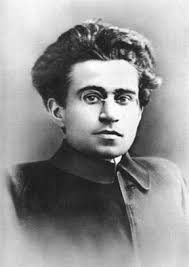
Gramsci was an Italian Marxist philosopher, journalist, linguist, writer, and politician. He wrote on philosophy, political theory, sociology, history, and linguistics.... Gramsci is best known for his theory of cultural hegemony, which describes how the state and ruling capitalist class – the bourgeoisie – use cultural institutions to maintain power in capitalist societies. The bourgeoisie, in Gramsci's view, develops a hegemonic culture using ideology, rather than violence, economic force, or coercion.
Introductory Comments
Marxism, as most socialists understood it around 1900, came with a reassuring timetable. Capitalism would grind workers into ever deeper misery until, like a boiler with its valve rusted shut, the system blew. Law, politics, and culture were mere stage scenery; the real drama lay in the economic "base," between owners and those with only their labor to sell. But the script kept missing its cues. Revolution came in 1917 to Russia, a largely peasant country, and Gramsci, a young Turin journalist, cheekily hailed it as "the revolution against Capital." In the industrial West, uprisings fizzled. Turin's factory occupations collapsed in 1920, and Mussolini marched on Rome two years later. Something was missing, Gramsci concluded, if not from Marx then from the mechanical way his followers read him.
The missing piece was hegemony: a ruling class's knack for making its outlook feel like plain common sense, even to those it exploits. Through schools, newspapers, and churches, bourgeois values seeped into the mental groundwater until workers saw their bosses' interests as their own. Force seldom needed to show itself. The remedy, then, was no single charge at the barricades. Workers would have to win a long contest for hearts and minds and build a worldview compelling enough to become the new common sense. Gramsci worked much of this out in a fascist prison cell. His notebooks' guarded vocabulary, which renders Marxism as "the philosophy of praxis," may have been meant to fool the censor.
Some of Gramsci's Key Positions
Marxism is too often read as economic determinism, as though culture and belief were mere by-products of the economy. History does not run so mechanically. Ideas, institutions, and collective will also shape events, and revolutions must be made, not merely awaited.
A ruling class holds power through "hegemony," a blend of force and consent in which consent does most of the daily work. State coercion stands in reserve, but in the West rule rests chiefly on civil society: schools, churches, newspapers, and voluntary associations.
Because Western states are protected by the dense trenches of civil society, a frontal assault like Russia’s in 1917 is unlikely to succeed there. What is needed instead is a "war of position," a long struggle to build a rival hegemony.
Every class produces its own intellectuals. The working class must develop "organic intellectuals," leaders rooted in its life who can give coherent form to its experience. That requires rigorous, broad schooling, not narrow vocational training.
To lead, the working class must rise above its narrow interests and present its cause as society's, forging alliances, above all with the peasantry. The Catholic Church offers both a rival and a model: it has long held learned and humble believers within a single worldview. Socialism must do the same.
Place in the History of Ideas
Gramsci's Place in History of Ideas
Andrew Heywood: Gramsci saw the capitalist state as being made up of two overlapping spheres, a "political society" (which rules through force) and a "civil society" (which rules through consent). This is a different meaning of civil society from the "associational" view common today, which defines civil society as a "sector" of voluntary organisations and NGOs. Gramsci saw civil society as the public sphere where trade unions and political parties gained concessions from the bourgeois state, and the sphere in which ideas and beliefs were shaped, where bourgeois "hegemony" was reproduced in cultural life through the media, universities and religious institutions to "manufacture consent" and legitimacy.
Mark Dooley: There are two key reasons for Gramsci’s emergence as the high priest of the new cultural order. First, he eschewed scientific or deterministic Marxism, which emphasizes material forces, in favor of a more humanistic approach, which emphasizes ideas and identity. Second, he emphasized the importance of the intellectual in the service of the revolution. On the first point, if traditional Marxism considered the socioeconomic "base" as the driving force of history, Gramsci insisted that the cultural and ideological "superstructure" is equally important. [For socialism to gain real power, it must control the] forces of "cultural produc- tion," ... that a society uses to perpetuate itself.
Random Thoughts on Gramsci
Capitalism, as Gramsci saw it, held workers captive less by chains than by habits of thought, and the way out ran through the classroom. Call it seizing the means of instruction. Workers needed more than vocational training that fitted them for one job and nothing else. They needed to understand their situation historically, to see how the present had been made and so how it might be remade. Only then could they raise intellectuals of their own and build a culture able to present their cause as everyone's. Here, though, the revolutionary springs a surprise. In his prison notebooks, Gramsci defended the old classical school, Latin grammar and all. Its drudgery, he argued, taught the concentration, precision, and stamina that serious thinking demands. The children of the rich had always had that training. The children of workers deserved it too, instead of being shunted early into trade schools.
All of which revives a question that has bedeviled educators since Plato's Academy: what is education for? Should schools hand down a culture's inheritance? Fit students for the jobs the economy offers? Or equip them to question injustice and imagine something better? Perhaps the honest answer is some vexing blend of all three: preserving what is worth keeping, preparing students for the world as it is, and equipping them for a better one. If so, no wonder school board meetings so often devolve into culture wars. The wonder is that they usually don't.
de Beauvoir (Women's oppression is due to the social construction of gender.)
Engels (The working class will lead the revolution against the bourgeoisie.)
Fanon (Overthrowing unjust regimes requires overthrowing their worldviews.)
George, Henry (People should own the value produced through their own labor)
Godwin (The goods that benefit us must be regulated by justice alone, not laws.)
Goldman (Revolution is a violent process, but also at times a necessary one.)
Horkheimer (Cultural, not just economic, forces drive history & shape society.)
Sorel (A moral revival of the country is needed to save it from decadence.)
Zizek (We have absorbed our ideologies so completely we no longer see them.)
Thinkers with opposing positions:
Burke (The idea of the overthrowing government is horrible and dangerous.)
Dostoyevsky (The cure to social ills is not socialism, but a true Christianity.)
Fourier (What's needed to fix social injustice isn't revolution, but cooperation)
Gentile (The state is the source of all authority and the object of all loyalty.)
Hayek (Only free market capitalism is consistent with freedom & democracy.)
Marx (Economic, rather than cultural, forces drive history and shape society.)
Montesquieu (Commerce tends to reduce prejudice and increase freedom.)
What others said about Gramsci
Thomas R. Bates: The basic premise of [his] theory of hegemony is one with which few would disagree: ... man is not ruled by force alone, but also by ideas.
Nicki Lisa Cole: Today, Gramsci is considered a foundational theorist for the sociology of culture, and for articulating the important connections between culture, the state, the economy, and power relations.
Mark Dooley: In Gramsci, the intellectuals had found a socialist saint who absolved Marxism of its Stalinist sins, and who charted the way toward a slow but steady revolution, the outcome of which would be to seize and dominate the so-called “bourgeois” bastions of culture, education, and politics.
Jason A. Smith: His contributions are derived mainly from his "Prison Notebooks" which were written over the course of his eight-year imprisonment under Benito Mussolini’s National Fascist Party.
Bradley Thomas: His advocacy of a war of position instead of a war of movement was not a rebuke of revolution itself, just a differing tactic....
Nicki Lisa Cole: Gramsci viewed the educational institution as one of the fundamental elements of cultural hegemony in modern Western society and elaborated on this in essays titled "The Intellectuals" and "On Education."
Andrew Heywood: The political and practical implications of Gramsci’s ideas were far-reaching because he warned of the limited possibilities of direct revolutionary struggle for control of the means of production; this "war of attack" could only succeed with a prior "war of position" in the form of struggle over ideas and beliefs, to create a new hegemony.
Mark Dooley: The impact of Gramsci’s vision is also evident in politics, most notably in America and Europe, in the form of policies intended to reorder society in line with radical liberal orthodoxy.
Main interests: Alienation, Class Struggle, Cultural Studies, Desire, History, Ideology, Journalism, Labor, Political Activism, Political Philosophy, Political Theory, Politics, Power, Revolution, Social Criticism, Social Theory, War, Will