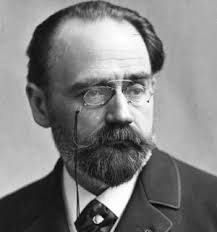
Émile Durkheim (1858 - 1917)
Open Durkheim's interactive page (graphs of influences, similar and opposing positions, and quotes)
Background
David Émile Durkheim
Born: April 15, 1858 in Épinal, Lorraine, France
Died: November 15, 1917 (aged 59) in Paris,
Île-de-France, France
Fields: Philosophy, Sociology, Education,
Anthropology, Religious Studies
Alma mater: École Normale Supérieure
Known for: Institutionalizing sociology,
introducing the sacred–profane dichotomy
Influences: Kant, Descartes, Plato, Herbert
Spencer, Aristotle, Montesquieu, Rousseau,
Comte, James, Dewey, Fustel de Coulanges,
Mill, Renouvier, Monod
Influenced: Marcel Mauss, Lévi-Strauss, Talcott
Parsons, Halbwachs, Lévy-Bruhl, Malinowski,
Braudel, Bourdieu, Charles Taylor, Bergson,
Levinas, Steven Lukes, Radcliffe-Brown, Evans-
Pritchard, Mary Douglas, Fauconnet, Bellah,
Gökalp, Bloor, Randall Collins, Haidt, Adorno
From Wikipedia
Durkheim... established the academic discipline of sociology and is commonly cited as one of the principal architects of modern social science, along with both Karl Marx and Max Weber…. Durkheim's conception of the scientific study of society laid the groundwork for modern sociology, and he used such scientific tools as statistics, surveys, and historical observation in his analysis of suicides in Roman Catholic and Protestant groups…. [He] was preoccupied with the accept- ance of sociology as a legitimate science.
Introductory Comments
Ask why someone did something, and you will usually get a story about motives: she was ambitious, he was heartbroken, they were afraid. Durkheim thought that for a science of society, this was exactly the wrong place to look. His great German contemporary, Max Weber, built sociology on the meanings individuals attach to their actions; the two scarcely acknowledged each other, but they stand as the classic opposite poles of the discipline. For Durkheim, society was a reality sui generis, a thing of its own kind that cannot be reduced to the intentions of its members. His "social facts," the collective ways of thinking, feeling, and acting that every group imposes on those within it, were real forces, not convenient statistical summaries.
His study of suicide put the idea to its hardest test. What act could be more private? Durkheim first set aside the usual psychological suspects (insanity, heredity, etc.) and then turned to the rates themselves. He found them remarkably stable from year to year, and remarkably different from one group to the next: Protestants versus Catholics, the single versus the married, soldiers versus civilians. Something beyond individual despair seemed to be at work. But what exactly? Can social forces really exist on their own, apart from the messy world where different people do different things for different reasons? And if they do, upon whom, or what, do they act? (For a surprising answer to that last question, see Random Thoughts.)
Some of Durkheim's Key Positions
Social life must be studied scientifically, not settled by philosophical speculation or reduced to individual psychology. Language, law, and moral codes exist outside any individual and press upon him from without. Society is a reality in its own right, greater than the sum of its members.
Since sociology cannot run experiments, comparison serves as its laboratory: the investigator tracks how social facts vary together across societies and periods. Even suicide, seemingly the most private of acts, follows stable rates that rise or fall with how tightly a group binds and regulates its members.
A social fact’s cause and its function must be investigated separately. To assume an institution exists simply because it is useful is to confuse the two. And as biology distinguishes health from disease, sociology distinguishes the normal from the pathological. By that standard even crime, found in every society, is normal.
Simple societies cohere through a "collective consciousness," a common body of beliefs and sentiments. Modern societies cohere through difference: the division of labor makes people unlike one another yet mutually dependent. In both simple and modern societies religion divides the world into sacred and profane, and its rituals renew the group’s unity. In worshipping the sacred, a society worships itself in symbolic form.
Place in the History of Ideas
Durkheim's Place in History of Ideas
Henri Peyre: In fact, Durkheim did not make an idol of sociology as did the positivists schooled by Comte, nor was he a "functionalist" who explained every social phenomenon by its usefulness in maintaining the existence and equilibrium of a social organism. He did, however, endeavor to formulate a positive social science that might direct people’s behavior toward greater solidarity. [Moreover,] Durkheim’s influence extended beyond the social sciences. Through him, sociology became a seminal discipline in France that broadened and transformed the study of law, economics..., linguistics, ethnology, art history, and history.
Anthony Gidden: According to Durkheim’s standpoint, the criteria underlying Marx’s hopes for the elimination of technological alienation represent a reversion to moral principles which are no longer appropriate to the modern form of society. This is exactly the problem which Durkheim poses at the opening of The Division of Labor: "Is it our duty to seek to become a thorough and complete human being... or, on the contrary, to be only a part of a whole...?" The analysis contained in the work, in Durkheim’s view, demonstrates conclusively that... the era of the "universal man" is finished. The latter ideal, which predominated up to the seventeenth and eighteenth centuries in western Europe is incompatible with the diversity of the contemporary order.
Random Thoughts on Durkheim
Durkheim’s "collective consciousness," the beliefs and sentiments shared by the members of a society, has made more than one reader nervous. Here is a thinker who wanted sociology to be as hardheaded as physics, and he seems to be summoning a ghost: a group mind floating somewhere above the heads of the group. Critics in his own day said as much. Nor did Durkheim always help himself, since his phrasing could make society sound like a vast thinking creature. Yet he denied that anmything spooky is required. When people come together, something new emerges, just as the hardness of bronze lies in neither the copper nor the tin that compose it. And that new thing leaves tracks everywhere: in legal codes, religious rites, and school curricula, and above all in the outrage a community feels when its rules are broken. Punishment, on this view, is less about deterring criminals than about the collective conscience reaffirming itself.
Which brings us to the question left hanging in the Introduction: upon whom, or what, do these forces act? Durkheim’s answer is upon us, but from the inside. Each person, he argued, is homo duplex, a double being, part individual appetite and part society taken up residence within - like a dybbuk, but better behaved. The pang of conscience that stays your hand, the sense that some things are simply not done: that is society speaking, and it speaks in the first person. The group mind isn’t hovering over our heads at all. It has moved in.
Influences
Durkheim was influenced by: Aristotle, Comte, Coulanges, Descartes, Dewey, James, Kant, Mill, Montesquieu, Plato, Renouvier, Rousseau, Spencer
Durkheim influenced: Adorno, Bergson, Bourdieu, Braudel, Douglas, Mary, Levinas, Levi-Strauss, Levy-Bruhl, Malinowski, Mauss, Marcel, Parsons, Saussure, Taylor, Charles
Similar and opposing positions
Thinkers with similar positions:
- Althusser (Collective consciousness produces a society & holds it together.)
- Barthes (Human consciousness is constrained by culture & its "structures.")
- Dewey (The social environment does much to shape the minds of people.)
- Lukács (Our social existence determines or shapes our consciousness.)
- Machiavelli (The study of society should be empirical. We need facts, not ideals.)
- Mead (Mind arises out of and relies on the social act of communication.)
- Spencer (Society is a living organism and its parts serve various functions.)
- Weber (In sociology there's no purely objective analysis & no universal laws.)
Thinkers with opposing positions:
- Berlin (Human sciences differ in both standards & goals from natural sciences.)
- Dilthey (Natural sciences observe and explain. Human sciences understand.)
- Goodman (There's no sharp divisions between art, science & normal experience)
- Hamann (Scientific reason leads to doubts about the reality of the world.)
- Kant (Categories of space & time are a priori. They precede all experience.)
- Marcel (Science & technology threaten to destroy the mystery of being.)
- Marx (The comfort of religion is illusory & keeps the masses quietly enchained.)
- Vico (Human sciences require different methods from the natural sciences.)
What others said about Durkheim
- Melissa Hurst: According to [Durkheim], society functions based on the division of labor and the equilibrium of social hierarchies.
- Paul Carls: Durkheim was one of the first thinkers in the Western tradition to examine how an individual’s social milieu affects the way that individual perceives the world.
- Zygmunt Bauman: Émile Durkheim… strove to insert and settle "society" in the place vacated by God and by Nature viewed as God’s creation or embodiment - and thereby to claim for the nascent nation-state that right to articulate, pronounce and enforce moral commandments and command the supreme loyalties of its subjects....
- Fromm: He states that in modern industrial society the individual and the group have ceased to function satisfactorily; that they live in a condition of "anomie," that is, a lack of meaningful and structuralized social life....
- Paul Carls: According to Durkheim, all elements of society, including morality and religion, are part of the natural world and can be studied scientifically.
- Frank W. Elwell: [Durkheim argued that as] society becomes more complex, individuals play more specialized roles and become ever more dissimilar in their social experiences, material interests, values, and beliefs.
- Fromm: Durkheim points out that only the political state survived the French Revolution as a solitary factor of collectivization. As a result, a genuine social order has disappeared, the state emerging as the only collective organizing activity of the social character. The individual, free from all genuine social bonds, finds himself abandoned, isolated, and demoralized.
- Henri Peyre: [Durkheim] becamed concerned with education and religion as the two most potent means of reforming humanity or of molding the new institutions required by the deep structural changes in society.
Schools: Communitarianism, Holism, Positivism, Social Liberalism, Structuralism
Main interests: Alienation, Anthropology, Community, Education, Habits, Ideology, Industrialism, Justice, Power, Psychology, Punishment, Religion, Social Philosophy, Social Theory, War
Durkheim's answers to philosophical questions
Economics
The effects of economic interdependence & division of labor can at times overwhelm or destroy personal ties & traditions.
Epistemology
The major categories of thought, such as space & time, are in large part the products of the collective life of a given society.
The major categories of thought are not innate, nor are they formed by the individual. Rather, they are formed by society.
Ethics
Since moral beliefs spring from the culture and life of a given society, it follows that morality is relative to that society.
'Wherever there are societies, there is altruism, because there is solidarity."
If excessive, the "authority which the moral conscience enjoys [may] too easily congeal into an immutable form."
Language
Language, as a product of the collective life of a society, shapes and colors the experience of individuals within that society.
Since language is the product of the collective life of a society, it's natural that language will in turn help maintain a society.
Law
"When mores are sufficient, laws are unnecessary. When mores are insufficient, laws are unenforceable."
The modern preoccupation with the individual and his rights has replaced religion as the force holding society together.
Metaphysics
The category of space is neither absolute nor a priori: It springs from and depends on a society's geographical use of space.
Psychology
The self is not an isolated ego, but part of a large web of social, historical & economic relations that shape its views & actions.
Religion and Theology
Religion is our most fundamental social institution. It was the first to give rise to a strong sense of collective consciousness.
Religion is not only a moral belief system and at times a type of solace, it's also a source of camaraderie and social solidarity.
Religion is the primary source of moral authority, since it is the most powerful means of making morality seem legitimate.
There's "something eternal in religion which [will] survive all the particular symbols in which religious thought [clothes] itself."
Society
"Because the individual is not sufficient unto himself, it is from society that he receives everything necessary to him...."
We should stop philosophizing about social institutions & instead study them in the new scientific discipline called sociology.
A collective consciousness transcends all social institutions & holds society together through shared norms, beliefs & values.