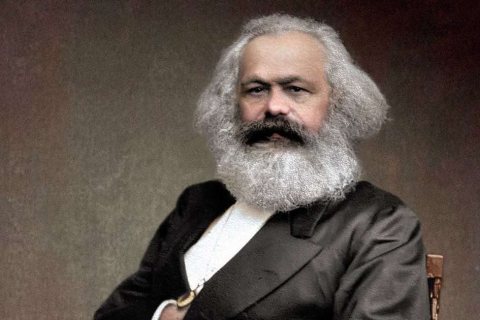
Marx was a German philosopher, political theorist, economist, journalist, and revolutionary socialist. He is best-known for the 1848 pamphlet The Communist Manifesto (written with Friedrich Engels), and his three-volume Das Kapital (1867–1894), a critique of classical political economy which employs his theory of historical materialism in an analysis of capitalism, in the culmination of his life's work. Marx's ideas and their subsequent development, collectively known as Marxism, have had enormous influence.
Introductory Comments
Marx took from Hegel the idea that history moves dialectically: opposing forces collide, and something new emerges from the wreckage. Few historians now believe history runs on so tidy a schedule. Yet Marx's own life fits the pattern suspiciously well. He was a man perpetually at war with himself. He was brilliant and utopian, warm and vindictive, charismatic and irresponsible, a loving father and an impossible colleague. Admirers saw a leader who ruined his health in the service of the working class. Detractors saw an unkempt bohemian who drank and smoked too much and left his wife, Jenny, and their children to years of hardship. The hardship was real. In the 1850s the family crowded into two rooms in London's Soho, pawned what they owned, and buried three of their children.
With Friedrich Engels, however, Marx became another man entirely. The letters show two overgrown schoolboys trading gossip, insults, and off-color jokes in a cheerful jumble of German, English, and French. When the two were together, the talk ran long and the beer ran freely. Engels called his friend "the Moor," a teasing nod to Marx's swarthy complexion. Marx called Engels "the General," in honor of his passion for military history. The friendship had its practical side, too. For nearly 20 years Engels worked in his family's Manchester cotton firm and sent Marx money. In other words, the critique of capitalism was bankrolled, in part, by a capitalist.
Some of Marx's Key Positions
Hegel was right that history moves dialectically: conflicts between opposing forces generate something new, which in turn generates new conflicts. He was also right that this movement has a direction, toward human freedom.
But Hegel had the dialectic standing on its head. The engine of history is not Spirit, but material life: how people produce what they need to survive, and who owns the means of producing it. Every economic system divides society into classes, and "the history of all hitherto existing society is the history of class struggles."
Capitalism is the most productive economic system yet devised, and also the most self-undermining. Workers are paid less than the value their labor creates, and capitalists keep the difference, called surplus value, as profit. Competition forces capitalists to cut costs, replace workers with machines, and concentrate wealth in fewer hands. Workers, meanwhile, grow more numerous, more exploited, and more alienated.
Eventually the workers, organized and conscious of their shared interests, overthrow the capitalists. A "dictatorship of the proletariat," meaning rule by the working class, follows. But this is a means, not the goal. The goal is communism: a classless society with no need for a state to enforce class rule, whose guiding principle is "from each according to his ability, to each according to his needs."
Place in the History of Ideas
Marx's Place in History of Ideas
Robert C. Solomon: … Marx concerned himself with the neglected people who made industry work and who suffered most from the "supply and demand" mechanisms of the market. The worker made prosperity possible, but he or she continued to live in wretched poverty, often working sixteen-hour days in dangerous, dirty, inhuman conditions. The plight of the worker had been examined by other economists such as Jean Baptiste Say and David Ricardo, who had argued that such wretchedness followed from - and would not be corrected by - the capitalistic economic system. What Marx added to their... studies was a sense of moral outrage.
Francis Fukuyama: It is of course not sufficient to appeal to the authority of Marx, Hegel, or any of their contemporary followers to estab- lish the validity of the direction of History. In the century and a half since they wrote, their intellectual legacy has been relentlessly assaulted from all directions. The most profound thinkers of the twentieth century have directly attacked the idea that history is a coherent of intelligible process; indeed, they have denied the possibility that any aspect of human life is philosophically intelligible.
Galbraith: If we agree that the Bible is a work of collective authorship, only Mohammed rivals Marx in the number of professed and devoted followers recruited by a single author.
Random Thoughts on Marx
Consider the irony. Marx argued that history is driven not by ideas but by the hard realities of economics. Yet for many he is the prime example of ideas driving history. And the irony comes doubled. Marx's enormous influence on the 20th century not only belies his own argument; it also undercuts his attack on Hegel. Hegel held that history is the unfolding of Spirit, meaning mind or reason working itself out over time. As a student, the young Marx had been an ardent Hegelian. The older Marx climbed into the ring against his old master and insisted that the forces at work in history are material, not mental, and economic above all. Marx did add, oddly enough, that theory becomes a material force once it seizes the masses. But this claim itself concedes the point: if ideas need to "seize" people before they can move history, then ideas - not just economic conditions - are doing real work.
The deeper problem, though, as Karl Popper later argued, is that Marxism, like Hegel's system, showed more of the post hoc inventiveness of the pundit than the "pre hoc" predictiveness of the scientist. Marx expected communist revolution to break out first in the most industrialized nations, such as England. It broke out instead in some of the least industrialized: Russia in 1917, China in 1949. That adds yet another layer of irony. The belief in Marx's ideas proved far more consequential than their truth. Then again, the same could be said of the entire history of ideas.
Althusser (Economic, ideological & politico-legal practices all interconnect.)
Engels (From each according to his ability, to each according to his needs.)
Engels (The working class will lead the revolution against the bourgeoisie.)
Gramsci (Often the ruling class imposes its worldview on the entire culture.)
Ricardo (The economic value of a good is based on the work that went into it.)
Veblen (The leisure class is addicted to wasteful and conspicuous consumption.)
Thinkers with opposing positions:
Adorno (Though capitalism is oppressive, it is also robust and adaptable.)
Bakunin (A communist vested with absolute power would soon become a tyrant.)
Berlin (Humans should never be sacrificed on an altar of glorious abstractions)
Burke (Laws of commerce are laws of Nature & therefore the laws of God.)
Dostoyevsky (The cure to social ills is not socialism, but a true Christianity.)
Fourier (What's needed to fix social injustice isn't revolution, but cooperation)
Hayek (The common interest requires everyone seek economic self-interest.)
Hegel (History follows the dictates of reason and the dialectics of ideas.)
Herzen (Revolutions often end up just replacing one dictatorship with another.)
Weber (Cultural, not just economic, forces drive history and shape society.)
What others said about Marx
Che Guevara: [Marx] expresses a revolutionary concept: the world must not only be interpreted, it must be transformed.
Benjamin: The class struggle, which is always present to a historian influenced by Marx, is a fight for the crude and material things without which no refined and spiritual things could exist.
Russell: His belief that there is a cosmic force called Dialectical Materialism which governs human history independently of human volitions, is mere mythology. His theoretical errors, however, would not have mattered so much but for the fact that... his chief desire was to see his enemies punished, and he cared little what happened to his friends in the process.
Jacques Barzun: ... the prejudice of equality was in his very fiber, joined to the ambition and jealousy of power, which made him ready to destroy the present moral order in the name of a higher which he saw.
Galbraith: Marx profoundly affected those who did not accept his system. His influence extended to those who least supposed they were subject to it.
Bakunin: As far as learning was concerned, Marx was, and still is, incomparably more advanced than I.... He called me a sentimental idealist and he was right; I called him a vain man, perfidious and crafty, and I also was right.
King: Moreover, Marx had revealed the danger of the profit motive as the sole basis of an economic system: capitalism is always in danger of inspiring men to be more concerned about making a living than making a life. We are prone to judge success by the index of our salaries..., rather than by the quality of our service and relationship to humanity....
Weil: Marxism is undoubtedly a religion, in the lowest sense of the word. Like every inferior form of religious life, it has been continuously used, to borrow the apt phrase of Marx himself, as an opiate for the people.
Main interests: Alienation, Causality, Class Struggle, Commerce, Democracy, Desire, Economics, Environment/Conservation, Equality, Free/Unfree Will, Freedom, Freedom of the press, Government, Habits, History, Ideology, Industrialism, Jurisprudence, Justice, Labor, Law, Political Activism, Political Philosophy, Political Theory, Politics, Power, Progress, Property, Public Administration, Punishment, Religion, Revolution, Social Criticism, Social Philosophy, Social Theory, Technology, Wealth