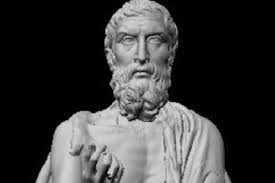
Epicurus (341 BC - 270 BC)
Open Epicurus's interactive page (graphs of influences, similar and opposing positions, and quotes)
Background
Epicurus
Born: February 341 BC in Samos (an Aegean
island that was an Athenian settlement)
Died: 270 BC in Athens, Greece
School: Epicureanism
Main interests: Atomism, materialism, ethics,
psychology, metaphysics, science, justice,
epistemology
Notable ideas: 'Moving' pleasures and 'static'
pleasures, swerving atoms explain free will
Influences: Democritus, Pyrrho, Aristippus,
Nausiphanes, Aristotle, Plato
Influenced: Seneca, Hermarchus, Lucretius,
Hobbes, Kant, Schopenhauer, Bentham, Mill,
Jefferson, Karl Marx, Michel Onfray, Hadrian,
Metrodorus of Lampsacus (the younger), Hume,
Philodemus, Amafinius, Catius, Foucault, Pierre
Gassendi, Han Ryner, Marcus Aurelius, Spinoza,
Locke
From Wikipedia
Epicurus was an ancient Greek philosopher and sage who founded Epicureanism, a highly influential school of philosophy…. Epicurus asserted that philosophy's purpose is to attain... happy (eudaimonic), tranquil lives characterized by ataraxia (peace and freedom from fear) and aponia (the absence of pain). He advocated that people were best able to pursue philosophy by living a self-sufficient life surrounded by friends. He taught that the root of all human neurosis is [the false assumption] that death will be horrific….
Introductory Comments
Like Plato and Aristotle, Epicurus founded his own school - called "the Garden." Picture a lush plot of fruit trees and vegetable beds, robed figures drifting along the paths and pausing to talk of science, art, or free will. Somewhere a lyre sounds. A sea breeze drifts in off the Mediterranean. All around is the beauty of nature and the easy fellowship of friends.
Idyllic, right? William James might have disagreed. In 1896 he spent a week at the Chautauqua Assembly, a genteel retreat in rural New York devoted to learning and culture. He attended the lectures, strolled the trails, took in the concerts, and soaked up what he called the "sweetness and security" filling the air. He loved every minute of it. And yet, on the train home, James caught himself feeling something he hadn't expected: relief. Pure relief to be rid of all that wholesome, well-organized contentment.
And his uneasiness points to something stubborn in us. We say we want serenity, yet a life of nothing but approved pleasures can start to feel airless. We seem to need friction - obstacles to push against, temptations to resist, the odd disaster to survive - as if struggle were not the enemy of a meaningful life but a condition of it. A world scrubbed clean of struggle turns out to be a world with nothing much at stake, and a life with nothing at stake is one we can admire from a distance but can rarely bear to live.
Some of Epicurus's Key Positions
Philosophy is not an end in itself but a means to a happy life - a life marked by ataraxia (freedom from fear and mental disturbance) and aponia (freedom from bodily pain). The goal, in short, is tranquility.
Such a life turns away from the restless chase after wealth, power, and glory. It aims instead at self-sufficiency, finding its pleasures in simple things: a modest meal, and above all the company of friends.
Two great fears stand in the way, and both must be cleared. The first is the fear of death. But death is nothing to us. Body and soul alike are made of atoms that scatter when we die, so there is no one left to suffer and no afterlife to dread.
The second obstacle is superstition - belief in meddling gods and unfounded tales. Against these we should trust the evidence of the senses, our only reliable guide to the world as it actually is.
On the nature of that world, Democritus was right: everything reduces to tiny atoms moving and colliding in the void. But we must add a crucial twist. Now and then an atom swerves - a small, uncaused deviation from its path. These swerves matter, for they loosen the grip of strict determinism and leave room for free will, without which we could not be held responsible for the choices that shape our lives.
Place in the History of Ideas
Epicurus's Place in History of Ideas
Archibald Alexander: While the Stoics held that a supreme rational purpose governed the world, the Epicureans sought to exclude from their explanation of nature everything that would suggest government.... While Stoicism was pantheistic in its conception of the universe, Epicureanism was individualistic; and while the former had a certain religious... aspect, the latter in its whole nature is anti-religious, conceiving the task of science to be the emancipation of the wise man from the phantoms of superstition which arise from fear and ignorance. At the same time, Epicurus and his followers did not deny the existence of the gods, but they held that they have nothing to do with... the affairs of men. The Stoic belief in Providence [was] to them but a refined illusion.
Seneca: You Epicureans take pleasure in making a study of dull torpidity, in seeking for a repose which differs little from sound sleep..., in amusing with the feeblest possible trains of thought that sluggish condition of your languid minds which you term tranquil contemplation, and in stuffing with food and drink... your bodies which are pallid with want of exercise; we Stoics, on the other hand, take pleasure in bestowing benefits, even though they cost us labor, provided that they lighten the labors of others; though they lead us into danger, provided that they save others... [and] alleviate the poverty and distresses of others.
Random Thoughts on Epicurus
Though Epicurus equated happiness with pleasure, the exact connection between the two turns out to be tricky. Not just any pleasure will do. Only the tranquil ones - flavorful food, a comfortable home, good friends, the occasional trip - lead to lasting happiness. More intense pleasures - whether the pursuit of wealth, power, fame, or sensual indulgence - are often poor investments. They breed too many cravings and complications to leave room for the peace of mind on which a happy life is built.
So the link between pleasure and happiness is not a matter of simple addition - as if more pleasures automatically meant more happiness. Happiness seems to require something else: a calm, clear-eyed assessment of one's life as a whole. (At least that's one way to read Epicurus.) One could push the idea further and say happiness is that assessment - a kind of meta-pleasure, springing from a favorable review of life in general, its ups and downs, its pleasures and pains, all calmly weighed. Happiness, on this reading, is not the sum of one's pleasures but a summing up of one's life.
Naturally, the thrill-seeker will be unimpressed. Why trade away a whole catalog of high-voltage pleasures just to secure the calm needed for one mild meta-pleasure? To which the Epicurean might reply that this "one" pleasure is the only one that colors all the rest - the difference between a life enjoyed and a life merely sampled.
Influences
Epicurus was influenced by: Aristippus, Aristotle, Democritus, Nausiphanes, Plato, Pyrrho
Epicurus influenced: Aurelius, Bentham, Erasmus, Foucault, Gassendi, Hadrian, Hobbes, Hume, Jefferson, Kant, Locke, Lucretius, Marx, Mill, Onfray, Philodemus, Schopenhauer, Seneca, Sextus Empiri., Spinoza
Similar and opposing positions
Thinkers with similar positions:
- Bacon, Francis (Knowledge springs from carefully observing the actual world.)
- Bergson (Freedom is a fundamental component within life and duration.)
- Democritus (Contentment is gained thru moderation and living a measured life.)
- Harris (It's almost certain that spirit or consciousness ends at death.)
- Hobbes (Our ultimate motive is always to experience pleasure and avoid pain.)
- Leucippus (Everything is composed entirely of various imperishable atoms.)
- Lucretius (Philosophy aims at liberating man from the fear of death & the gods.)
- Lucretius (True happiness springs from modest desires and simple pleasures.)
Thinkers with opposing positions:
- Al-Farabi (Humans stand between two worlds - the earthly and the heavenly.)
- Augustine (Spirit or consciousness lives on after death.)
- Bataille (Violence & erotic excess can be liberating & sacramental experiences.)
- Chrysippus (Free will springs from our participation in the deterministic world.)
- Einstein (Causality is universal. God does not play dice with the universe.)
- Heidegger (Acknowledging one's mortality is a source of anxiety & authenticity.)
- Pinker (Uncaused or random events do not support the concept of free will.)
- Schopenhauer (Since desire leads to suffering, self-denial is our best path.)
What others said about Epicurus
- Nietzsche: A little garden, figs, little cheeses and in addition three or four good friends - these were the sensual pleasures of Epicurus.
- Lucretius: So the vital strength of [Epicurus's] spirit won through, and he made his way far outside the flaming walls of the world and ranged over the measureless whole, both in mind and spirit.
- Epictetus: [When Epicurus argues] that the good ought to be in the flesh, again the explanation becomes lengthy.... But take your own case, Epicurus: what more masterful faculty do you yourself possess? What is that thing within you which takes counsel, which examines into all things..., which after examining the flesh itself, decides that it is the principal matter?
- Nietzsche: The Epicurean man uses his higher learning to make himself independent from dominant opinions.... [He] walks so to speak by the side of windless paths... while over him, in the wind, the tops of the trees rustle....
- Augustine: [Epicurus had a] dream of innumerable worlds formed and destroyed by the fortuitous movements of atoms....
- Seneca: I myself believe, though my Stoic comrades would be unwilling to hear me say so, that the teaching of Epicurus was upright and holy, and even, if you examine it narrowly, stern....
- Jefferson: And I wish I could subjoin a translation of Gassendi's Syntagma of the doctrines of Epicurus, which, notwithstanding the calumnies of the Stoics and caricatures of Cicero, is the most rational system remaining of the philosophy of the ancients, as frugal of vicious indulgence, and fruitful of virtue as the hyperbolical extravagances of his rival sects.
- Cicero: Epicurus saw that if the atoms travelled downwards by their own weight, we should have no freedom of the will. He therefore... said that the atom while travelling [sometimes] makes a very slight swerve to one side.
Schools: Atomism, Deontological Ethics, Epicureanism, Ethical Hedonism, Physicalism
Main interests: Death, Desire, Epistemology, Ethics, Free/Unfree Will, Friendship, Happiness, Justice, Metaphysics, Perception, Physics, Psychology, Science, Virtue, Will, Wisdom
Epicurus's answers to philosophical questions
Economics
Greed for possessions does not lead to a rich life: "Not what we have, but what we enjoy, constitutes our abundance."
"Wealth beyond what is natural, is no more use than an overflowing container. Real value is... generated by… philosophy."
Epistemology
Complete skepticism is completely unwarranted. We can rely on our senses to gain real knowledge of the world.
Ethics
Though our actions properly reflect our self-interest, moderation and amiability prevent excesses.
A prudent pursuit of pleasure, such as friendship, and an avoidance of pain form the ultimate Good.
Though the value of friendships rests in the pleasures they provide, true friends behave generously towards one another.
"Death does not concern us, because as long as we exist, death is not here. And when it does come, we no longer exist."
The only thing that is intrinsically valuable is pleasure. Other things are incidentally valuable insofar as they give us pleasure.
Physical pleasure is a good thing when pursued in moderation. When not, it undermines a person both physically & morally.
Law
"There is no such thing as justice in the abstract; [laws are] merely [compacts] between men."
Justice is not only an agreement “neither to harm nor be harmed,” it is also “what is useful in mutual associations.”
Metaphysics
Platonic Forms do not exist. All that exists are atoms and the empty space through which atoms move.
The occasional uncaused swerves of atoms allow for free will in an otherwise deterministic universe.
The mind and the body affect on another, because both are entirely physical. In fact, the mind is an organ of the body.
"I was not, I was, I am not, I care not."
Mind
The mind is an organ of the body, & is made up entirely of atoms. However, the atoms of the mind are finer than other atoms.
The mind is a bodily organ, but it is not the brain. Instead, the mind resides in the chest.
Philosophy
"[T]here is no use in philosophy, unless it casts out the suffering of the soul."
Philosophy is a way of living - one that places tranquility over ambition and self-sufficiency over the pursuit of wealth.
Philosophy can lead us to a contented and tranquil life - a life free of fear, pain and other mental disturbances.
Psychology
"Be moderate in order to taste the joys of life in abundance."
The happy life is a self-sufficient one, full of simple and moderate pleasures like food and the company of friends.
Religion and Theology
The gods are exalted & happy beings, who don't allow anything to trouble their tranquility. Thus, they have no concern for us.
Though the gods exist, we are not protected by their loving care. If we were, we would not see so much suffering in the world.
Death is the end of what we call soul. Nothing of us remains after death.
Since the gods do not concern themselves with men nor interfere with the affairs of men, there's no reason to worship them.
Science
The pursuit of science has no practical value. Only the prudent pursuit of pleasure matters.