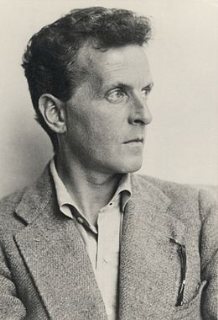
Wittgenstein… worked primarily in logic, the philosophy of mathematics, the philosophy of mind, and the philosophy of language.... His philosophy is often divided into an early period, exemplified by the Tractatus, and a later period, articulated primarily in the Philosophical Investi- gations. The "early Wittgenstein" was concerned with the logical relationship between propositions and the world…. The "later Wittgenstein" [argued] that the meaning of words is best understood as their use within a given language game.
Introductory Comments
Few philosophers write one revolutionary book. Wittgenstein wrote two, and the second spends much of its energy taking apart the first. Having worked with and soon moved past Bertrand Russell at Cambridge, he set out in the Tractatus (1921) to explain how language hooks onto the world. His answer was crystalline. A meaningful proposition pictures a possible fact, sharing its logical structure as a map shares the layout of a terrain. Whatever cannot be pictured (ethics, aesthetics, the meaning of life) cannot be said, and the book ends by commanding silence about it. The logical positivists of the Vienna Circle read this as dismissal, but for Wittgenstein what lay beyond words mattered most. He even pronounced his own propositions nonsense, a ladder to be kicked away once climbed.
Convinced he had solved philosophy's problems, Wittgenstein left the field to teach in village schools in rural Austria. Back at Cambridge from 1929, he began dismantling his own edifice. The Philosophical Investigations, published after his death, studies language not in the clean room of formal logic but in the wild, in workshops, marketplaces, and kitchens where words are tools for getting things done. Philosophy, he now held, builds no systems. It dissolves the confusions that arise when we misread how our words work. If the early Wittgenstein was an architect drafting blueprints, the later one was a plumber clearing philosophical drains that have backed up.
Some of Wittgenstein's Key Positions
Many philosophical problems are not real problems at all but confusions produced by language. "Philosophical problems arise when language goes on holiday": words get lifted out of the everyday settings where they do honest work and pressed into abstract service. Philosophy's task is not to answer such questions but to dissolve them by recalling how the words are actually used.
Words are tools, not labels. For a large class of cases, the meaning of a word is its use in the language. Assuming every word must name some object is often the first wrong step.
Speaking a language is part of an activity, or of a "form of life." Giving orders, describing, joking, and praying are each "language games," with their own rules and purposes. Words used in these different language games share no single essence, only overlapping "family resemblances."
In the simplest such game, builder A calls out "block" "pillar," "slab," or "beam," and assistant B brings the stone he has learned to bring at that call. To understand "Slab!" is to know what to do when you hear it. Most language games are far more tangled than that, but all of them are rule-governed practices embedded in human life. The trouble starts when philosophers borrow this everyday vocabulary and try to force it to answer questions it was never built to handle - at which point they become "bewitched" by language.
Place in the History of Ideas
Wittgenstein's Place in History of Ideas
John Searle: The philosophical tradition that goes from Descartes to Husserl... involves a search for foundations: metaphysically certain foundations of knowledge, foundations of language and meaning, foundations of mathe- matics, foundations of morality, etc. [...] Now, in the twentieth century, mostly under the influence of Wittgenstein and Heidegger, we have come to believe that this general search for these sorts of foundations is misguided.
Bertrand Russell: The earlier Wittgenstein, whom I knew intimately, was a man addicted to passionately intense thinking, profoundly aware of difficult problems of which I, like him, felt the importance, and possessed (or at least so I thought) of true philosophical genius. The later Wittgenstein, on the contrary, seems to have grown tired of serious thinking and to have invented a doctrine which would make such an activity unnecessary.
Bryan Magee: Since the later philosophy of Wittgenstein not only is not about philosophi- cal problems in any traditional sense but denies their authentic existence, it is capable of appealing powerfully only to people who do not have philosophical problems. This explains two things about it that might otherwise be difficult to account for simultaneously: its great appeal to academic philosophers and its attraction to people outside philosophy.
Random Thoughts on Wittgenstein
A central insight of the later Wittgenstein is the concept of "language games": words derive their meaning not from picturing reality but from their role in specific human activities, or "forms of life." Just as the word "checkmate" makes sense only within the practice of chess, our words gain their sense from the contexts, customs, and purposes they serve. But this hardly reduces language to mere utility. Language games are as varied as human life itself, from giving orders and telling jokes to thanking, cursing, and praying. Some get practical work done; others express what matters most to us. Indeed, they can give voice to our most precious religious beliefs: the rituals of prayer, the vocabulary of grace, the language of spirit.
This making room for spiritual expression may be the deepest continuity between Wittgenstein's early and later philosophies (see Introductory Comments). Both the austere logician and the later theorist of language games wanted to shield religious life from the imperious claws of scientific reason, which would judge faith as if it were a failed hypothesis. The difference lies in how they did it. The early Wittgenstein declared, "Whereof one cannot speak, thereof one must be silent." Had he cared to revise those words, the later Wittgenstein might have said, "Whereof science cannot speak, thereof religion has its voice." The later man was willing to make room for the actual language of religion, even when that language reaches toward what cannot finally be said.
Agamben ("Forms of life" can be traced genealogically by studying language.)
Austin, J.L. (Words not only assert things, but also do or perform things.)
Bacon, Francis (Much confusion springs from the enchantment of language.)
Berlin (There is no single criterion of meaningfulness. No absolute certainty.)
Brandom (We adopt different vocabularies to different contexts & problems.)
Carnap (Many philosophical questions abuse language and are meaningless.)
Feyerabend (The glorification of science undermines other meaningful pursuits.)
Goethe (Science and philosophy cannot unravel all the mysteries of the world.)
Nagel (As limited creatures, we will never achieve a unified worldview.)
Rorty (Language can't represent reality by "holding a mirror up to nature.")
Thinkers with opposing positions:
Collingwood (Methods of the humanities are not like those of science.)
Derrida (It's fruitless to ground meaning on links betweeen text and the world.)
Frege (Concepts must objectively exist independent of their instantiations.)
Hamann (Language does not spring from reason. Reason springs from language.)
Russell (Language is ultimately dependent upon a layer of atomic facts.)
Strawson (Ordinary language analysis can shed light on metaphysical issues.)
What others said about Wittgenstein
Russell: [He was] perhaps the most perfect example I have ever known of genius as traditionally conceived; passionate, profound, intense & dominating.
Alice Crary: [We should understand] Wittgenstein as aspiring, not to advance metaphysical theories, but rather to help us work ourselves out of confusions we become entangled in when philosophizing.
Carnap: [Wittgenstein's] intellect, working with great intensity and penetrating power, had recognized that many statements in the field of religion and metaphysics did not, strictly speaking, say anything…. But this result was extremely painful for him emotionally, as if he were compelled to admit a weakness in a beloved person.
E. Skidelsky: Like Kant, he found it necessary to deny knowledge in order to make room for faith. His semantic innovations were ultimately at the service of his mysticism; they aimed at preserving the integrity of the unsayable.
Dennett: Here is a model of thinking so intense, so pure, so self-critical that even its mistakes are gifts.
Carnap: His... attitude toward people and problems, even theoretical problems, were much more similar to those of a creative artist than to those of a scientist; one might almost say, similar to those of a religious prophet....
Ayer: Whereas [the earlier] Wittgenstein previously searched for the general form of propositions, something that he called the essence of language, [in his later writings he] wants to say there is no such thing. His language-games have no one thing in common. If they are brought under the same heading it is because they are related to one another in various ways.
G. H. von Wright: He was of the opinion... that his ideas were generally misunderstood and distorted even by those who professed to be his disciples. He doubted he would be better understood in the future.
Schools: Analytic Philosophy, Antireductionism, Behaviorism, Common Sense Realism, Fideism, Holism, Linguistic Philosophy
philosophy, Logical Atomism, Logical Positivism, Ordinary Language Philosophy, Pluralism, Post-analytic Philosophy, Pyrrhonism, Quietism, Skepticism