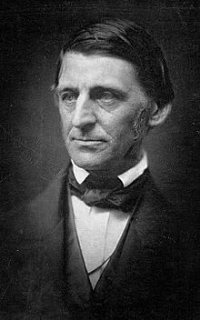
Emerson was an American essayist, lecturer, philosopher, minister, abolitionist, and poet who led the Transcendentalist movement of the mid-19th century. He was seen as a champion of individualism and critical thinking, as well as a prescient critic of the countervailing pressures of society and conformity. Friedrich Nietzsche thought he was "the most gifted of the Ameri- cans," and Walt Whitman called Emerson his "master." … Emerson wrote on a number of sub- jects, never espousing fixed philosophical tenets.
Introductory Comments
Picture mid-19th-century Concord, Massachusetts: Emerson, Thoreau, Hawthorne, the two Alcotts, Sanborn, and a steady traffic of visiting friends, all of them within an easy walk of one another. Writers breaking bread and trading thoughts - by the fireplace, at the post office, on the road out to the millpond, wherever they happened to meet. It sounds idyllic, a transcendental Camelot tucked into the New England woods. A century and a half of admiring biography has done nothing to discourage the picture.
The reality was knottier. Proximity is not the same as harmony, and Concord was a small village stocked with outsized personalities. Emerson and Thoreau, the closest pair, wore on each other: Thoreau chafed at his mentor's air of gentle condescension, while Emerson came to find him prickly, and contrary by reflex. Hawthorne, who never quite joined the others, took his revenge in print - in "The Celestial Railroad." Bronson Alcott struck many of his neighbors as a lofty dreamer with no head for practical life, an assessment his daughter Louisa shared. Concord, despite the name, was not all concord. The most poignant word on the subject came from Concord'a main draw, Emerson himself, and he wrote it early, in 1841, before most of the disappointments had arrived: "All association must be a compromise, and, what is worst, the very flower and aroma of the flower of each of the beautiful natures disappears as they approach each other."
Some of Emerson's Key Positions
Each person must look inward for the truth that is his or her own. We must not give into conformity, nor the "foolish consistency" that chains a mind to an opinion merely because it held that opinion yesterday. Trust the promptings of your own nature; be true to your own self.
The same holds for the maker of things. Every poet, painter, or creator must discover his unique gift - what he alone has to say, and how he alone can say it. Imitation serves well enough as an apprenticeship, but it must be dropped before the genius that resides in the individual can emerge.
What is true of persons is true of peoples. Each nation or culture needs a healthy self-respect; each must stand erect and speak its own truth in its own way. America has looked to Europe too long for its models and measures, especially in literary matters. Americans must find their own voice.
Yet self-trust does not end in mere idiosyncrasy - and here the apparent paradox dissolves. Though no two of us are alike, the soul within each resonates to the same higher truths, which is precisely why self-trust is safe: what proves true in one's own private heart proves true for all. The chief of these truths is that Nature, in all its myriad parts, reveals the Over-Soul - the one universal soul in which every particular being participates, and which lends spiritual significance to everything we see, from the grass below to the sun above.
Place in the History of Ideas
Emerson's Place in History of Ideas
Vince Brewton: Emerson remained throughout his lifetime the champion of the individual and a believer in the primacy of the individual’s experience. In the individual can be discovered all truths, all experience. For the individual, the religious experience must be direct and unmedi- ated by texts, traditions, or personality. Central to defining Emerson’s contribution to American thought is his emphasis on non-conformity that had so profound an effect on Thoreau. Self-reliance and independence of thought are fundamental to Emerson’s perspective in that they are the practical expressions of the central relation between the self and the infinite. To trust oneself and follow our inner promptings corresponds to the highest degree of consciousness.
Santayana: He inherited the problems and the preoccupations of the theology from which he started, being in this respect like the German idealists.... Emerson, too, was not primarily a philosopher, but a Puritan mystic with a poetic fancy and a gift for observation and epigram, and he saw in the laws of Nature, idealized by his imagination, only a more intelligible form of the divinity he had always recognized and adored. His was not a philosophy passing into a religion, but a religion expressing itself as a philosophy and veiled, as at its setting it descended the heavens, in various tints of poetry and science.
Random Thoughts on Emerson
Emerson's self-reliance is a tonic, and it was prescribed for a real illness: a young country still checking its posture in the European mirror, and a New England where respectable opinion sat on people like a heavy coat. His move is bracing and genuinely democratic - the test of a thought is not who said it first but whether it rings true in one's own experience. For anyone who makes things, the advice is indispensable, since imitation reliably produces competent, forgettable work. The doctrine also has an unusual psychological effect. Most philosophy leaves its readers scratching their heads or rubbing their chins; Emerson leaves them standing staighter and taller.
But self-reliance also has its risks. Emerson asks us to trust the self without asking where the self came from: Is the inner voice one treats as bedrock merely a deposit of upbringing, of class, and/or of the last book one happened to read? He offers no way to tell the inner prophet from the inner crank, since both sound the same from the inside. Moreover, in America the doctrine has at times hardened into forms Emerson would probably have condemned: Social Darwinism, Libertarianism, rugged individualism curdled into indifference. Then the softer corruptions - self-absorption, self-promotion, self-branding - plus a prosperity gospel that worships worldliness. From "Trust thyself" to "Sell thyself": Emerson can hardly be held responsible for all of his descendants - though he is the one who told them not to listen to their elders.
Bergson (Intuition gives our minds direct access to the nature of reality.)
Cavell (Philosophy should ponder the uncanny significance of the ordinary.)
Chrysippus (The universe itself is God or the universal outpouring of His soul.)
Cicero (If you have a garden and a library, you have everything you need.)
Coleridge (No radical metaphysical split exists between realms of mind & matter)
Humboldt, A. (Communion with Nature has a moral and spiritual dimension.)
John of Damas. (God's being is revealed in our ordinary experience of nature.)
Ortega (We are in no way free when we submerge our individuality in a group.)
Schleiermacher (Religion is above all & essentially an intuition and a feeling.)
Swedenborg (There are links among the physical, spiritual, and divine worlds.)
Thoreau (Besides being beautiful, Nature is also a moral & spiritual guide.)
Thinkers with opposing positions:
Calvin (The only way to obtain knowledge of God is to study scripture.)
Fichte (Freedom springs from submerging individuality into a larger group.)
Luther (Man's sinfulness is infinitely distinct from God's perfection.)
Lyotard (We've outgrown our need for universal theories & grand narratives.)
Stevenson (Moral statements do not express propositions but mere emotions.)
What others said about Emerson
Karl Kraus: Emerson: German philosophy that in crossing the great water took some on underway.
Edmund Clarence Stedman: He began where many poets end, seeking at once the upper air, the region of pure thought and ideality.... Emerson was the freest and most ideal of them all....
Melville: You complain that Emerson, tho' a denizen of the land of gingerbread, is above munching a plain cake in company of jolly fellows, and swigging off his ale like you and me. Ah, my dear Sir, that's... not his fault. His belly, Sir, is in his chest, and his brains descend down into his neck, and offer an obstacle to a draughtful of ale or a mouthful of cake.
James Russell Lowell: There was a majesty about him beyond all other men I have known, and he habitually dwelt in that ampler and diviner air to which most of us, if ever, only rise in spurts.
Melville: [Emerson had a] self-conceit so intensely intellectual that at first one hesitates to call it by its right name.
James Elliot Cabot: It was a maxim with him that power is not so much shown in talent or in successful performance as in tone; the absolute or the victorious tone... He disliked limitations....
James Russell Lowell: What, then, is his secret? Is it not that he out-Yankees us all? that his range includes us all? that he is equally at home with the potato-disease and original sin, with pegging shoes and the Over-soul? that, as we try all trades, so has he tried all cultures? and above all, that his mysticism gives us a counterpoise to our super-practicality?
Henry James: [N]o one has had so steady and constant, and above all so natural, a vision of what we require and what we are capable of in the way of aspiration and independence.