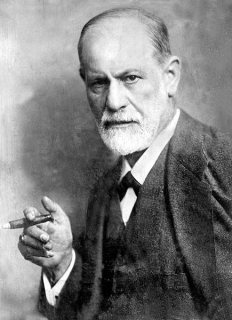
Freud was... the founder of psychoanalysis, a clinical method for evaluating and treating pathologies seen as originating from conflicts in the psyche, through dialogue between patient and psychoanalyst, and the distinctive theory of mind and human agency derived from it.... In founding psychoanalysis, Freud developed therapeutic techniques such as the use of free association, and he established the central role of transference in the analytic process…. Freud [also] went on to develop a model of [our] psychic structure....
Introductory Comments
Few thinkers invite a dose of their own medicine as irresistibly as Freud. Put him on his own couch, and the diagnosis practically writes itself. An unresolved Oedipus complex sets young Sigmund against his father, and later against every father figure in the Viennese medical establishment. His libido, denied its natural outlet, is sublimated into an astonishing torrent of books and papers. The twenty cigars a day betray an oral fixation, and the meticulous case notes an anal one. And the death drive, turned outward as aggression, accounts for the bitter excommunication of his onetime disciples Adler and Jung. Freud, it must be said, started the game himself. His self-analysis in the late 1890s, spurred by his father’s death, is where he first uncovered the Oedipal wishes he would later declare universal.
Still, the game is more fun than illuminating. It runs theories whose scientific standing is dubious back through the man who devised them, and a loop that tidy explains everything and therefore nothing. It also crowds out what plainly mattered: the intellectual ferment of fin-de-siècle Vienna, the antisemitism that shadowed a Jewish doctor’s career, the ambition of an outsider determined to make his name, and the sheer particularity of a person no theory fully captures. Psychoanalyzing Freud does offer the sweet revenge of seeing him hoisted with his own petard. But as the saying attributed to him goes (though he probably never said it), sometimes a cigar is just a cigar.
Some of Freud's Key Positions
Philosophers have long defined human beings as the rational animal. Yet much of what we do is driven by the unconscious, a part of the mind kept largely out of awareness that steers us all the same. The ego is not master in its own house.
The mind is divided against itself. The id demands instant gratification of instinct. The superego, the internalized voice of parental authority, forbids. The ego must broker a settlement between them and reality, and when it fails, neurosis follows.
The sexual drive, or libido, is present from infancy. In early childhood it gives rise to the Oedipus complex: desire for one parent, rivalry with the other. Its normal resolution forms the conscience, and its mishandling can scar a life. Most of this is repressed, pushed out of awareness but not disarmed. It returns in disguise, in dreams, slips of the tongue, and neurotic symptoms.
Psychoanalysis, the "talking cure," brings such material to light through free association, the interpretation of dreams, and transference, in which the patient redirects onto the analyst feelings once aimed at parents.
Against Eros, the drive toward life and union, stands a death drive that seeks a return to the inorganic. Turned outward, it becomes aggression. Civilization restrains both and pays for the restraint in guilt and discontent.
Place in the History of Ideas
Freud's Place in History of Ideas
Lance Workman and Will Reader: Freud de- serves mention for two reasons. First, unlike many subsequent psychologists Freud was in- terested in ultimate questions; he was preoccu- pied by finding out why people behaved as they did, not simply how. Second, although many of these accounts were distinctly non-Darwinian..., some of his ideas are much more in line with recent [evolutionary] psychology.
Bertrand Russell: Man is essentially a dreamer, wakened sometimes for a moment by some peculiarly obtrusive element in the outer world, but lapsing again quickly into the happy somnolence of imagination. Freud has shown how largely our dreams at night are the pictured fulfilment of our wishes; he has, with an equal measure of truth, said the same of day-dreams; and he might have included the day-dreams which we call beliefs.
Victor Pelevin: Doctor Freud not only used cocaine himself, but he also prescribed it to his patients. And then he drew his generalizations. Cocaine is a strong sexual arouser. That's why everything Freud invented - all those oedipuses, sphinxes and sphincters - is relevant only to a mental dimension of a patient, whose brain is turned to fried-eggs by cocaine. In such a state, one really has only one problem left - what to do first, to screw his mother or to do away with his father.
Random Thoughts on Freud
Freud came of age among steam engines, boilers, and pressure gauges, and it shows. Trained in a physiology that treated the conservation of energy as gospel, he gave psychoanalysis an "economic" model in which the drives behave like a fixed supply of fluid. It can be dammed, diverted, or drained, but never conjured from nothing. Libido withdrawn from the world floods back into the self, and libido denied its natural outlet must find another. The noblest channel is sublimation, which pipes sexual energy into art, science, and other respectable pursuits. Every symphony, by this accounting, is a seduction foregone.
The system is elegant, mechanical, and stubbornly zero-sum. Civilization runs on the energy it diverts, and it sends a bill. Renounced instinct breeds frustration, and aggression with nowhere to go turns inward, returning as conscience and guilt. Even the death drive fits the plumbing: it is a pressure seeking the ultimate release. The trouble is all the evidence to the contrary. If anger were steam, letting it off should lower the pressure. Yet experiments have found that venting anger tends to stoke it rather than relieve it. Absorbing work and close relationships, meanwhile, often leave people with more vigor rather than less. Still, the old picture dies hard. We still speak of "venting," "bottling it up," "blowing off steam" and the like. Apparently, when it comes to understanding ourselves, we're still more comfortable calling a plumber than a psychologist.
Adorno (Human civilization developed thru' the suppression of human nature.)
Butler, Joseph (Our conscience naturally rules over our passions and self-love.)
Chrysippus (We should be free of unruly emotions, as they disturb judgment.)
Dostoyevsky (Humans are full of irrational cravings and contradictions.)
Empedocles (Two opposing forces are at work in this world: Love and Strife.)
Feuerbach (God is for us the outward projection of a human's inward nature.)
Nussbaum (The claim that gender is just a cultural construct is not plausible.)
Schelling (Much of our behavior springs from unconscious motives and beliefs.)
Thinkers with opposing positions:
Adler (The social realm plays a large role in shaping human psychology.)
Borges (Attempting to explain the self is a self-defeating quest for integration.)
Brentano (There is no such thing as an unconscious mental act.)
Davidson (Mental events are not governed by strict psychological laws.)
Irigaray (Psychoanalysis often sees men as the subject and women as the Other.)
Jung (The collective, not personal, unconscious is most determinant.)
Locke (The mind at birth is a blank slate that experience will write upon.)
Marcuse (The realization of man's erotic nature is liberation for humanity.)
What others said about Freud
Pinker: The idea that boys want to sleep with their mothers strikes most men as the silliest thing they have ever heard.
Peter Gay: While the implications of Darwin’s views were... unsettling, they were not quite so directly abrasive... as Freud’s views on infantile sexuality, the ubiquity of perversions, and the dynamic power of unconscious urges.
Dean Koontz: The basic assumption of Freud is that none of us is responsible for what we are: What we are is a consequence of what our parents did to us, what our culture did to us, what society did to us, the injustices we've suffered. So, in essence, we're victims.... That's so grossly simplistic. And yet it has dominated the thinking of our century....
John Irving: Sigmund Freud was a novelist with a scientific background. He just didn’t know he was a novelist. All those damn psychiatrists after him, they didn’t know he was a novelist either.
Einstein: He had a sharp vision; no illusions lulled him to sleep except for an often exaggerated faith in his own ideas.
Fromm: Freud was one of the last representatives of Enlightenment philosophy. He genuinely believed in reason as the one strength man has and which alone could save him from confusion and decay.
Whitehead: The ideas of Freud were popularized by people who only imperfectly understood them, who were incapable of the great effort required to grasp them in their relationship to larger truths, and who therefore assigned to them a prominence out of all proportion to their true importance.
Francis Crick: By modern standards, Freud can hardly be regarded as a scientist but rather as a physician who had many novel ideas and who wrote persuasively and unusually well.
Schools: Atheism, Secular Humanism, Voluntarism
Main interests: Alienation, Biography, Causality, Childhood, Consciousness, Desire, Dreams, Eroticism, Family, Free/Unfree Will, Habits, Happiness, Health, Human Will, Literature, Memory, Mind, Mythology, Perception, Personal Identity, Power, Psychoanalysis, Psychology, Religion, Semiotics, Sexuality, Social Philosophy, War, Will