Democritus (c. 460 BC - c. 370 BC)
Open Democritus's interactive page (graphs of influences, similar and opposing positions, and quotes)
Background
Democritus
Born: c. 460 BC in Abdera, Thrace (now part of
Greece)
Died: c. 370 BC (aged around 90)
Schools: Atomism, Materialism
Main interests: Metaphysics, Mathematics,
Astronomy
Notable ideas: Atomism, Aetiology (causality),
The Milky Way (Via Lactea) as a concentration
of distant stars
Influences: Leucippus, Melissus of Samos,
Anaximander, Heraclitus, Anaxagoras
Influenced: Epicurus, Pyrrho, Lucretius, Aristotle,
Montaigne, Severino, Baruch Spinoza, George
Santayana, Karl Marx, Friedrich Nietzsche,
Michel Onfray, Spencer
From Wikipedia
Democritus was an Ancient Greek pre-Socratic philosopher from Abdera, primarily remembered today for his formulation of an atomic theory of the universe. None of his work has survived…. The theory of Democritus held that everything is composed of "atoms," which are physically, but not geometrically, indivisible; that between atoms, there lies empty space; that atoms are indestructible, and have always been and always will be in motion; that there is an infinite number of atoms and of kinds of atoms, which differ in shape & size.
Introductory Comments
When his father died, the young Democritus inherited a handsome fortune and did what any intellectually restless heir might do: he spent it on travel. What followed may have been history's first Grand Tour - Greece, Persia, Babylon, Egypt, and possibly India and Ethiopia. Along the way he encountered an extraordinary assortment of sages, philosophers, mathematicians, and men of letters - along with, one suspects, a generous sampling of cranks, crackpots, and charlatans. After more than five years abroad, Democritus returned to his native Abdera, sat down at his desk, and tried to make sense of it all.
With all sorts of competing theories bouncing around in his head, Democritus did something bold: he swept them all aside and started fresh. The result was atomic theory - the radical, elegant claim that all of reality rests on tiny, indestructible particles too small to see. He arrived at this partly by wrestling with Parmenides's notorious argument that change is impossible. But one can't help wondering whether the Grand Tour itself nudged him toward the atom. After years of absorbing grand, sweeping, endlessly complicated worldviews, perhaps Democritus found the small and humble atom deeply appealing. And wonderfully paradoxical: The man who had seen more of the world than almost anyone alive concluded that the world, at bottom, was almost nothing at all.
Some of Democritus's Key Positions
Everything in nature is the result of the motions and interactions of matter. The world does not operate for the sake of any final purpose or goal. Instead, natural processes unfold according to necessity, without the guidance of divine intentions or cosmic design.
The basic constituents of reality are atoms: tiny, indivisible, and indestructible particles moving through empty space. These atoms differ in shape, size, arrangement, and position, and their combinations give rise to the objects and phenomena we encounter. The differing qualities of things are explained by the differing arrangements and densities of atoms. What seems to us a variety of substances and forms is, at bottom, a variety of atomic formations.
Despite what Parmenides claimed, the void is real. Empty space exists between atoms and makes motion possible. Without the void, atoms could not move, combine, separate, or produce the changes observed in the world.
The senses provide only a limited and often misleading picture of reality. Genuine knowledge comes when reason interprets sensory experience and infers the unseen structures and causes that lie beneath appearances. Atoms and the void cannot be perceived directly, but their existence is the best explanation of the world we observe.
Place in the History of Ideas
Democritus's Place in History of Ideas
Cassirer: When Democritus described the struc- ture of his atoms he had recourse to analogies taken from the world of our sense experience. He gave a picture, an image of the atom, which resembles the common objects of our macrocosm. The atoms were distinguished from each other by their shape, their size, and the arrangement of their parts. Their connections were explained by material links; the single atoms were supplied with hooks and eyes, with ball and sockets to render them attachable. All this imagery, this figurative illustration has vanished in our modern theories of the atom.
Russell: [Democritus and] the atomists, unlike Socrates, Plato, and Aristotle, sought to explain the world without introducing the notion of purpose or final cause. The "final cause" of an occurrence is an event in the future for the sake of which the occurrence takes place. In human affairs, this conception is applicable. Why does the baker make bread? Because people will be hungry…. But experience has shown that the mechanistic question [what earlier circumstances caused this event?] leads to scientific knowledge, while the teleological question [what purpose did this event serve?] does not. The atomists asked the mechanistic question, and gave a mechanistic answer. Their successors, until the Renaissance, were more interested in the teleological question, and thus led science up a blind alley.
Random Thoughts on Democritus
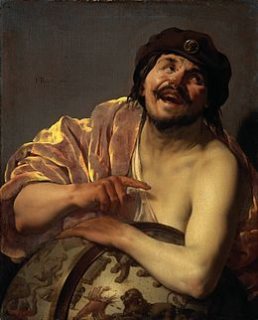
For more than 2000 years, Democritus has been known as the Laughing Philosopher. Why? The surviving fragments of his writings do not suggest a stand-up comic in sandals. The truth is that no one knows exactly why. Still, one possible explanation is worth considering. Democritus was a thoroughgoing materialist. Human beings, he argued, are not fallen angels, disembodied souls, or miniature gods. We are material creatures inhabiting a material world. Such a view naturally draws attention to the embarrassing gap between our lofty would-be selves and our pathetic "actual-be" selves. We aspire to wisdom, virtue, and greatness; meanwhile, we succumb to pettiness and vanity and spend much of life attending to the animal needs of the body. Seen from one angle, this gap is tragic. Seen from another, it is simply funny.
The connection between materialism and comedy, then, runs deeper than slapstick, though slapstick is a good place to start. We also laugh when a pompous character is exposed, when a hypocrite is unmasked, or when someone's noble motives turn out to be rather less than noble. In each case, the joke lies in the distance between appearance and reality. The materialist may describe this (as Aristophanes did) as a clash between"cloudy" thoughts and earthly deeds. Whatever the terminology, the result is the same: a burst of laughter at the spectacle of humans failing to rise above their humanity.
Influences
Democritus was influenced by: Anaxagoras, Anaximander, Heraclitus, Leucippus, Melissus
Democritus influenced: Aristotle, Epicurus, Lucretius, Marx, Montaigne, Nietzsche, Onfray, Pyrrho, Santayana, Severino, Spencer, Spinoza
Similar and opposing positions
Thinkers with similar positions:
- Empedocles (All things are a mixture of various imperishable parts or particles.)
- Epicurus (Contentment is gained thru moderation and living a measured life.)
- Hobbes (All things, including humans and their minds, are entirely material.)
- Holbach (The universe is simply matter in motion, bound by laws of nature.)
- Lucretius (An occasional spontaneity or swerve in the atoms allows for free will)
- Pyrrho (Given our human limitations, we can never be sure of what is true.)
- Santayana (Mind has no causal power. All motion has merely physical causes.)
- Skinner (Behavior is a matter of stimuli & responses, not psyche or inner states.)
Thinkers with opposing positions:
- Berkeley (Causation is due to God, not to the interactions of matter.)
- Davidson (Though mind springs from matter, it can't be reduced to matter.)
- Edwards (God alone is the only real cause at work in the world - not matter.)
- Ficino (All things in the great chain of being spring ultimately from God.)
- James (Tho' our bodies live in a physical world, our souls live a spiritual universe)
- Parmenides (Movement thru the void is impossible, since the void cannot exist.)
- Plato (Soul and body are distinct substances, and soul is superior to body.)
- Whitehead (The world is a process and can't be reduced to mere matter.)
What others said about Democritus
- Russell: [The view of Democritus] was remarkably like that of modern science, and avoided most of the faults to which Greek speculation was prone.
- Thomas Heath: ... there was no subject to which [Democritus] did not notably contribute, from mathematics and physics on the one hand to ethics and poetics on the other; he even went by the name of "wisdom."
- Santayana: We owe to Democritus this ideal of practical intelligibility.... His system... represents an ultimate ideal, every advance in science reconstitutes it in some particular. Mechanism is not one principle of explanation among others. In natural philosophy, where to explain means to discover origins, transmutations, and laws, mechanism is explanation itself.
- Diogenes Laërtius: [Democritus taught that] the end of action is tranquillity, which is not identical with pleasure,... but a state in which the soul continues calm and strong, undisturbed by any fear or superstition or any other emotion.
- Florian Cajori: [According to Democritus] vision is caused by the projection of particles from the object seen, into the pupil of the eye.
- Aristotle: [Of all our predecessors, only] Democritus penetrated below the surface…. [He seems] not only to have thought carefully about all the problems, but also to be distinguished from the outset by his method.
- Richard Feynman: If, in some cataclysm, all of scientific knowledge were to be destroyed, and only one sentence passed on to the next generation of creatures, what statement would contain the most information in the fewest words? I believe it is the atomic hypothesis that all things are made of atoms - little particles that move around in perpetual motion….
- Popper: [Democritus] formulated the doctrine that human institutions of language, custom, and law are not [built-in] but man-made, not natural but conventional, insisting, at the same time, that we are responsible for them.
Schools: Atomism, Determinism, Naturalism, Physicalism, Pre-Socratic Philosophy
Main interests: Astronomy, Free/Unfree Will, Mathematics, Metaphysics, Physics
Democritus's answers to philosophical questions
Education
"Education is an ornament for the fortunate and a refuge for the unfortunate."
"Nature and education are somewhat similar. The latter transforms man, and in so doing creates a second nature."
Epistemology
Sensations are produced in the soul when atoms emitted from other objects impact the atoms of the soul.
"We think there is color, we think there is sweet, we think there is bitter, but in reality there are atoms and a void."
Subjective sense impressions can never reveal the laws of nature. Rather, we know these laws through the intellect.
"We know nothing in reality; for truth lies in an abyss."
Ethics
Happiness is found in nobility of action - even if this comes from imitating others - and in avoiding excessive self-indulgence.
Seek pleasure, but in moderation. "Throw moderation to the winds, and the greatest pleasures bring the greatest pains."
Metaphysics
Our world is a physical mechanism made up of minuscule and indestructible atoms that are constantly in motion.
"Everything existing in the universe is the fruit of chance and necessity."
"[M]an blames nature & fate yet his fate is mostly but the echo of his character & passion, his mistakes & his weaknesses."
"Nothing exists except atoms and empty space; everything else is opinion." But even mind or psyche is made up of atoms.
Mind
"Soul and intellect are just the same thing."
Nature
The world is a type of machine - a physical mechanism on a grand scale. Unlike us, it has no spirit or soul.
We could learn much from watching animals: "The animal needing something knows how much it needs, the man does not."
Political Philosophy
The state should never obstruct our freedom, for the freedom of the individual is more important than the needs of the state.
Psychology
"It is hard to fight desire; but to control it is the sign of a reasonable man."
"Raising children is an uncertain thing; success is reached only after a life of battle and worry."
"The person who can laugh with life has developed deep roots with confidence & faith… in oneself, in people & in the world."
"Men find happiness neither by means of the body nor through possessions, but through uprightness and wisdom."
Religion and Theology
No supernatural powers exist that can overrule or override the laws of nature.
When our bodies die, so do we. After time, the atoms that make up our bodies break apart to form other things and creatures.
Science
"The first principles of the universe are atoms and empty space; everything else is merely thought to exist."
Sex and Gender
"Sexual intercourse is a slight attack of apoplexy."
"To speak but little becomes a woman; and she is best adorned who is in plain attire."