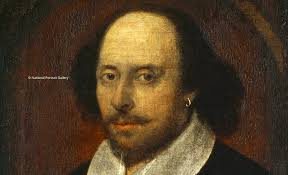
Shakespeare was an English playwright, poet and actor. He is widely regarded as the greatest writer in the English language and the world's preemi-nent dramatist.... His extant works... consist of some 39 plays, 154 sonnets, three long narrative poems and a few other verses, some of uncertain authorship. His plays have been translated into every major living language and are performed more often than those of any other playwright. Shakespeare remains arguably the most influen- tial writer in the English language....
Introductory Comments
Was Shakespeare a romantic or a cynic? Or was he a bit of both? Consider the beginning of Shakespeare's Sonnet 138, which most scholars believe concerns his own romantic life: "When my love swears that she is made of truth, / I do believe her though I know she lies, / That she might think me some untutored youth, / Unlearned in the world's false subtleties." So already we have a parting of the ways between love and truth: a beautiful young woman (some say Mary Fitton, a maid of honor to Queen Elizabeth, some say Emilia Lanier, a poet in her own right, some say a literary fabrication), who swears that she is truthful, and a somewhat older man (often taken to be the poet himself), who has reason to very much doubt her claims, but pretends otherwise so that he might seem more innocent and thus more youthful.
And on it goes: "Thus vainly thinking that she thinks me young, / Although she knows my days are past the best, / Simply I credit her false-speaking tongue: / On both sides thus is simple truth suppressed." Of course one might object that whatever these two are up to, it can't really be love. But why not? Why insist that romance must be based on truth? After all, if love requires some playful imagination and even a degree of role playing, why spoil the fun with anything as grim as honesty? Perhaps that's why Shakespeare lets the two senses of "lie" blur into one: "Therefore I lie with her, and she with me, / And in our faults by lies we flattered be."
Some of Shakespeare's Key Positions
Given our powerful emotions, acquired biases, and narrow perspectives, it is hardly surprising that we humans are often internally conflicted and confused - and externally at odds with one another. Peace eludes us, both within and without.
We are confused not only about what is true but also, given what we think might be true, about what should be done. Our senses can deceive us, our assumptions can mislead us, and other people can fool us altogether. Nor can we easily know what others really think, what they want, or even whether they are our friends.
We are more baffled yet by the person in the mirror. Like actors on a stage, we play the parts assigned to us, but the part keeps changing - not only over a lifetime, but from one companion to the next. Amid these shifting roles and fluctuating desires, it is no surprise that we sometimes seem to know ourselves least of all.
And we are confused about the world itself. Is there a design at work in it, or is it merely sound and fury, signifying nothing? So much depends on our angle of vision, which is itself prone to sudden lurches. Seized by love or ambition, we find life a grand adventure. Crushed by guilt or disappointment, we find it an appalling tragedy. Viewed from a cool distance, it turns out to be a comedy after all. Nothing is clear or unclear, but thinking makes it so
Place in the History of Ideas
Shakespeare's Place in History of Ideas
Colin McGinn: According to an orthodox philosophy, we are rational beings capable of knowledge of the world, not signally prone to error; we also enjoy a constant identity over time, a unitary self that persists in its given nature over the course of our existence; and we live in a fundamentally rational universe in which justice is done and events make sense. In my interpretation, Shakespeare rejects that comforting picture entirely, and his plays are patterned by this rejection. With church authority crumbling and science not yet established, Shakespeare held a view of man and the universe that has no established name but that is approximated by such labels as "pessimism," "nihilism", "skepticism."
William Hazlitt: Shakespeare was in one sense the least moral of all writers; for morality (commonly so called) is made up of antipathies; and his talent consisted in sympathy with human nature, in all its shapes, degrees, depressions, and elevations. The object of the pedantic moralist is to find out the bad in everything: his was to show that "there is some soul of goodness in things evil."... In one sense, Shakespeare was no moralist at all; in another, he was the greatest of all moralists. He was a moralist in the same sense in which nature is one. He taught what he had learnt from her. He showed the greatest knowledge of humanity with the greatest fellow-feeling for it.
Random Thoughts on Shakespeare
Though Shakespeare lived in the long shadow of the Protestant Reformation - an age of religious fanaticism and violence - he seems to take the world on its own terms, not as a mere anteroom to eternity. In his plays at least, he rests on no dogmas, but tries to see things as they are. Like any good naturalist, he is fascinated by the strengths and weaknesses, the quirks and contradictions, of the people around him, and is determined to catch on page and stage some of those "rich and strange" transformations Ariel sings of in The Tempest.
This naturalism does not stop him from having fun with witches, ghosts, and sprites. Nor does it make him a moral relativist. Quite the reverse: Shakespeare is a formidable moralist, and his moral force springs from that very naturalism. He locates morality not in some decree from on high but within us - as part of human nature itself. Tellingly, when his characters do something that shocks us, his favorite word for it is not "immoral" but "unnatural." Evil deeds are of course natural in the trivial sense that they happen in nature; yet Shakespeare shows that only the truly cold - an Iago - walks away unscathed. Most of his evildoers, from Macbeth to Othello to Claudius, end up recoiling in horror at the "unnaturalness" of what they have done. Shakespeare's moral world does not require a set of commandments nor a divine judge who punishes transgressions. Nature herself, once violated, provides the in-voice.
Bayle (People’s behaviour reflects their character, not their religious beliefs.)
Camus (We value life in spite of our mortality and the universe's silence.)
Dawkins (Nature may guide us, but towards no rational purpose or end.)
Dostoyevsky (Humans are full of irrational cravings and contradictions.)
Herder (Poetry helps to define, if not also create, the uniqueness of a nation.)
Jaspers (Philosophical claims are expressions of our mental dispositions.)
Kafka (Dark and repressed aspects of our ourselves must occasionally surface.)
Lotze (Reality is larger & wider than philosophy. The Absolute is mere notion.)
Montaigne (Nothing is certain in life: We change as much as do our judgments)
Murdoch (Literature can help us clarify and improve our moral perspective.)
Ortega (Life is a struggle between our inner self and our outer circumstances.)
Ovid (Human habits and impulses are worthy topics for poetry.)
Schiller (History is the story of how human passions play out on world stage.)
Thinkers with opposing positions:
Epictetus (Nothing is good or bad independent of human desires & beliefs.)
Maimonides (Poetry is of little value, since it was founded on pure invention.)
Proust (Art is justified by revealing to us the beauty and charm of everyday life.)
Schopenhauer (Art exists in a realm free of the forces at work on and within us.)
What others said about Shakespeare
Robert Graves: The remarkable thing about Shakespeare is that he is really very good - in spite of all the people who say he is very good.
Coleridge: He is of no age - nor, I may add, of any religion, or party, or profession. The body and substance of his works came out of the unfathomable depths of his own oceanic mind.
McGinn: If I were to award him a single label, it would be “naturalist,” in somewhat the sense that one speaks of a student of natural history: he is a clear-eyed observer and recorder, sensitive to the facts before his eyes, not swayed by dogma or tradition... he is simply saying, This is the way things are.... He is a detached, supremely sane student of human beings....
Emerson: What point of morals, of manners, of economy, of philosophy, of religion, of taste, of the conduct of life, has he not settled? What mystery has he not signified his knowledge of?
Darwin: I have tried lately to read Shakespeare, and found it so intolerably dull that it nauseated me.
Keats: [There is a cetain quality] which Shakespeare possessed so enormously - I mean Negative Capability, that is when man is capable of being in uncertainties, Mysteries, doubts without any irritable reaching after fact and reason.
Byron: Shakespeare's name, you may depend upon it, stands absurdly too high and will go down. He had no invention as to stories, none whatever. He took all his plots from old novels, and threw their stories into dramatic shape... That he threw over whatever he did write some flashes of genius, nobody can deny; but this was all.
Dickens: "I'm always ill after Shakespeare," said Mrs. Wititterly. "I scarcely exist the next day; I find the reaction so very great after a tragedy, my lord, and Shakespeare is such a delicious creature."
Schools: Humanism
Main interests: Biography, Causality, Classics, Death, Desire, Ethics, Family, Fate, Game Theory, Happiness, Health, History, Human Will, Law, Literature, Love, Metaphilosophy, Mind, Nature, Personal Identity, Poetry, Political Theory, Power, Psychology, Punishment, Sexuality, Sublime Nature, Theatre, Time, Tragedy, War, Wealth, Will, Wisdom