Elizabeth Anscombe (1919 - 2001)
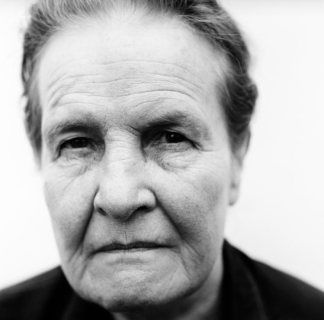
Open Anscombe's interactive page (graphs of influences, similar and opposing positions, and quotes)
Background
Gertrude Elizabeth Margaret Anscombe
Born: 18 March 1919 in Limerick, Ireland
Died: 5 January 2001 (aged 81) in Cambridge,
England
Alma mater: St Hugh's College, Oxford and
Newnham College, Cambridge
Spouse: Peter Geach
School: Analytic philosophy
Institutions: Newnham College, Cambridge and
Somerville College, Oxford
Notable ideas: Brute facts, "under a
description", direction of fit, attack on
consequentialism
Influences: Aristotle, Ludwig Wittgenstein, Peter
Geach, Thomas Aquinas
Influenced: Michael Dummett, Anthony Kenny,
Thomas Nagel, Roger Scruton, Donald
Davidson, Charles Taylor, John Searle, Philippa
Foot, Iris Murdoch, MacIntyre, Paul Feyerabend
From Wikipedia
Anscombe was a British analytic philosopher. She wrote on the philosophy of mind, philosophy of action, philosophical logic, philosophy of lan- guage, and ethics. She was a prominent figure of analytical Thomism…. [Anscombe also] introduced the term consequentialism into the language of analytic philosophy, and had a seminal influence on contemporary virtue ethics. Her monograph "Intention" [stinulated] philosophical interest in the concepts of intention, action, and practical reasoning....
Introductory Comments
For Anscombe, the moral vocabulary most phi- losophers take for granted - "you ought not to lie," "it is wrong to steal" - only makes sense if a divine legislator stands behind it: "ought" im- plies someone doing the ought-ing, and if you have removed God from the picture, you're left with a verb in search of a subject. As a devout Catholic, Anscombe herself had no trouble sup- plying that someone. But she found it intellec- tually scandalous that secular philosophers con- tinued wielding the language of divine com-mand - duty, moral law, categorical obligation - while having quietly abandoned the theology that gave it meaning. They were, in effect, writ- ing checks on a closed account.
Anscombe's alternative was not to abandon moral absolutes but to relocate them. Rather than deriving ethics from commands handed down from above, Anscombe proposed that we ground moral knowledge in a rigorous under- standing of human nature - what human beings are, what they need, how they act, and what enables them to flourish. Some actions are in- trinsically destructive to human flourishing - not because God forbids them, but because of what human beings fundamentally are. The method isn't a reading off commands, but an investigation of human practices and capacities. Think of it as moral philosophy getting its hands dirty with actual human life - less Moses on the mountain, more Aristotle in the marketplace.
Some of Anscombe's Key Positions
Intentions can be broken down into three types: The first type is one where purpose and action are directly linked. The second type is one where an action is linked to a further pur- pose or more ultimate intention. And the third type of intention is just a desire to do some- thing in the future, with no action needed now.
Morally speaking, it is the second type of inten- tion that warrants most consideration, since it is asociated with the distinction between in- tended and unintended consequences. Utilitar- ians like Bentham and Mill focus their ethics on the actual consequences of actions, no matter the intention of the doer of the action. A good act is simply one with good results.
Such "Consequentialism" claims that there is no moral difference between an intended act and an uninteneded act, as long as both acts have the same consequences. But, as moral creatures, this is not how we live our lives. Nor can we, again as moral agents, adhere to some Kantian deontology, where actions must be based on universal laws, regardless of consequences.
Morally speaking, what counts are intentions - not consequences nor so-called universal laws. As Aristotle taught, a virtuous person is some- one whose character is virtuous. Character is internal and, as such, is a matter of internal intentions and their internal strength.
Place in the History of Ideas
Anscombe's Place in History of Ideas
Duncan Richter: A committed Catholic…, she was an influential and original thinker in the Catholic tradition and the Wittgensteinian manner. Although she worked in almost every area of philosophy, she is best known to philosophers today for her work on ethics and the philosophy of action. Outside of philosophy she is best known for her conservative views on sexual ethics....
Daniel Weltman: Anscombe says there is one solution if we do not want to accept God as the basis of morality and do what God commands. We can return to the earlier way of thinking about good and bad. Using philosophy and psychology, we can figure out what things are good for humans as a species, just like we can figure out what things are good for other living creatures, like plants. Good plants get sun (for instance), and good humans behave honestly (for instance).
Duncan Richter: [Her paper “Modern Moral Philosophy”] put forward three theses: that all the major British moral philosophers from Henry Sidgwick on were essentially the same (that is, consequentialists); that the concepts of moral obligation, the use of the word ought with a special moral sense, and related notions, are harmful and should be dropped; and that we should stop doing moral philosophy until we have an adequate philosophy of psychology.
Random Thoughts on Anscombe
Anscombe’s natural basis for moral absolutes (see Introductory Comments) complements her virtue ethics: Moral evaluation should focus on character and disposition rather than on rule-following or outcome-calculating. A courageous and just person, with well-formed practical wis- dom, perceives what situations genuinely re- quire. Moral absolutes then provide the bound-aries - they mark the outer limits of what any virtuous person, reasoning clearly about human good, could ever endorse. Some actions - say, deliberately executing an innocent person or lying in a way that corrodes trust - are never justified, no matter the consequences.
Yet a genuinely unresolved difficulty lingers in Anscombe’s virtue ethics: it rests on a robust conception of human nature that is far from philosophically neutral. Drawing heavily on Ar- istotelian teleology - the notion that humans have a natural end or purpose - and Catholic worldview, it invites the skeptical retort: what justifies this particular picture of humanity? Without a compelling defense, appealing to "what human nature requires" can start to look as question-begging as the divine commands she critiqued. But with a compelling defense, well, that's another story. In that case perhaps a secular philosopher could develop a rigorous ethical system based on human nature alone. After all, if we refuse to be guided by God, who can we be guided by but ourselves?
Influences
Anscombe was influenced by: Aquinas, Aristotle, Geach, Wittgenstein
Anscombe influenced: Davidson, Dummett, Feyerabend, Foot, Kenny, MacIntyre, Murdoch, Nagel, Scruton, Searle, Taylor, Charles
Similar and opposing positions
Thinkers with similar positions:
- Anselm (The idea of God as absolute perfection proves His very existence.)
- David Lewis (The first-person pronoun, "I," does not refer to anything.)
- Foot (Ethics should emphasize internal virtues, not external results.)
- Geach (Catholicism should synthesize Thomistic and Analytic approaches.)
- Green (Objective ethics can be based on the objective function of mankind.)
- Moore (Though in part intuitive, moral judgments can be objectively true.)
- Murdoch (The Good is real and the moral life is a journey from illusion to reality.)
- Searle (Intentions deal with the directedness or aboutness of mental states.)
- Sidgwick (Ethics must distinguish foreseen from unforeseen consequences.)
Thinkers with opposing positions:
- Bentham (Happiness means experiencing pleasure & avoiding pain.)
- Hare (Moral statements do not objectively describe, but rationally prescribe.)
- Hume (Causation is merely the constant conjunction of certain events.)
- Kant (The only thing good without qualification is a “good will.”)
- Lewis, C.S. (The belief that nothing exists beyond nature is self-refuting.)
- Mill (Moral worth derives solely from the consequences of one's actions.)
- Spinoza (Moral absolutes do not exist. Nothing is inherently good or evil.)
What others said about Anscombe
- Roger Scruton: [Anscombe was] perhaps the last great philosopher writing in English.
- Daniel Weltman: By developing a [psychologically and philosophically sound] theory of human virtue..., Anscombe thinks we can return moral philosophy to a place where we can come up with concrete answers.
- Eric Wiland: She worked on an unusually broad array of topics: the entire range of the history of philosophy (ancient, medieval, modern, recent), metaphysics, epistemology, philosophy of language, philosophy of mind/psychology, philosophy of action, moral philosophy, political philosophy, and the philosophy of religion.
- Duncan Richter: ... Anscombe argued that some metaphysical theses are the result of our being misled by grammar. Her work on the first person singular is a good example of this way of dealing with philosophical problems.
- Davidson: [Anscombe's monograph "Intention" was] the most important treatment of action since Aristotle.
- Daniel Weltman: [Anscombe argues] that unless God gives us moral commands, moral claims, including claims about what we morally "ought" to do, make no sense because "ought" implies that there is some power telling us what to do.
- Duncan Richter: G.E.M. Anscombe was a colourful figure, known for smoking cigars, wearing a monocle, and staunchly defending implausible ideas. She was no posing contrarian though. Her unfashionable views on ethics reflected her strong Christian faith, and her often counterintuitive philosophical work was strongly influenced by Ludwig Wittgenstein....
- J. Schwenkler: Anscombe was... Wittgenstein's greatest student, and he handpicked her to edit and translate the "Philosophical Investigations." [She once said] "I don't have a single idea in my head that wasn't put there by Wittgenstein."
Schools: Analytic Philosophy, Aristotelianism, Feminism, Ordinary Language Philosophy, Thomism, Virtue Ethics
Main interests: Desire, Ethics, Fact–value distinction, Free/Unfree Will, Just War, Language, Metaphysics, Politics, Religion, Virtue, Will
Anscombe's answers to philosophical questions
Ethics
Philosophers should abandon rule- and consequence-based ethics in favor of an Aristotelian focus on character and virtues.
Moral obligations can follow from factual premises by analyzing how concepts like "promising" bridge the gap.
Moral philosophy must be based on an adequate philosophy of psychology, which we currently lack.
Metaphysics
Despite what Hume wrote, we have a direct experiential grasp of causation through our own agency.
Mind
Mental states cannot be fully understood without reference to their context and their expression in behavior.
The first-person pronoun "I" does not refer to an object or entity in the way ordinary nouns do.
Intention is best understood through its expression in action, not as an inner mental event.
Nature
"… we humans are a bad lot and our lives as Christians even if not blackly and grossly wicked are usually very mediocre."
Philosophy
Philosophy should pay close attention to ordinary language to avoid conceptual confusion.
Sex and Gender
"Those who [treat] sex as mere casual enjoyment pay the penalty: they become shallow…. They dishonor their own bodies...."
"The command to a Christian couple is: 'Grow in grace and love together.' But a joint command can only be jointly obeyed."