Electric WebOpen the interactive pageAll thinkersAbout

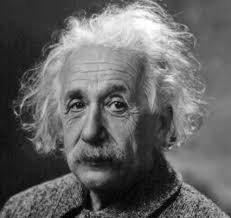
Albert Einstein (1879 - 1955)

Germany · 1900-1999 · Wikipedia

Albert Einstein

Open Einstein's interactive page (graphs of influences, similar and opposing positions, and quotes)

Background

Albert Einstein
  Born:  14 March 1879 in Ulm, Kingdom of
     Württemberg, German Empire
  Died:  18 April 1955 (aged 76) in Princeton, New
     Jersey, US
  Education:  Swiss Federal Polytechnic (B.A.,   
     1900), University of Zurich (Ph.D., 1905)
  Known for:  General relativity and special
     relativity, Photoelectric effect, E=mc2, Theory
     of Brownian motion, Einstein field equations    
  Influences: Newton, Gandhi, Freud, J.C. Maxwell,
     Spinoza, Hendrik Lorentz, Bernhard Riemann,
     Schopenhauer, G.B. Shaw, Thomas Young,
     H. Minkowski, Dostoyevsky, Hume, E. Mach, M.
     Schlick, K. Pearson, Henry George, B. Russell
  Influenced:  Ernst G. Straus, Nathan Rosen, Leó
     Szilárd, S.N. Bose, Wolfgang Pauli, M. Schlick,
     Popper, D. Bohm, B. Podolsky, G. Nordström,
     L. Brillouin, H. Reichenbach, Riazuddin, Carnap
 
From Wikipedia
 
Einstein was a German-born theoretical physicist best known for developing the theory of relativity. Einstein also made important contributions to quantum theory. His mass–energy equivalence formula E = mc2, which arises from special relativity, has been called "the world's most famous equation." He received the 1921 Nobel Prize in Physics for "his services to theoretical physics, and especially for his discovery of the law of the photoelectric effect."
Introductory Comments
 
The popular image of Einstein has wild hair, no socks, and a head somewhere out among the galaxies. It leaves little room for the man who wrote to presidents, signed manifestos, and urged Americans to defy congressional committees. Yet the times would not leave him alone. He opposed the First World War when most German intellectuals cheered it on. Through the 1920s he was an outspoken pacifist. Hitler cured him of that. In 1939 he signed a letter warning Roosevelt that Germany might build an atomic bomb.
 
After Hiroshima, Einstein spent his last decade arguing that the bomb had made international control a matter of survival rather than idealism. He also argued for a world authority far stronger than the failed League of Nations. Along the way he made the case for democratic socialism and defended civil liberties during the McCarthy era. A committed but uneasy Zionist, he hoped for a Palestine shared by Arabs and Jews.
 
Behind the politics lay something closer to temperament than doctrine: a kind of cosmic humility. Einstein rejected both a personal God and personal immortality. Yet he spoke reverently of a "cosmic religious feeling," an awe before the order of a universe that owes nothing to human wishes. From that vantage point, nationalism looked like "the measles of mankind." The man who abolished absolute space and time also had, it turns out, little patience for the absolute ego.
Some of Einstein's Key Positions
 
The physical world is stranger than common sense allows, yet not beyond the reach of reason. Space and time seem to be identical for every observer. They are no such thing. Two observers in relative motion will disagree about lengths, durations, and even simultaneity, and neither will be wrong. Beneath these shifting measurements, though, something holds firm: the speed of light and the laws of physics are the same for everyone. Relativity is not relativism.
 
What also holds firm is space-time: the three dimensions of space and one of time woven into a single four-dimensional continuum, or manifold. Gravity is not a force tugging across empty space but the curvature of space-time itself, bent by matter and energy.
  
Nature is lawful to the core, and a complete theory must describe reality as it is, whether or not anyone is looking. Quantum mechanics falls short of that standard, since its probabilities mark gaps in the theory, not chance in nature. Or to speak metaphorically, God does not play dice.
 
Nor does God work miracles. A universe governed throughout by cause and effect leaves no room for a deity who suspends natural law or hands out rewards and punishments. What remains is a cosmic religious feeling: awe before nature’s rational order, nearer to Spinoza’s God than to Scripture’s.

Place in the History of Ideas

Einstein's Place in History of Ideas
  
Jacob Bronowski: It is almost impertinent to talk of the ascent of man in the presence of two men, Newton and Einstein, who stride like gods. Of the two, Newton is the Old Testament god; it is Einstein who is the New Testament figure. He was full of humanity, pity, a sense of enormous sympathy. His vision of nature herself was that of a human being in the presence of something god-like, and that is what he always said about nature.... Einstein was a man who could ask immensely simple questions. And what his life showed, and his work, is that when the answers are simple too, then you hear God thinking.
 
Wolfgang Pauli: His God is somehow involved in the immutable laws of nature. Einstein has a feeling for the central order of things. He can detect it in the simplicity of natural laws.... Admittedly, this is a far cry from the contents of religion. I don't believe Einstein is tied to any religious tradition, and I rather think the idea of a personal God is entirely foreign to him. But as far as he is concerned there is no split between science and religion: the central order is part of the subjective as well as the objective realm....
  
Bertrand Russell: Men like Einstein proclaim obvious truths about war but are not listened to. So long as Einstein is unintelligible, he is thought wise, but as soon as he says anything that people can understand, it is thought that his wisdom has departed from him.
Random Thoughts on Einstein
 
Science has often shaped philosophy. Aristotle’s biology seeped into his metaphysics, and Darwin handed Dennett an entire worldview. Now and then, though, the causal arrow points the other way. Or seems to, since Hume himself doubted that anyone ever actually sees a causal arrow.
  
Case in point: As a young patent clerk in Bern, Einstein met with two friends in what they grandly called the Olympia Academy, reading philosophy over cheap dinners. Among their authors were Hume and Mach. Decades later, Einstein said these readings had decisively helped him toward special relativity. Hume showed that concepts as basic as cause and effect cannot be logically squeezed out of experience. Einstein concluded that such concepts are human inventions, and human inventions can be questioned. Mach, for his part, dismissed Newton’s absolute space as a "conceptual monstrosity." Together, they emboldened Einstein to question common sense.
 
Einstein later outgrew his teachers in certain ways. Still, the larger moral holds. At the edges of understanding, where concepts strain and crack, physicists need philosophy the way mountaineers need oxygen. Without it, they risk building elegant mathematics on assumptions nobody thought to examine. Or perhaps the moral is humbler still: when a young man is stuck, he could do worse than a cheap dinner, two good friends, and an old book by a Scottish skeptic.

Influences

Einstein was influenced by: Dostoyevsky, Freud, Gandhi, George, Henry, Hume, Lorentz, H., Maxwell, J.C., Minkowski, H., Newton, Riemann, B., Schopenhauer, Shaw, Spinoza

Einstein influenced: Bohm, David, Bose, S.N., Brillouin, L., Carnap, Nordstrom, G., Pauli, W., Podolsky, B., Popper, Reichenbach, Rosen, Nathan, Schlick, Straus, Ernst G., Szilard, Leo

Similar and opposing positions

Thinkers with similar positions:

Thinkers with opposing positions:

What others said about Einstein

Schools: Agnosticism, Determinism, Humanism, Internationalism, Liberalism, Secular Humanism, Secularism, Socialism

Main interests: Astronomy, Beauty, Causality, Cosmology, Free/Unfree Will, Music, Optics, Physics, Politics, Power, Punishment, Racism, Science, Time, Welfare State

Einstein's answers to philosophical questions

Art and Aesthetics

Is there a connection between art and spirituality? Is art at times akin to a religious ceremony?
"The most beautiful thing we can experience is the mysterious. It is the source of all true art and science."
What is the proper role or task of the art critic? Or does the art critic have no useful role?
"Whoever undertakes to set himself up as a judge of Truth and Knowledge is shipwrecked by the laughter of the gods."

Economics

If greed or self-interest is the engine that drives the economy, should it be tempered at all?
Greed is crippling. A socialist ecomony "would attempt to develop in [man] a sense of responsibility for his fellow-men."

Education

What is the personal value of an education? How does it aid or enrich the individual?
"It is the supreme art of the teacher to awaken joy in creative expression and knowledge."
What is the social or societal value of an education? How does it aid or enrich society?
"The point is to develop the childlike inclination for play… and to guide the child over to important fields for society."
What methods are most effective or productive in educating the young?
"[A]side from stimulation, [the curiosity of inquiry] stands mainly in need of freedom; without this it goes to wreak and ruin."
What methods, arrangements or emphases in education should be avoided or replaced?
"It is a grave mistake to think that the enjoyment of [learning] can be promoted by means of coercion and a sense of duty."
What motivation is most relevant to education: self-actualization, societal rewards, what?
"The most important motive for work in school and in life is pleasure in work, pleasure in its result…."
To what extent, if at all, should education be inner-directed? Does this differ according to age?
Encourage individuality: "If you judge a fish by its ability to climb a tree, it will spend its whole life believing that it is stupid."
What, philosophically speaking, should be the emphasis or goal of a liberal education?
"The value of a college education is not the learning of many facts but the training of the mind to think."
To what extent, if any, should education encourage the morals and mores of a given society?
"I believe... that overemphasis on the purely intellectual attitude... in our education, has [impaired] ethical values."

Epistemology

To what extent can we rely on empirical evidence? To what extent can we rely on science?
"The reciprocal relationship of epistemology and science is of noteworthy kind." Each is a check against the other.
To what extent can we rely on logic or reason? To what extent should we rely on logic or reason?
"I never made one of my discoveries through the process of rational thinking."
What is truth? Is it objective or relative or a bit of both? By what standard should it be judged?
"Relativity, as I see it, merely denotes that certain physical [facts] are relative with regard to certain other [physical] facts."
Is truth something discovered or something constructed? Or does this depend on the topic?
"Concepts that have proven useful in ordering things easily achieve such authority over us... we forget their earthly origins...."
What is intuition and can it be a source of truth? When, if ever, should it be trusted?
"I believe in intuition and inspiration.... At times I feel certain I am right while not knowing the reason."

Ethics

Is happiness the most important purpose or aim in life? If not, what is more important?
"I have never looked upon ease and happiness as ends in themselves - this critical basis I call the ideal of a pigsty."
Is the meaning we find in life something discovered or created? Or is there no meaning here?
"How strange is the lot of us mortals! Each of us is here for a brief sojourn; for what purpose he knows not...."
What moral obligations do we have towards others and how do these obligations vary?
"[W]e are here for the sake of each other - above all for those upon whose smile and well-being our own happiness depends."
What is the moral significance, if any, of death? Should our mortality affect how we live?
"The fear of death is the most unjustified of all fears, for there's no risk of accident for someone who's dead."

History

What are the main forces that shape history: economics, leadership, social conflict? What?
"We are inclined to overemphasize the material influences in history." Values, traditions and emotions are equally important.

Language

What is the role of language in our thought? To what extent does thinking rely on language?
"Without language our mental capacities would be poor indeed, comparable to those of the higher animals…."

Law

Should secular laws and religious laws be completely separate and distinct?
"Unless the cause of peace based on law gathers behind it the force and zeal of a religion, it hardly can hope to succeed."

Metaphysics

What is the fundamental nature or substance of things? Mind? Matter? Process? Spirit? God?
"Everything is energy and that’s all there is to it. Match the frequency of the reality you want and you… get that reality."
What is time? Is it something absolute that can exist on its own or is it inherently relative?
Time is neither independent nor uniform. Rather, it's part of the space-time continuum & depends on your frame of reference.
What is space? Can it exist independent of matter? If not, how is it related to matter?
Space is neither independent nor uniform. Rather, it is part of the space-time continuum and is curved by massive bodies.
Does free will really exist? If so, how is it consistent with universal causality?
"I am a determinist. As such, I do not believe in free will. The Jews believe in free will.... In that respect, I am not a Jew."
Is the supposed dualism of mind and matter real or can the two "realms" be reduced to one?
I admire Spinoza "because he is the first philosopher to deal with the soul and body as one, and not two separate things."
Is metaphysics actually possible or are the questions here beyond human understanding?
Man makes for himself "a simplified... picture of the world [and substitutes] this cosmos of his for the world of experience."

Mind

What is the intellect? How does it differ from other aspects of mind? What are its functions?
"The intellect has little to do on the road to discovery. There comes a leap in consciousness, call it Intuition or what you will…."

Nature

What place do humans have in nature? What, if anything, sets them above other animals?
"[W]e owe our principal advantage over the beasts [to our possession of language and] to the fact of living in human society."
How should humans use or approach the rich assortment of life forms on earth?
We must rise above our sense of separateness "by widening our circle of compassion to embrace all living creatures."
Does nature have any moral significance? Does nature offer us any moral lessons?
Nature still has much to teach us: "We still do not know one thousandth of one percent of what nature has revealed to us."

Philosophy

What is the connection between the use (or misuse) of language and the practice of philosophy?
"When I study philosophical works I feel I am swallowing something which I don't have in my mouth."

Political Philosophy

What are the basic functions of government? What should government not pursue?
"[T]he chief duty of the state to protect the individual and give him the opportunity to develop into a creative personality."
To what extent can the relations between nations be regulated or at least pacified?
"[W]orld government [is the only] way of eliminating the most terrible danger" (nuclear weapons) man has ever faced.
Is democracy simply rule by the majority? If not, what else does it entail? And with what risk?
Democracy requires a check on the immense power of the private capital, else the interests of the people won't be protected.
Should government try to prevent immoral behavior between consenting adults?
"Nothing is more destructive of respect for the government & the law of the land than passing laws which can't be enforced."
When, if ever, should freedom of speech be restricted to protect the greater good?
Dictatorship & censorship lead to stultification. "Science [in partiucalar] can flourish only in an atmosphere of free speech."

Psychology

What is the best approach to leading a productive and well adjusted life?
"Out of clutter, find simplicity. From discord, find harmony. In the middle of difficulty lies opportunity."
To what extent can behavior be shaped by external rewards and punishments?
"If people are good because they fear punishment, and hope for reward, then we are a sorry lot indeed."

Religion and Theology

What exactly is religion? How is it distinguished from other institutions and belief systems?
Ideally, religion "should be based on a religious sense arising from the experience of all things… as a meaningful unity."
What explains the origin of religion: revelation, reason, fear, awe, story-telling, fellowship?
"It was the experience of mystery - even if mixed with fear - that engendered religion." And it still sustains true religiosity.
What is spirituality? Does it require belief in God? Does it entail a certain approach to life?
"Veneration for this force [at work in nature and] beyond anything that we can comprehend is my religion."
Does God exist? If so, can His existence be proven? And if it cannot, how do we know He exists?
"I believe in Spinoza's God, Who reveals Himself in the lawful harmony of the world," not in the God of organized religion.
What are the essential attributes of God? Given our own limitations, what can we say of God?
"... the presence of a superior reasoning power, which is revealed in the incomprehensible universe, forms my idea of God."
Is morality possible without religion - or at least without some belief in God?
"A man's ethical behavior should be based... on sympathy, education, & social ties & needs; no religious basis is necessary."
What is the role of miracles in religion? How much credence, if any, should we give miracles?
The person who believes in universal causality cannot entertain the idea of a God who interferes in the course of events.
Is atheism simply the lack of belief or is there something positive and uplifting in atheism?
"What separates me from most so-called atheists is a feeling of utter humility toward the [mysteries] of the cosmos."

Science

What is science and how does it differ from other disciplines or ways of knowing?
"The whole of science is nothing more than a refinement of everyday thinking."
Does science offer the best way to know about the world? What are its strengths and limits?
Science must self reflect: "Science without epistemology is - insofar as it is thinkable at all - primitive and muddled."
What roles do induction and deduction play in science? How are these roles connected?
"Logic will get you from A to B. Imagination will take you everywhere."
What exactly is the scientific method? Do different sciences have different methodologies?
"When I examine... my methods..., I [see] that the gift of fantasy has meant more to me than... absorbing positve knowledge."
What exactly is scientific truth? How reliable are such truths? How objective are they?
Despite quantum theory, physics deals with certainties, not probabilities: "God does not play dice with the world."
What is a scientific theory? When scientific theories disagree, how should we decide?
"Qualities I sought in a scientific theory were naturalness, inner perfection and logical simplicity from an aesthetic approach."
Are the methodologies of the physical and social sciences fundamentally different?
"The supreme task of the physicist is to arrive at those universal elementary laws from which the cosmos can be built up...."
Why is mathematics so important in science? And is our world inherently mathematical?
Basic physical processes like gravitation & electromagnetism can't be explained mechanically. For these we need math.
What is scientific progress? Is science actually getting closer and closer to the truth?
"The most beautiful fate of a physical theory is to point the way to the establishment of a more inclusive theory...."
What is the ultimate goal of science? Truth? Power? A better life? A more humane society?
"Our entire much-praised technological progress... could be compared to an axe in the hand of a pathological criminal."
Is science compatible with religion? If they conflict, which one should we believe?
Science deals with facts & religion deals with values. "Science without religion is lame, religion without science is blind."

Society

If human beings are social animals, what needs are met by society - and what are not?
Though I work alone, I sense my "belonging to the invisible community of those who strive for truth, beauty, and justice."
What role does family play in the larger community? What are its strengths and limitations?
Society is built on family: "The individual, if left alone from birth would remain... beast-like in his thoughts and feelings."
What are the main benefits of living in a society? What are the main dangers?
"All that is valuable in human society depends upon the opportunity for development accorded the individual."
What is more important in achieving social progress: individual effort or teamwork?
"Everything that is really great and inspiring is created by the individual who can labor in freedom."