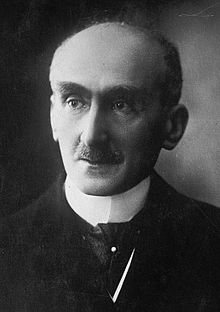
Bergson was a French philosopher who was influential in... continental philosophy, especially during the first half of the 20th century…, but also after 1966 when Gilles Deleuze published Le Bergsonisme. Bergson is known for his arguments that processes of immediate experience and intuition are more significant than abstract rationalism and science for understanding reality…. [I]n France [Bergson was] seen as opposing the "secular and scientific" attitude adopted by the Republic's officials.
Introductory Comments
For much of Western philosophy, change has been a troublesome guest at a banquet honoring permanence. Plato located ultimate reality in eternal Forms; Aristotle found it in substances that endure through change. Later philosophers, in very different ways, continued the search for stable entities, essential properties, and logical relations. The result was what Bergson might have called the "metaphysics of the snapshot" - a tendency to treat reality as a collection of things that happen to change, rather than as an unceasing process of change itself. The philosophical enterprise became, in large part, an effort to catalog the universe's furniture, as though reality were a vast museum where Being obligingly held still for inspection. Not all philosophers fell into this habit, but enough did to keep the museum well stocked.
Bergson wanted to set the exhibits moving. For him, reality is not fundamentally a collection of things but an unceasing flow that our practical intellect freezes into a series of snapshots. Much as a melody cannot be understood by examining its notes in isolation, the continuous movement of reality cannot be fully grasped through static concepts. Such analysis is indispensable to science, but it cannot capture what Bergson called duration - the flowing, indivisible experience of lived time. For that, he turned to intuition, a disciplined effort to enter into reality rather than inspect it from outside. Or if you prefer: to wade into the current rather than stand on the shore.
Some of Bergson's Key Positions
Intellect and intuition are two distinct ways of knowing. Intellect, the faculty behind logic and science, evolved to help living beings act on matter. It does this superbly by cutting the world into fixed, measurable units, but that habit makes it clumsy with anything that flows. Intuition enters into a thing and grasps it from within. Philosophy needs both, with intuition recovering what intellect chops into pieces.
Time shows the difference most clearly. Science treats time as if it were space: a line of identical instants, like ticks of a clock. Lived time, or duration (durée), is a continuous, qualitative flow in which past and present melt together, as the notes of a melody blend into a single tune. Duration can be lived and intuited, but never measured.
Because the self lives in duration rather than in separate moments, freedom is real. A free act springs from the whole personality as it has grown through time, and no mechanical model of the mind can predict it.
Life itself is duration on a cosmic scale. Evolution follows neither blind mechanism nor a preset plan. It is driven by the élan vital, a vital impetus that surges into matter, meets its resistance, and splits along diverging lines, producing novelties no one could have foreseen. In human consciousness, life has acquired the remarkable capacity to reflect upon its own becoming.
Place in the History of Ideas
Bergson's Place in History of Ideas
Robert C. Solomon: [Bergson] rejected the realist insistence that consciousness is always consciousness of objects, and insisted that we are immediately aware only of our own experi- ence, and can know the objects that cause that experience only by inference. What we know best and immediately, therefore, is the flow and duration of our own consciousness, of the pass- ing of the past and the continuing arrival of the future. But this is knowledge that does not yield easily to concepts; one knows it rather by living it, through inutition.... Furthermore, our knowledge of other people and their experi- ence resists conceptualization, and must be known through intuition too. Concepts are useful for the scientific study and description of the material, spatial world, but not for the understanding of human experience.
Bertrand Russell: One of the bad effects of an anti-intellectual philosophy, such as that of Bergson, is that it thrives upon the errors and confusions of the intellect. Hence it is led to prefer bad thinking to good, to declare every momentary difficulty insoluble, and to regard every foolish mistake as revealing the bankruptcy of intellect and the triumph of intuition.... [A]s regards mathematics, he has deliberately preferred traditional errors in interpretation to the more modern views which have prevailed among mathematicians for the last eighty years.
Random Thoughts on Bergson
Bergson viewed nature not as a mere mechanism but as a restless creative force - an élan vital that propels life toward ever-new possibilities. This vital impulse is the invisible animator behind evolution's spectacular pageant: the reason life doesn't merely persist but continually experiments, proliferates, and produces astonishing new forms. Watch a seed crack through concrete, observe the staggering diversity of a coral reef, consider the emergence of human intelligence, and something of this creative impulse seems to reveal itself. Yet evolution, for Bergson, is no steady march toward greater complexity and consciousness. Life branches in unpredictable directions, encounters obstacles, and sometimes runs into dead ends.
Darwin, by contrast, offered a view of nature that seems almost disappointingly sober - though no less magnificent for its sobriety. Natural selection requires no mysterious vital force, only variation, heredity, and differences in reproductive success. Organisms inherit traits that may help or hinder them, and those that confer an advantage tend to become more common over generations. The breathtaking complexity we see - the eye, the wing, the brain - emerges from countless modifications accumulating like interest in a very old bank account. Julian Huxley is said to have quipped that the élan vital explained life about as well as an élan locomotif would explain a railway engine. So: no life force, no vital spark, no invisible hand. And yet, the results.
Augustine (Time is subjective and exists only in our apprehension of reality.)
Darwin (Intelligence is a practical faculty that evolved to help us survive.)
Dilthey (Unlike natural sciences, human sciences embrace life and experience.)
Fichte (Intuition gives our minds direct access to the ground & nature of reality.)
Goethe (Science & philosophy need to ponder the dynamic character of nature.)
Hamann (Intuition and personal genius are best tools for understanding nature.)
James (Thought is stream of consciousness, which we distort into concepts.)
Schleiermacher (Religion is above all & essentially an intuition and a feeling.)
Whitehead (The world is a process and can't be reduced to mere matter.)
Thinkers with opposing positions:
Carnap (Many philosophical questions abuse language and are meaningless.)
Descartes (The workings of nature are completely physical and mechanical.)
Einstein (Actual time is relative but not subjective. It is what clocks measure.)
Frege (Logic is the appropriate measure of what can or cannot be.)
Hobbes (Since the will is causally determined, it is not free in its choices.)
McGinn (Uncaused or random events do not support the concept of free will.)
Parmenides (Reality is one and changeless. Existence is timeless and uniform.)
Spencer (Survival of the fittest is the driving force in the mechanism of life.)
What others said about Bergson
Lewis Mumford: [For Bergson] organic time is cumulative in its effects... [T]he past... remains present in the future that has still to be born.
G. J. Whitrow: As the [19th] century progressed, ... truth itself tended to be regarded no longer as eternal and changeless but as time-dependent.... This radically new point of view received its extreme formulation in… Bergson....
Cassirer: In [Bergson's] philosophy of nature the organic world had been described as the result of a struggle between two contrary forces. On the one hand we find the mechanism of matter, on the other hand the creative... power of the "élan vital." The pendulum of life constantly swings from one pole to the other. The inertia of matter resists the energy of the vital impulse.
Edwin Arthur Burtt: Berkeley, Hume, Kant, Fichte, Hegel, James, Bergson all are united in one earnest attempt, the attempt to reinstate man with his high spiritual claims in a place of importance in the cosmic scheme.
Peirce: ... it is not very gratifying to my feelings to be classed along with a Bergson who seems to be doing his utmost to muddle all distinctions.
Robert C. Solomon: Bergson substituted a teleological theory for Darwin's mechanistic model, and postulated a "vital force" that pervaded the entire evolutionary process.
Russell: Of Bergson's theory that the intellect is a purely practical faculty, developed in the struggle for survival, and not a source of true beliefs, we may say, first, that it is only through the intellect that we know of the struggle for survival and the biological ancestry of man: if the intellect is misleading, the whole of this merely inferred history if presumably untrue.
Mark Sinclair: Deleuze’s interpretation [of Bergson] served to keep the flame of Bergson’s philosophy alive and it has been a key motivation for the renewed scholarly attention to it.