Electric WebOpen the interactive pageAll thinkersAbout

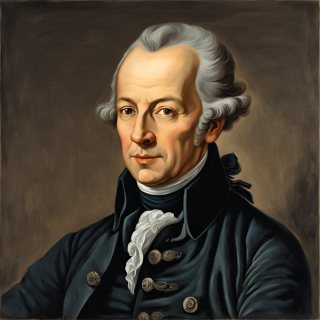
Immanuel Kant (1724 - 1804)

Königsberg, Germany · 1700-1799 · Wikipedia

Immanuel Kant

Open Kant's interactive page (graphs of influences, similar and opposing positions, and quotes)

Background

                      Immanuel Kant
  Born:  22 April 1724 in Königsberg, Prussia
      (now Kaliningrad, Russia)
  Died:  12 February 1804 (aged 79) in
     Königsberg, Prussia
  Ethnicity:  German
  Alma mater:  University of Königsberg
     (MA, 1755; PhD, 1755; Dr. habil., 1770)
  School:  Kantianism, Enlightenment philosophy,
     German idealism
  Main interests: Epistemology, Metaphysics,
     Ethics, Cosmogony, Political Theory,
     Aesthetics, Religion
  Notable ideas: Transcendental idealism,
     Critical philosophy, Synthetic a priori,
     Numenon, Categorical imperative,
     Hypothetical imperative, "Kingdom of Ends"
     The primacy of the practical, Nebular
     hypothesis, "Sapere aude"
 
From Wikipedia
 
Kant was a German philosopher and one of the central Enlightenment thinkers. Born in Königsberg, Kant's comprehensive and systematic works in epistemology, metaphysics, ethics, and aesthetics have made him one of the most influential and controversial figures in modern Western philosophy. He has been called the "father of modern ethics", the "father of modern aesthetics", and for bringing together rationalism and empiricism, he has earned the title of "father of modern philosophy".
Introductory Comments
 
Hume, Kant confessed, woke him from his dogmatic slumber. It was not a gentle awakening. By the time Hume had finished, causality was a habit of expectation, the self a bundle of passing perceptions, and God, the soul, and the life to come were placed beyond the reach of any argument. Even natural science, the pride of the age, seemed to rest on nothing sturdier than custom. Kant fell silent for a decade, gathered his considerable wits, and emerged with a proposal:
 
Philosophers had assumed that our knowledge must conform to objects - and on that assumption, Kant granted, Hume was right that nothing could be known about objects in advance. So reverse it. Let objects, insofar as they can be experienced at all, conform to the equipment we bring to them. Kant compared the maneuver to Copernicus, who explained the wheeling heavens by setting the spectator in motion instead. The comparison has always been a little slippery, since Copernicus moved us off center and Kant appears to move us back onto it. But the shared move is the one that matters: when appearances do not add up, suspect the observer. One might grumble that Kant merely says the world looks the way we are built to see it, which Hume would happily concede. But Kant claims something stronger: whatever we encounter will be spatial, temporal, and causally ordered - precisely the necessity Hume had denied. The cost is steep. That necessity holds only for the world as it appears, never for the world in itself.
Some of Kant's Key Positions
 
A philosophy built entirely on empirical evidence, like Hume's, explains far less than it promises. Pressed rigorously, it unsettles the basic furniture of thought - enduring objects, the unity of the self, and above all causality. Experience shows one event following another, never making another.
 
What the empiricists miss is that knowledge requires more than sense data. It requires a mind that supplies the forms in which data can appear at all: space and time as the forms of sensible intuition, and the categories - substance, causality, unity, necessity - as the concepts by which the understanding binds appearances into a coherent world. Concepts without intuitions are empty; intuitions without concepts are blind.
 
A philosophy built entirely on empirical evidence, like Hume's, explains far less than it promises. Pressed rigorously, it unsettles the basic furniture of thought - enduring objects, the unity of the self, and above all causality. Experience shows event an following another, never making another.
 
Morality is the ultimate priority. A rational will must act only on principles it could will as law for every rational being - categorically, not as a means to ends it happens to want. Morality also licenses what theory cannot prove: a rational faith in freedom, immortality, and God. This is hope, not incentive. Acting well to collect a reward would destroy the act's moral worth.

Place in the History of Ideas

Kant's Place in History of Ideas
 
Bertrand Russell: According to Kant, the outer world causes only the matter of sensation, but our own mental apparatus orders this matter in space and time, and supplies the concepts by means of which we understand experience. Things in themselves, which are the causes of our sensations, are unknowable; they are not in space or time, they are not substances, nor can they be described by any of those other general concepts which Kant calls "categories." Space and time are subjective, they are part of our apparatus of perception.
 
Stephen Hicks: Kant was the decisive break with the Enlightenment.... Contrary to the Enlighten- ment account of reason, Kant held that the mind is not a response mechanism but a consti- tute mechanism. He held that the mind - and not reality - sets the terms for knowledge. And he held that reality conforms to reason, not vice versa. In the history of philosphy, Kant marks a fundamental shift from objectivity as the standard to subjectivity as the standard. Wait a minute, a defender of Kant may reply. Kant was hardly opposed to reason. After all, he favored rational consistency and he believed in universal principles. So what is anti-reason about it? The answer is that more fundamental to reason than consistency and universality is a connection to reality. Any thinker who con- cludes that... reason cannot know reality is not fundamentally an advocate of reason.
 
Random Thoughts on Kant
 
Hume and Kant are usually staged as two boxers circling each other, and the picture is not wrong - but several of the punches sail past the chin. Hume, no less than Kant, saw that the mind does not passively receive the world but works it into shape. He simply called the shaping habit and custom rather than form and category, and made it acquired rather than given. Even that contrast is softer than it looks. Kant disliked the word "innate" and instead described his forms as an original acquisition - something the mind does not find in itself ready-made but generates itself.
 
One punch does land, though. For Hume, custom explains why we expect the sun to rise; it never shows that it must. Repetition breeds confidence - not proof. Kant wanted exactly what Hume said could not be had: necessity and universality, guaranteed in advance of all possible experience. The second difference is the one between pure and practical reason. Pure reason, Kant concluded, fixes the boundaries of knowledge, and the territory inside is smaller than one hoped - appearances only, never things as they are in themselves. But practical reason shows why a moral agent must proceed as though freedom, immortality, and God were real, not as proven facts but as assumptions the moral life requires. Regarding free will, Hume does go along partway in that he considers it a natural illusion. But regarding the other two beliefs, no way. Kant saw religion as a moral compass; Hume doubted there was even a North.

Influences

Kant was influenced by: Aristotle, Descartes, Epicurus, Hume, Leibniz, Locke, Plato, Rousseau, Smith, Adam, Spinoza, Swedenborg, Wolff

Kant influenced: Adorno, Cassirer, Fichte, Hegel, Heidegger, Husserl, Kierkegaard, Nietzsche, Nozick, Peirce, Rawls, Schelling, Schlegel, Schopenhauer

Similar and opposing positions

Thinkers with similar positions:

Thinkers with opposing positions:

What others said about Kant

Schools: Antireductionism, Common Sense Realism, Continental Philosophy, Deontological Ethics, Enlightenment, Fideism, German Idealism, Innatism, Internationalism, Liberalism, Natural Law Theory, Rationalism, Secularism, Skepticism, Transcendental Idealism, Voluntarism

Main interests: Architecture, Art and Aesthetics, Beauty, Causality, Consciousness, Cosmology, Desire, Epistemology, Equality, Ethics, Fact–value distinction, Free/Unfree Will, Freedom, Habits, Happiness, History, Human Will, Immortality, Infinity, International Law, Jurisprudence, Just War, Law, Logic, Mathematics, Metaphysics, Mind, Perception, Personal Identity, Physics, Political Philosophy, Progress, Punishment, Racism, Religion, Salvation, Sublime Nature, Time, Universals, Virtue, War, Will, Wisdom
Kant's answers to philosophical questions

Art and Aesthetics

What is art? How does it differ from other human endeavors? How is it similar?
In contrast to the other arts, fine arts don't rely on any prior rule, though others may later discover a new rule at work.
What is beauty? Is it completely subjective? If not, how can it be objectively assessed?
An object is beautiful when we it evokes a disinterested pleasure in us - a pleasure of pure contemplation.
What role does emotion play in creating and appreciating art? Does art transform our emotions?
"That taste is always barbaric which needs a mixture of charms and emotions in order that there may be satisfaction...."
Is the value and meaning of a work of art a completely subjective matter?
Artistic worth is based on received pleasure. Moreover, one can't be argued into feeling pleasure through artistic analysis.
What is the proper role or task of the art critic? Or does the art critic have no useful role?
Though no universal formula exists for art critics to apply, they can still use reason to correct & extend judgments of taste.

Epistemology

From what source or sources does knowledge spring? Sensation? Reason? Intuition? Or what?
Knowledge is both sensibility & understanding: "Thoughts without content are empty, intuitions without concepts are blind."
Are perceptions direct and unmediated representations of the world around us?
Perceptions are never raw sensory data, but always shaped or organized by our innate categories of thought.
If experience is inherently subjective or phenomenological, how can we know anything?
Aside from analytic truths, all we can know is the phenomenal world. We cannot know what things are in themselves.
Are sensations written on a "blank slate" or does experience rely on a set of innate assumptions?
If raw experience existed, it would be unintelligible. Intelligible experience rests on basic assumptions about the world.
If we are born with a set of predetermined mental categories, how do they shape experience?
Innate categories like time, space, causality, etc., shape experience along temporal, spatial, causal, etc. lines.
Can anything be known without reference to experience? What about "pure" deduction?
Some of our basic concepts do not spring from experience. Rather, innate concepts make experience possible.
To what extent can we rely on logic or reason? To what extent should we rely on logic or reason?
Unlike empirical judgments, purely analytic judgments do not add anything to our knowledge of the world.
What distinguishes belief from knowledge? How are beliefs acquired and how are they used?
"I have therefore found it necessary to deny knowledge, in order to make room for faith."
What connection, if any, exists between truth and practical consequences?
Practical vs. pure reason: "[R]eason is... given to us as a practical faculty, that is, as one that influences the will."
Is complete skepticism a viable or justifiable position? If not, what about limited skepticism?
Skepticism is a useful starting point, but if taken too far it undermines ethics, science and social progress.

Ethics

Is morality relative and subjective? Can moral truths be objective in any sense? If so, how?
We should approach moral decisions objectively and see that they always represent or rest on universal principles.
If moral truths actually exist, how can we find them? Through reason? Faith? Intuition? How?
Moral laws spring inexplicably from within: "Two things awe me most, the starry sky above me and the moral law within me."
Should ethical decisions be based on moral principles or practical consequences? Or what?
Moral decisions must never be based on consequences. Only universal principles can justify moral decisions.
Should moral generalities be avoided and each unique situation be judged by itself?
Moral decisions are inherently universal. If moral principles do not apply to everyone, they are not truly moral.
What connection, if any, exists between virtue and happiness?
"Morality isn't the doctrine of how we may make ourselves happy, but of how we may make ourselves worthy of happiness."
Is happiness the most important purpose or aim in life? If not, what is more important?
Happiness is not the purpose of life, but insofar as our actions are dutiful, we become worthy of happiness.
Is the meaning we find in life something discovered or created? Or is there no meaning here?
"Without man and his potential for moral progress, the whole of reality would be a mere wilderness, a thing in vain…."
Is there a moral yardstick or ultimate good that can serve as a standard for judging our actions?
"Act that your principle of action might safely be made a law for the whole world."
What moral obligations do we have towards others and how do these obligations vary?
Since every person is endowed with reason, each must be treated as an end in himself - never as a means to our ends.
What is conscience and where does it spring from? Or is conscience more pretense than reality?
Conscience is the moral law within us. It has nothing to do with either the seeking or the avoidance of consequences.
Given the effects of nature and nurture, are we ultimately responsible for our behavior?
Though man has free will, his freedom is limited: "Out of the crooked timber of humanity no straight thing was ever made."
What is love? An ideal? An emotion? An independent force in nature?
Unlike benevolence, "love is a matter of feeling, not of will or volition...; hence there is no such thing as a duty to love."

History

In what sense and to what extent, if at all, is the course of history one of progress?
Culture has progressed in that it is increasingly easier to satisfy our needs, though we may never be perfectly satisfied.

Law

Why are laws needed? And when are laws not needed or inappropriate?
Though state laws are needed, it's more important to "live your life as though your every act were to become a universal law."
How should laws be determined? What makes laws legitimate? What makes them invalid?
When making laws, legislators should ask "the question whether the people could have imposed such a law on itself."
What is the connection, if any, between morality and law?
"In law a man is guilty when he violates the rights of others. In ethics he is guilty if he only thinks of doing so."
What are natural laws and how, if at all, do they relate to civil laws?
Natural laws concern innate or God-given rights & duties. Human laws concern acquired or man-made rights & duties.
Do innate human rights actually exist? If so, what is their origin, nature and/or relevance?
Natural or innate rights rest on purely rational and thus also universal principles. They should guide our juristic actions.
How is punishment justified? As retribution? Rehabilitation? Deterrence?
Any theory of punishment based on utilitarian grounds should be dismissed. All that matters is the degree of retribution.
How should punishment be measured out? What determines excessive punishment?
Punishment should be based on the principle of equality so that the punishment is commensurate with the injury done.

Metaphysics

Do "forms" or universals exist? If so, do they exist independent of material things?
Transcendental forms at work in human cognition, such as space and time, do, in some sense, exist independently.
What is time? Is it something absolute that can exist on its own or is it inherently relative?
We can't know what time is in itself, but as the a priori "form of the internal sense," time makes all experience possible.
What is space? Can it exist independent of matter? If not, how is it related to matter?
"Space and time are the framework within which the mind is constrained to construct its experience of reality."
What is causation and does the "law" of causality imply universal determinism?
We can't prove causality exists, but as an innate category of thought it helps make experience possible.
Does free will really exist? If so, how is it consistent with universal causality?
We can't prove free will exists, but practical reason shows that morality requires the assumption of free will.
Are we living in a pluralistic world or is there an essential oneness to all being?
Though our experiences of the world are many, they are brought together in the transcendental unity of apperception.
Is metaphysics actually possible or are the questions here beyond human understanding?
"Metaphysics is a dark ocean without shores or lighthouse, strewn with many a philosophic wreck."

Mind

What is mind? Is it a substance or a process? Does it have parts? Does it serve a function?
The mind brings together the faculties of sense, understanding and reason into a unified and self-regulating system.
Who or what is that being we call self? And is our sense of self-identity justified?
The unity of self helps bring together all our experiences into one coherent whole & makes synthetic knowledge possible.

Nature

What purpose, if any, is at work in nature? Or is nature unconcerned with its own workings?
The fact that creatures make good use of what nature provides does not prove that such things were created for others.
Is there a spiritual or vitalistic element in nature, or is nature a purely physical process?
We often find what is most threatening in nature - lightning, thunder, volcanoes, hurricanes, etc. - sublime.
Are the numerous species of plants and animals immutable or do they evolve over time?
The similarity we often see in the various structures and parts of living things makes one suspect a common descent.
What place do humans have in nature? What, if anything, sets them above other animals?
"Without man and his potential for moral progress, the whole of reality would be a mere wilderness, a thing in vain…."

Philosophy

What is philosophy anyway? And what function does it serve?
"[T]he interests of my reason… combine in [these] questions: 1.What can I know? 2.What ought I to do? 3.What may I hope?"
How should the discipline of philosophy be best approached and/or pursued?
In doing philosophy, we should make a clear distinction between the speculative and the practical or moral.
What is the difference between philosophy and science? What, if any, are their connections?
By resting in part on the innate categories of the mind, philosophy is to that degree a scientific study of the mind.
What is the role of logic in the pursuit of philosophy? What are its limitations here?
Pure reason, divorced from empirical matters, can ask itself transcendental questions that are impossible to answer.
What connection, if any, exists between mathematics and philosophy?
Philosophers are seriously misled if they think they can apply the method of mathematics to their own inquiries.

Political Philosophy

What is the origin of sovereignty and/or government? How, if at all, is this origin relevant?
The state originates with a social contract. This in turn signifies the rightfulness of the state and its constitution.
What is the best form of government - democracy, aristocracy, monarchy, something else?
The only rightful constitution is a pure republic - that is, a truly representative system of the people.
To what extent is government founded on force? What limits should be placed on such force?
Government should be founded on a respect for everyone's freedom. When constraints exist, they must be reciprocal.
To what extent can the relations between nations be regulated or at least pacified?
Creating a world state is the best way to end the continual conflict between nations and maintain peace on earth.
When, if ever, is revolution justified? What are the inherent dangers of revolution?
"Resistance on the part of the people of the state is never legitimate; for... submisssion [here makes] law & order possible."
When, if ever, should freedom of speech be restricted to protect the greater good?
If speech is restricted, we're deprived of "testing the correctness of our moral judgments [and] are exposed to error."

Psychology

What are the major functions or forces at work in human psychology?
Humans have three distinct and fundamental faculties: the faculty of knowledge, of pleasure and pain, and of desire.
To what extent does reason determine our actions? To what extent do impulse and desire rule?
Though reason should control our behavior, it must not only serve our higher ends, but also our physical or creature needs.
What is the will? What role does will play in human psychology? What are its constraints?
Only humans possess a will that can, at least when acting morally, disregard all instinctive desires and inclinations.
What is the best approach to leading a productive and well adjusted life?
To lead moral and rewarding lives we must place duty above the urges of our bodies and our appetites.
Is happiness actually possible? If so, how is it achieved? If not, what is our alternative?
"Rules for happiness: something to do, someone to love, something to hope for."

Religion and Theology

What exactly is religion? How is it distinguished from other institutions and belief systems?
The significance of religion is moral: Belief in God and immortality shows that moral acts are ordained and rewarded.
What explains the origin of religion: revelation, reason, fear, awe, story-telling, fellowship?
Religious belief is a type of faith, but in Christianity it is a rational faith, since practical reason proves its moral worth.
Does God exist? If so, can His existence be proven? And if it cannot, how do we know He exists?
Practical (not pure) reason shows that our innate moral consciousness justifies a belief in both God and immortality.
What role does faith play in religion? Is it more important than reason?
Though faith is the basis of religion, practical reason shows that religious belief can serve & support our moral nature.
Is morality possible without religion - or at least without some belief in God?
Though the Bible offers good and useful moral advice, reason alone could provide us with the same guidance.
Did God create the universe and/or design nature? If so, is God still at work in the world?
God created the world and the moral law. He now judges us accordingly - with unerring precision and perfect justice .
Do souls or spirits exist after death? If so, in what manner and for what sort of creatures?
We are justified in believing that an eternal life awaits us, since such a belief helps us live moral and Christian lives.
What role do symbols, rites and rituals play in religion? Can religions exist without these aids?
"It is a superstitious illusion to [think one becomes] well-pleasing to God through [rituals] which anyone can perform...."
What is the role of miracles in religion? How much credence, if any, should we give miracles?
Even if miracles happened, they would not prove God's existence, since we cannot know Him via sensory experiences.

Science

What is science and how does it differ from other disciplines or ways of knowing?
"[A scientist] must approach nature [in the character] of a judge, who compels the witnesses to reply to [his] questions...."
What roles do induction and deduction play in science? How are these roles connected?
Unlike pure logic, science is closely linked to the empirical world. Transcendental reason does not give rise to science.
Why is mathematics so important in science? And is our world inherently mathematical?
Math is fundamental in physics because it is the "a priori intuition of the pure forms of phenomena - space and time."
Do living things evolve over time? If so, is this due to a process of natural selection?
"God put a secret art into the forces of Nature so as to enable it to fashion itself out of chaos into a perfect world system."

Sex and Gender

What is the moral significance of human sexuality? When should sexual impulses be restrained?
"Sexual love can... be combined with human love..., but taken by itself and for itself, it is nothing more than appetitie."
What is the function or nature of marriage? How should this function or nature be realized?
Marriage is sanctioned by natural law, being the union of two for mutual pleasure of sex & mutual rearing of children.

Society

If human beings are social animals, what needs are met by society - and what are not?
"It is only in society that it occurs to man to be not merely a man, but a refined man… (the beginning of civilization)."
Do societies progress in any meaningful way? If so, how should we measure this progress?
Social progress & defective man: "From such crooked wood as that which man is made of, nothing straight can be fashioned."