Maimonides (1135 - 1204)
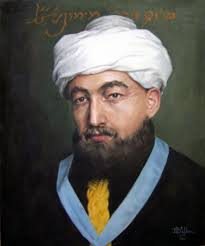
Open Maimonides's interactive page (graphs of influences, similar and opposing positions, and quotes)
Background
Moses Maimonides
Born: 1135 in Cordova, Almoravid Empire
(present-day Spain)
Died: 12 December 1204 (aged 69) in Fostat,
Egypt (now Cairo, Egypt)
Religion: Judaism
Era: Medieval Philosophy
Region: Jewish philosophy
Schools: Jewish law, Jewish ethics
Influences: Talmud, Plato, Aristotle, al-Farabi,
Avicenna, Avempace, Averroes, Algazel,
Ibn Zuhr, Ibn Sina, Ibn Tumart, Plotinus
Influenced: Jeremiah Stamler, Spinoza, Aquinas,
Albertus Magus, Duns Scotus, Joyce, Bodin,
Leibniz, Newton, Strauss, Friedländer, Levinas
From Wikipedia
Maimonides was a Sephardic rabbi and philoso- pher who became one of the most prolific and influential Torah scholars of the Middle Ages. In his time, he was also a preeminent astronomer and physician, serving as the personal physician of Saladin. He was born and lived in Córdoba [Spain]..., until his family was expelled for refusing to convert to Islam.... Influenced by Aristotle, Al-Farabi, Ibn Sina, and his contemporary Ibn Rushd, he became a prominent philosopher and polymath in both the Jewish and Islamic worlds.
Introductory Comments
Maimonides was born in Córdoba in 1138, near the tail end of what's often called the golden age of Jewish culture in Muslim Spain - several centuries during which Jews found real room to flourish under Islamic rule. His own family tree hints at just how rich that world could be: son of Maimon the Judge, son of Joseph the Wise, son of Isaac the Rabbi, son of Obadiah the Judge, a lineage of scholars stretching back generations. Few thinkers of the Middle Ages were born into a world so open to learning.
Then Maimonides's luck ran out. In 1148 a Berber dynasty, the Almohads, took Córdoba and swept away the old protections for non-Muslims. Jews and Christians now faced a stark menu: convert to Islam, leave, or die. So the family left - from southern Spain to North Africa, then to Palestine, and at last to Egypt, where Maimonides flourished once more under a more tolerant Muslim rule.
But the years of wandering left their mark, and perhaps we can see it most clearly in his universalism. He labored to square religious and ethical belief with reason, to draw Judaism into the wider conversation of ideas, and to honor the wisdom of non-Jewish thinkers - Aristotle above all, but also Plato, Avicenna, Al-Farabi, Averroes, and Galen. The older Maimonides, in short, dreamt of being a citizen of the world in an age that offered little room for such a thing. A dream, in its own way, as quixotic as Quixote's.
Some of Maimonides' Key Positions
Reason can prove that God exists and can illuminate much about the world He created, but reason alone cannot capture God's true nature. Indeed, no positive attributes can be grasped; we come closer to Him by saying what He is not than by saying what He is. Here faith must take over where philosophy leaves off.
Faith, however, is no license for idle fancy. Matters of belief are to be weighed and settled by learned men - steeped in the Torah and Talmud. Poetry, because it delights in fiction and metaphor rather than literal truth, cannot serve as a reliable guide to religious doctrine.
For the learned, disciplined faith includes the study of philosophy. Faith reaches beyond philosophy's strict limits, yet philosophy can help make faith intelligible - even to those who do not yet share it. For example, when the Torah commands us to love and fear God, it points toward what philosophers describe as contemplating the order of creation, earthly and heavenly alike.
Because the truths of faith can be rendered in philosophical terms, there can be no genuine conflict between what Scripture reveals and what the mind discovers through science and philosophy. Apparent contradictions signal that we have misread the text, or misunderstood the science. And among the guides to that science and philosophy, none stands taller than Aristotle.
Place in the History of Ideas
Maimonides' Place in History of Ideas
Anthony Kenny: Maimonides' project for recon- ciling philosophy and religion depends on his heavily agnostic view of the nature of theology. We cannot say anything positive about God, since he has nothing in common with people like us: lacking matter and totally actual, im- mune from change and devoid of qualities, God is infinitely distant from creatures. He is a simple unity, and does not have distinct attrib- utes such as justice and wisdom.... We have no way of describing God... except through nega- tion. If we are not to fall into idolatry, we must explain as metaphor or allegory every anthropomorphic text in the Bible.
Jonathan Jacobs: Aristotelianism and Neoplato- nism intersect in [Maimonides’] view that the further away from the ground and source of being - the further from God in the created order - the less perfect are beings and the more susceptible they are to degeneration, change, and ceasing to be. The more fully a human being actualizes the intellect, the more like God that individual becomes inasmuch as actuated intellect has no tendency to corruption or change. A human being whose intellect is actualized as fully as possible is able to come closer to God. That striving involves the exercise of ethical virtue and intellectual virtue. This is an intellectualized conception of imitatio dei.... [H]uman beings are capable of being close to God through understanding.
Random Thoughts on Maimonides
In the history of ideas, ripples from Plato and Aristotle reach all the way to the present, and now and then overlap in surprising ways. We can watch this Greek turbulence at work in Maimonides's philosophy - above all in his conception, and his "anti-conception," of God. Like Aristotle's Unmoved Mover, Maimonides's God is the First Cause who sets the world in motion, for reason tells us the causal chain cannot regress forever. He therefore thinks of God in abstract, logical terms rather than concrete, anthropomorphic ones. And through what Aristotle called the Active Intellect - the meeting ground of the divine and human minds - we may, by perfecting our own understanding, inch a little closer to God.
But that is not the whole story. Maimonides also insists that we can never say what God is, only what He is not: not finite, not material, not changeable, and so on. Here we catch a different, more distant ripple. The impulse runs back through Plato - who held that ultimate Reality outstrips our everyday thinking, since it lies beyond that thinking altogether - but it reaches Maimonides only after a long detour. It passes through Plotinus and the Neoplatonists, for whom the One lies past all speech, and then through the Islamic writers, like Avicenna and Al-Farabi, who folded that mystical strain into a rigorous logic. And so, the ancient ripples overlap once again: Maimonides has both Aristotle's confidence in reason and Plato's reverence for what lies beyond it.
Influences
Maimonides was influenced by: Al-Farabi, Al-Ghazali, Aristotle, Avempace, Averroes, Avicenna, Ibn Tumart, Ibn Zuhr, Plato, Plotinus
Maimonides influenced: Albertus Mag., Aquinas, Bodin, Jean, Duns Scotus, Friedlander, Joyce, Leibniz, Levinas, Mendelssohn, Newton, Nicholas of C., Spinoza, Stamler, J., Strauss
Similar and opposing positions
Thinkers with similar positions:
- Albertus Mag. (Aristotle's philosophy is compatible with religious beliefs.)
- Al-Kindi (The purely contemplative part of the Soul is its higher & eternal part.)
- Anselm (Evil has no positive nature, but is simply the absence of good.)
- Aristotle (Man does not realize himself through emotions, but through reason.)
- Augustine (Evil is not a force, but comes from lack of goodness.)
- Averroes (Intricate design in the natural world must be due only to God.)
- Avicenna (The pursuit of science is consistent with religious devotion.)
- Pascal (God is infinitely incomprehensible. We can't reason our way to God.)
- Pseudo-Denys (God is beyond reason. We know what He isn't, not what He is.)
Thinkers with opposing positions:
- Abelard (Evil is a real force in the world and some things are evil by nature.)
- Bayle (The value of faith is directly proportional with its repugnancy to reason.)
- Darwin (Intricate design in the natural world can be explained thru science.)
- Diderot (The universe is simply matter in motion, bound by laws of nature.)
- Heidegger (Poetry, not philosophy, is best at unveiling the mysteries of Being)
- Maistre (Evil is real and exists because of its place in the divine plan.)
- Sextus Empiri. (Demonstrative reasoning doesn't lead to true knowledge.)
What others said about Maimonides
- Shlomo Pines: Maimonides is the most influential Jewish thinker of the Middle Ages, and quite possibly of all time.
- Vitaly Naumkin: Maimonides is perhaps the only philosopher in the Middle Ages, perhaps even now, who symbolizes a confluence of four cultures: GrecoRoman, Arab, Jewish, and Western.
- Strauss: Maimonides states that the intention of his work is to explain the meaning of Biblical words [and] Biblical parables. Such an explanation is necessary, because the external meaning of both lends itself to grave misunderstanding. Since the internal meaning, being hidden, is a secret, the explanation of each such word or parable is the revelation of a secret.
- Christopher Hitchens: When Maimonides says that the Messiah will come but that "he may tarry," we see the origin of every Jewish shrug from Spinoza to Woody Allen.
- Abdel Rahman Badawie Badawi: I regard him first and foremost as an Arab thinker.
- Russell: [Maimonides tried] to reconcile Aristotle with Jewish theology. Aristotle is the authority on the sublunary world, revelation on the heavenly. But philosophy and revelation come together in the knowledge of God.
- David Shatz: [Maimonides's] writings contain extensive discussion of... the attempt to "quell the impulses" of matter that distract people from intellectual pursuits and impede cognition of what is not physical. The quelling of such impulses is associated with the attainment of holiness. Morality is a preparation for contemplation and constitutes no trivial task.
- Jonathan Jacobs: [Maimonides] did not seek to replace tradition with philosophy but to articulate the rationality of tradition and show the ways in which philosophical depth and truth are present in Jewish thought and tradition.
Schools: Aristotelianism, Intellectualism, Jewish Theology, Neoplatonism, Platonism
Main interests: Astronomy, Biology, Cosmology, Faith, Fate, Free/Unfree Will, Happiness, Health, History of Philosophy, Immortality, Medicine, Religion, Theology, Universals, Virtue, Wisdom
Maimonides's answers to philosophical questions
Art and Aesthetics
Since even the best poetry is imaginary and hence false, it does not enrich us. Rather, it weakens and impoverishes us.
Crafts and the applied arts are generally useful, whereas the so-called fine arts are generally useless flights of the imagination.
Education
"Give a man a fish and you feed him for a day; teach a man to fish and you feed him for a lifetime."
"All the evils that men cause, to each due to certain desires or opinions or religious principles, are rooted in ignorance."
"The person who wishes to attain human perfection should study logic first, next math, then physics, &, lastly, metaphysics."
To acquire knowledge, one must first admit ignorance. "Teach thy tongue to say I do not know, and thou shalt progress."
Epistemology
No conflict exists between what God revealed in holy scripture and what reason has discovered through philosophy.
Some beliefs are necessary to maintain social order and religious faith but are also, strictly speaking, untrue.
Compete skepticism isn't warranted, but humility is. For "every person thinks his mind more clever & more learned than it is."
Ethics
Since many virtues lie in a mean between two extremes, we should look for this mean in all our actions and positions.
Virtue is a willingness and an ability to be guided by reason. Virtue therefore requires both intelligence and practice.
Though outside forces often shape our disposition, one can still choose to behave in ways to improve one's character.
Though bodily pleasures have their role, we must not allow them to disturb our love and knowledge of God.
Metaphysics
"He... who begins with Metaphysics, will not only become confused in matters of religion, but will fall into complete infidelity."
Nature
God placed man above animals by giving him reason, but below angels in that he still must rely on his bodily senses.
Psychology
"Man's obsession to add to his wealth and honor is the chief source of his misery."
Religion and Theology
"As long as the soul lies dormant and does not acquire its form from knowledge, then the nature of the soul is useless...."
It is best to describe God through negative attributes - not non-existent, not ignorant, not multiple, not corporeal, etc.
Though reason can prove the existence of God, only faith can show us the exact nature or attributes of God.
Evil is not a creation, but an absence of good. God created all that is good in the world, but not the absence of good.
"The basic principle is that there is a First Being who brought every existing thing into being…." That First Being is God.
The Torah's command to love and fear God is what philosophers mean when they say we should contemplate creation.
We must have free will, otherwise God would never have punished the wicked nor rewarded the righteous.
"In the world to come, there are no bodies, but only the souls of the righteous alone, without bodies, like the angels."
Holy scripture is at times symbolic or metaphoric - for example, when God is described in anthropomorphic terms.
"Apparent exceptions [to laws of nature actually] originate in these laws, although man is unable to see the causal relation."
Knowledge of God perfects the soul and endows it with immortality. Such knowledge is the highest form of happiness.
Talk of God can only communicate our experience of the divine - not the reality or true nature of the divine.
Sex and Gender
"And so our rabbis decreed that a man should honor his wife more than himself, and love her as much as he loves himself."
Society
When confronted with the hatred of others, say to yourself: "I will destroy my enemies by converting them to friends."