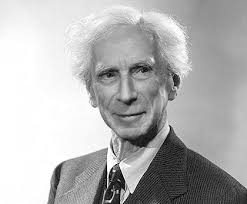
Russell was a British philosopher, logician, mathe- matician, and public intellectual. He influenced mathematics, logic, set theory, and various areas of analytic philosophy. He was one of the early 20th century's prominent logicians and a founder of analytic philosophy, along with his predecessor Gottlob Frege, his friend and col- league G. E. Moore, and his student and protégé Ludwig Wittgenstein. Russell with Moore led the British "revolt against idealism." … In 1950, Russell was awarded the Nobel Prize in Literature....
Introductory Comments
Russell started where certainty seemed safest: in mathematics, whose truths owe nothing to human frailty or historical accident. Late in life he summed up what followed in three tidy steps. He liked math until it became too difficult, so he took to philosophy. When philosophy became too difficult, he took to politics. It is a good joke, and like most good jokes, it is not quite true. Russell ran for Parliament in 1907 as a champion of women’s suffrage. He went to prison in 1918 for opposing the First World War, and he wrote a book on mathematical philosophy in his cell. He was still producing serious philosophy in his seventies. Yet, the joke captures a real direction of travel: a long, dignified retreat from Absolute Truth toward the unstable world we actually live in.
The retreat began closer to home than the joke admits. Russell went to math looking for certainty, and in 1901 he found a paradox at its very foundations. It concerns the set of all sets that are not members of themselves, which must both include itself and not include itself. Decades later, he had concluded that mathematical truths were not eternal facts about some higher realm. They were more like elaborate ways of saying the same thing twice. He called this disenchantment "the retreat from Pythagoras." Yet the descent was not a fall. The habits he formed among the axioms came with him into public life: the demand for clear premises, and the refusal to accept a conclusion merely because it is comfortable.
Some of Russell's Key Positions
The world is not, as idealists and mystics insist, a single seamless whole. It is many things, genuinely distinct and genuinely related. Analysis bottoms out in logical atoms: simple particulars, such as fleeting "little patches of color," along with their qualities and relations. Tables, planets, and even persons are logical constructions built from them.
Logic, not speculative metaphysics, is the essence of philosophy. It offers metaphysics' generality without the guesswork, and grand systems should yield to patient, piecemeal analysis. Mathematics itself is logic in disguise, derivable from purely logical principles. Ordinary language misleads. "The present King of France is bald" seems to be about a king, but it actually asserts that exactly one King of France exists and is bald, and so it is simply false. Grammar is a poor guide to logical form.
There is no good evidence for God or immortality, and the burden of proof lies with the believer. God cannot strictly be disproved, any more than Zeus can. Still, the great religions are untrue and harmful, rooted chiefly in fear. Humanity is the product of causes with no foresight of their result, the outcome of "accidental collocations of atoms."
An indifferent universe does not make life meaningless. Values are not written into the cosmos. They express human desires, and they are no less worth living by for that. The good life is inspired by love and guided by knowledge.
Place in the History of Ideas
Russell's Place in History of Ideas
Will Durant: There have been two Bertrand Russells: one who died during the war; and another who rose out of that one's shroud, an almost mystic communist born out of the ashes of a mathematical logician. Perhaps there was a tender mystic strain in him always; represented at first by a mountain of algebraic formulae; and then finding a distorted expression in a so- cialism that has the earmarks rather of a reli- gion than of a philosophy. The most character- istic title among his books is Mysticism and Logic: a merciless attack on the illogicality of mysticism, followed by such a glorification of scientific method as makes one think of the mysticism of logic.
Alistair Cooke: The great thing about [Russell] is that he will not give in - to prudence, cynicism or simple horse sense. Sometime, somewhere, he agonizes, the rational man will make a de- cent world of his instincts.... [H]e is surely one of the glories of our time.... For he is at once a man of unyielding honesty, a first-class intellect and the possessor of one of the master styles of the English language. It is the last of these gifts that guarantees the onlooker an unflagging fascination with his life. For it gives charm to many a frailty, makes the world over every day in the light of his intelligence and his irony, and converts every political crusade,... learned [exchange] and lovers' quarrel into an episode as enchanting as a Mozart concerto.
Random Thoughts on Russell
Every philosopher who has tried to tidy up language eventually discovers that language does not want to be tidied. Russell made the attempt with unusual verve. Ordinary grammar, he argued, is a con artist that wears wears many costumes. Philosophers must rip the costumes off. Break a sentence down far enough and you reach atomic propositions, each matching a simple fact about the world. Rebuild in the austere notation of symbolic logic and you have a "logically perfect language," one whose structure mirrors reality's. Admittedly, this perfected language is only for philosophers - not for ordering lunch.
The awkward twist is that Russell’s sharpest critic was his own former student. Wittgenstein’s Tractatus had helped shape logical atomism, and his later Philosophical Investigations took it apart. Language, he now argued, is less a mirror than a toolbox, woven into countless activities: giving orders, telling jokes, thanking, cursing, praying. Stating facts is just one game among many. Faulting ordinary speech for falling short of logic is like faulting a Swiss Army knife for being a poor saw. Russell was not persuaded. He grumbled that the later Wittgenstein seemed to have grown tired of serious thinking and invented a doctrine that made it unnecessary. Sulking? Perhaps. But he had a point: nobody asks physicists to limit themselves to the vocabulary of the street. Perhaps language is both, a Swiss Army knife for living and, when philosophers truly need one, a saw.
Ayer (Language that is not verifiable is not true or untrue but meaningless.)
Dewey (Democracy applies not just to politics, but also to industry & society.)
Frege (Concepts must objectively exist independent of their instantiations.)
Moore (The notion of "good" and indeed all human values are indefinable.)
Thinkers with opposing positions:
Austin, J.L. (Words not only assert things, but also do or perform things.)
Bergson (Intuition gives our minds direct access to the nature of reality.)
Derrida (There is nothing outside context. All meaning relies on context.)
Hamann (I trust the power of passion and symbol over abstraction and logic.)
Horkheimer (Rationality doesn't inevitably lead to progress in morality & law.)
Lewis, C.I. (First principles in logic must be based on pragmatic considerations.)
Nagel (Being a thinker is to have a subjective perspective on the world.)
Pinker (Language evolved as a practical tool, not as a purely logical instrument.)
Quine (Empirical & theoretical knowledge can't be separated from each other)
Rorty (Language can't represent reality by "holding a mirror up to nature.")
Strawson (If an indicative sentence can't be verified, it's not necessarily false.)
Wittgenstein (Words are tools. A word's meaning is its use in the language.)
What others said about Russell
C. D. Broad: As we all know, Mr. Russell produces a different system of philosophy every few years....
Einstein: Dear Bertrand Russell.... The clarity, sureness, and impartiality which you have brought to bear to the logical, philosophical and human problems dealt with in your books are unrivalled not only in our generation.
Alan Wood: This is the great paradox of Russell. All his instincts were on the side of the "rationalists"; his greatest hatred was for those who exalted emotion, or any sort of mystic intuition.... But because Russell was the greatest rationalist of all, he had to admit that reason cannot prove the mystics wrong. In fact, in some private moods he was a mystic himself.
Wittgenstein: Russell's books should be bound in two colors, those dealing with mathematical logic in red - and all students of philosophy should read them; those dealing with ethics and politics in blue - and no one should... read them.
Bryan Magee: [Russell] was revered as a sort of intellectual godfather by logical positivists everywhere, including Vienna.
Edwin Arthur Burtt: To Russell, man is but the chance and temporary product of a blind and purposeless nature, an irrelevant spectator of her doings, almost an alien intruder on her domain.
Orwell: He has rather an eclectic mind, he is capable of saying shallow things and profoundly interesting things in alternate sentences.... But he has an essentially decent intellect, a kind of intellectual chivalry which is far rarer than mere cleverness. Few people during the past thirty years have been so consistently impervious to the fashionable bunk of the moment.
Ayer: Like Voltaire, he brought wit, lucidity and passion to his attacks on superstition, public folly, hypocrisy and injustice. He was, however, by far Voltaire's superior as a technical philosopher.
Main interests: Autobiography, Causality, Civil Rights, Democracy, Desire, Education, Epistemology, Ethics, Free/Unfree Will, Freedom, Government, Habits, Happiness, History of Ideas, History of Philosophy, Language, Logic, Mathematics, Metaphysics, Mind, Political Activism, Politics, Probability, Progress, Psychology, Racism, Religion, Science, Semantics, Set Theory, Social Criticism, Social Philosophy, Time, Universals, War, Will, Wisdom