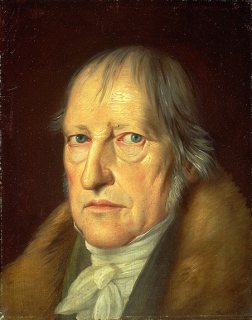
Hegel was a German philosopher and one of the most influential figures of German idealism and 19th-century philosophy. His influence extends across the entire range of contemporary philo- sophical topics, from metaphysical issues in epistemology and ontology, to political philoso- phy, the philosophy of history, philosophy of art, philosophy of religion, and the history of philosophy…. Throughout his work, Hegel strove to address and correct the problematic dualisms of modern philosophy, Kantian and otherwise....
Introductory Comments
In 1790, three students at the Tübinger Stift - a Protestant seminary in Württemberg whose job was to turn out pastors for the duke - found themselves sharing a room and a grievance. Georg Wilhelm Friedrich Hegel and Friedrich Hölderlin were 20. Friedrich Schelling was 15 and insufferably brilliant. All 3 chafed at the Stift's discipline, all 3 read Plato and Kant and Spinoza on their own time, and all 3 watched events in France with the excitement of young men who have just learned that a world can be remade. Two of them went by Friedrich; the third hid his in the middle.
Then life did what life does. Schelling, the prodigy, arrived first - a chair at Jena by 23, while Hegel was still tutoring other people's children - and built a philosophy of nature in which mind and matter were one reality viewed from two sides. Hegel followed him to Jena on his coattails and in 1807 repaid the favor with a jab at any Absolute in which all distinctions dissolve: "the night in which all cows are black." Schelling recognized himself. The letters stopped. Hölderlin's departure was gentler and sadder. He turned to poetry, convinced that Being comes before every division philosophy draws between subject and object, and that only verse can hold it whole. And then, from 1806, he turned to a in Tübingen, where he lived out his last 36 years. Schelling outlived Hegel by 23 years, and in 1841 was summoned to Berlin, to Hegel's own chair, expressly to stamp out the lingering legacy of his old friend.
Some of Hegel's Key Positions
History is not a random heap of facts without rhyme or reason. It is the unfolding of Geist - Spirit, or Mind - reason at work in the world, coming to know itself through human deeds. Mind and matter connect because absolute idealism treats thought and being not as alien realms but as aspects of one rational whole: what is rational is actual, and what is actual is rational.
Spirit advances by overcoming apparent dualisms - subject and object, mind and nature, necessity and freedom. It does so dialectically. A position, pressed hard enough, generates a contradiction out of its own resources; that contradiction is not erased but raised to a higher level. The result carries its predecessors inside it, and the process begins again.
The end is freedom. World history is the progress of the consciousness of freedom: in the ancient East one was free, among Greeks and Romans some were free, and in the modern European world the principle that all are free is established. Freedom here is not doing as one pleases, nor the end of conflict. It means finding one's own reason in laws and customs one can recognize as one's own.
Freedom takes concrete shape in the rational modern state - constitutional monarchy, rule of law, a professional civil service, representative estates.This state is the highest realization of freedom in the world.
Place in the History of Ideas
Hegel's Place in History of Ideas
Francis Fukayama: For better or worse, much of Hegel's historicism has become part of our contemporary intellectual baggage. The notion that mankind has progressed through a series of primitive stages of consciousness on his path to the present, and that these stages corres- ponded to concrete forms of social organiza- tion, such as tribal, slave owning, theocratic, and finally democratic egalitarian societies, has become inseparable form the modern under- standing of man. Hegel was the first philoso- pher to speak the language of modern social science, insofar as man for him was the product of his concrete historical and social environ- ment and not, as earlier natural right theorists would have it, a collection of more or less fixed "natural" attributes.
James H. Billington: Accepting the romantic belief that truth was revealed in the peculiari- ties of history rather than in a static natural order, Hegel nevertheless simultaneously pressed the Enlightenment idea that all was rational.
H. H. Carr: Hegel clothed his absolute in the mystical shape of a world spirit, and made the cardinal error of bringing the course of history to an end in the present instead of projecting it into the future. He recognized a process of continuous evolution in the past, and incongruously denied it in the future.
Random Thoughts on Hegel
On the face of it, Hegel's central idea is preposterous. A World Spirit shaping the course of human history? A Divine Reason dissolving every dualism, step by step, while nudging humanity, step by step, toward the perfection of Freedom? A reader may be forgiven for reaching for his coat. And yet. Strip away the metaphysical machinery and something interesting remains - a story about freedom widening by way of contradictions each age hands down to the next. Consider it as a plot:
In the ancient East, one man is free, and for Hegel not even he is: a despot surrounded by subjects has no one whose recognition is worth having. In Greece, freedom widens to the citizens of the polis, but rests on slavery, and on a civic custom so unexamined that Athens killed Socrates for examining it. Rome answers with universal law - everyone a person in the eyes of the code, everyone a subject in the eyes of the emperor. Freedom as an empty form. Christianity then supplies the missing content: all human beings are free in spirit. But a principle is not yet a world. Fifteen centuries pass before it acquires laws and constitutions to live under. Combined, these two concepts - Christianity and constitutional government - ensure the maximum amount of freedom, which his readers, then and ever since, took to mean the Prussian state that paid his salary. At which point the World Spirit, her work complete, lies down for a long and blissful nap.
Adorno (Philosophy springs from particular socio-historical conditions.)
Badiou (History is largely driven by conflict or ruptures within the status quo.)
Bosanquet (Finite existence transcends itself & points toward an infinite whole)
Gentile (Mind is the Absolute and thinking creates the phenomenal world.)
Heraclitus (There's a certain unity of opposites at work in our changing world.)
Marx (History is a long dialectical process of thesis/antithesis/synthesis.)
Thinkers with opposing positions:
Bacon, Francis (All real knowledge rests upon observed facts & scientific method)
Bakunin (The state is an instrument of class rule of the rich over the masses.)
Cousin ("Absolute" systems based on deductive abstractions are illegitimate.)
de Beauvoir (We can neither escape our personal freedom nor give it away.)
Engels (All recorded history hitherto has been a history of class struggle.)
Feuerbach (The next stage of civilization will be a humanistic materialism.)
Herzen (There was no “rational” inevitability at work in the course of history.)
Lotze (Reality is larger & wider than philosophy. The Absolute is mere notion.)
Lukács (Dialectical materialism, not dialectical reason, is the road to truth.)
Mill (Freedom is not something we find in the state, but in ourselves.)
What others said about Hegel
Russell: Hegel's philosophy is so odd that one would not have expected him to be able to get sane men to accept it, but he did.
Singer, Peter: No philosopher of the 19th or 20th centuries has had as great an impact on the world as Hegel. The only possible exception to this... statement would be Karl Marx - and Marx himself was heavily influence by Hegel.
Berlin: [Hegel's "objective," rational, and inexorable march of history is] a sinister mythology which authorizes the indefinite sacrifice of individuals to such abstractions - for all that he calls them "concrete" - as States, traditions, or the will or destiny of the nation or the race. The world is, after all, composed of things and persons and of nothing else.
Cassirer: Hegel's concern and philosophical ambition was to reconcile "nature" and "idea." But instead of this reconciliation his result was the subordination of nature to the absolute idea. Nature retains nothing in its own right….
Whitehead: My criticism of Hegel procedure is that when in his discussion he arrives at a contradiction, he construes it as a crisis in the universe.
Schopenhauer: Should you ever intend to dull the wits of a young man and to incapacitate his brains for any kind of thought whatever, then you can't do better than give him Hegel to read.
James: [In Hegel's logic] relations elsewhere recognized under the insipid name of disinctions (such as that beween knower and object, many and one) must first be translated into impossibilities and contradictions, then "transcended" and identified by miracle, ere the proper temper is induced for thoroughly enjoying the spectacle they show.
Merleau-Ponty: All the great philosophical ideas of the past century - the philosophies of Marx and Nietzsche, phenomenology, German existentialism, and psychoanalysis - had their beginnings in Hegel.
Schools: Antipositivism, Christian Theology, Continental Philosophy, German Idealism, Hegelianism, Historicism, Holism, Metaphysical Idealism, Objective Idealism, Post-Kantian Philosophy, Process Philosophy, Rationalism, Romanticism
Main interests: Alienation, Architecture, Art and Aesthetics, Causality, Chemistry, Class Struggle, Classics, Consciousness, Death, Desire, Equality, Freedom, Habits, History, History of Ideas, History of Philosophy, Human Will, Justice, Law, Literature, Logic, Mathematics, Metaphors, Metaphysics, Music, Political Philosophy, Progress, Property, Public Administration, Racism, Religion, Social Philosophy, Social Theory, Tragedy, War, Will