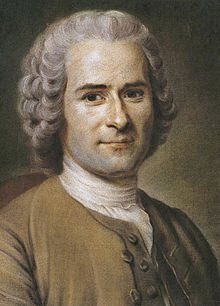
Rousseau was a Genevan philosopher, writer, and composer. His political philosophy influenced the progress of the Age of Enlightenment throughout Europe, as well as aspects of the French Revolu- tion and the development of modern political, economic, and educational thought. His Discourse on Inequality, which argues that private property is the source of inequality, and The Social Contract, which outlines the basis for a legitimate political order, are cornerstones in modern political and social thought.
Introductory Comments
In a Peanuts strip, Linus Van Pelt delivers one of the great one-line self-indictments: he loves mankind, it's people he can't stand. The joke fits Rousseau better than it fits any blanket-toting six-year-old. Rousseau declared himself a lover of humanity in book after book. He also handed all five of his children to the Paris foundling hospital, wrote of Thérèse Levasseur - his partner of 33 years - with a condescension he never seems to have noticed, and turned one by one on his friends. Diderot, Grimm, Madame d'Épinay, and finally Hume, who had gone to real trouble to find him refuge in England, were each recast as villians and dispatched with the sharpest pen in Europe.
So how does the great friend of mankind end up such a poor friend to men? Perhaps he thought genius exempt from ordinary duty; perhaps his persecution mania simply made friendship impossible - though there the paranoia deserves a caveat, since his books really were burned and he really was driven from Môtiers by neighbors throwing stones. His philosophy, at any rate, offers no alibi. Rousseau never preached unbuttoned impulse, nor condoned selfishness. He simply ignored what he himself preached. The irony here is even sharper in that he diagnosed Linus's disease before catching it. In Emile he mocks the philosopher who professes to love the Tartars so as to be excused from loving his neighbors - as fair a description of Rousseau's life as anything his enemies managed.
Some of Rousseau's Key Positions
Unlike Hobbes's supposed war of all against all, the state of nature was in fact peaceful. Natural man was solitary, idle, and easily satisfied, moved by amour de soi - an untroubled concern for his own survival - and pitié, a reflexive reluctance to watch another suffer. He was neither brute nor decadent, but he was not yet virtuous either. Virtue requires reason and choice; his goodness was innocence.
The fall came with settlement, agriculture, and metalworking, which taught men to measure themselves against one another. Self-love curdled into amour-propre, the restless hunger to stand higher in other people's eyes. The first man to fence off a plot and find neighbors credulous enough to nod along was, the true founder of civil society. The pact that followed was a confidence trick: the rich dressed up their holdings as justice, and the poor forged their own chains.
Nevertheless, the cure is not to return to the woods, but to reconstruct society. This is achieved through an education that shields natural feeling from corrupting comparison, and through a social contract in which absolute sovereignty is given to the people - never to government, their agent. What binds citizens together is the General Will, which is discovered when citizens deliberate and vote as equals, setting aside private interests and focusing on the common good. After the General Will is discovered, everyone must submit to it - if not willingly, by force.
Place in the History of Ideas
Rousseau's Place in History of Ideas
Berlin: [Rousseau was in] a kind petit bourgeois revolt against a society from which the déclassé feels excluded. Rousseau makes common cause with the outcasts, the rebels, the free wild artists. That is what makes him the founder of romanticism and wild individualism, as well as the founder of so many other movements of the nineteenth century - of socialism and com- munism, of authoritarianism and nationalism, of democratic liberalism and anarchism, of almost everything, save what might be called a liberal civilization, with its fastidious love of culture….
Will Durant: How did it come about that a man born poor, losing his mother at birth and soon deserted by his father, afflicted with a painful and humiliating disease, left to wander for twelve years among alien cities and conflicting faiths, repudiated by society and civilization..., driven from place to place as a dangerous rebel, suspected of crime and insanity... - how did it come about that this man, after his death, tri- umphed over Voltaire, revived religion, trans- formed education, elevated the morals of France, inspired the Romantic movement and the French Revolution, influenced the philoso- phy of Kant and Schopenhauer, the plays of Schiller, the novels of Goethe..., the socialism of Marx, the ethics of Tolstoy, and, altogether, had more effect upon posterity than any other writer or thinker of [the] eighteenth century...?
Random Thoughts on Rousseau
Rousseau is routinely filed among the founders of modern democracy, and his account of voting looks democratic enough at first glance. Citizens assemble, a question is put, and the tally reveals the General Will. But look again at what Rousseau thinks the ballot asks. It does not ask what you want. It asks what the General Will is - and on that question you can simply be wrong, the way one can be wrong about the sum of a column of numbers. When the count goes against you, he says, your error is now plain, and you should be glad to be rid of it. If you refuse to admit your error, you have set yourself against the free will of the people, and Rousseau has already supplied the remedy: such a man will be "forced to be free."
It is a short walk from there to a state that treats dissent as a defect requiring repair - and it is the walk Robespierre took, quoting Rousseau, when the Committee of Public Safety went hunting for enemies of the people. Rousseau would have been appalled, and he had grounds. He insisted the General Will can never be delegated, which rules out any vanguard party claiming to speak for it, and he thought genuine sovereignty possible only in states small enough for citizens to assemble in person. Corsica, maybe. France, no. But the language he left behind proved portable in ways his cautions were not. Every regime that ever silenced a dissenter in the name of the People's true wishes has spoken a dialect of his vocabulary, and few paused to read his footnotes.
Aquinas (Certain rights are natural or inherent by virtue of our humanity.)
Bosanquet (The state has more reality than the individual persons within it.)
Cicero (Republics require that citizens place public good over private gain.)
Diderot (A productive life requires a balance between emotion and reason.)
Emerson (Besides being beautiful, Nature is also a moral & spiritual guide.)
Feyerabend (The glorification of science undermines other meaningful pursuits.)
Freud (Human civilization developed thru' the suppression of human nature.)
Jaspers (Our freedom is threatened by modern science, economics and politics.)
Whitehead (Education should be interdisciplinary and relevant to actual life.)
Thinkers with opposing positions:
Albertus Mag. (The pursuit of science is consistent with religious devotion.)
Arendt (Power coming from the collective will needs no enforcement.)
Condorcet (Civilization inevitably leads to progress in morality & justice.)
Croce (Freedom is not a birthright or natural right. It is an earned right.)
Hooker (In the state of nature nothing constrains the perilous conflict of wills.)
Horkheimer (Popular culture can itself be a form of insidious totalitarianism.)
Ortega (The tyranny of the majority can be a serious threat to our freedom.)
What others said about Rousseau
Madame de Staël: Rousseau said nothing new, but set everything on fire.
Hayek: [Rousseau] urged people to shake off the very restraints to which they owed their productivity and numbers, and produced a conception of liberty that became the greatest obstacle to its attainment.
Mill: The superior worth of simplicity of life, the enervating and demoralising effect of the trammels and hypocrisies of artificial society, are ideas which have never been entirely absent from cultivated minds since Rousseau wrote; and they will in time produce their due effect, though at present needing to be asserted as much as ever....
Cassirer: In society Rousseau believed he had found the decisive feature of... human existence, of human happiness and misery. Such was the conclusion he derived from his study and criticism of political and social institutions.
Russell: Liberty is the nominal goal of Rousseau's thought, but in fact it is equality that he values, and he seeks to secure even at the expense of liberty.
Kant: Rousseau first discovered beneath the diversity of human shapes the deeply hidden nature of man and the latent law according to which Providence is justified by Rousseau's observations.
Voltaire: No one has ever employed so much intellect to persuade men to be beasts. In reading [Rousseau's] work one is seized with a desire to walk on four paws. However, as it is more than sixty years since I lost that habit, I feel, unfortunately, that it is impossible for me to resume it.
Hume: [Rousseau] has not had the precaution to throw any veil over his sentiments; and, as he scorns to dissemble his contempt for established opinions, he could not wonder that all the zealots were in arms against him.
Main interests: Agriculture, Autobiography, Botany, Childhood, Class Struggle, Commerce, Community, Death, Democracy, Desire, Education, Equality, Family, Freedom, Friendship, Geography, Government, Habits, Happiness, History, Jurisprudence, Just War, Justice, Language, Law, Literature, Love, Memory, Mind, Music, Personal Identity, Political Philosophy, Political Theory, Power, Property, Psychology, Public Administration, Punishment, Salvation, Sexuality, Social Criticism, Social Philosophy, Social Theory, Sublime Nature, Virtue, War, Wealth, Will