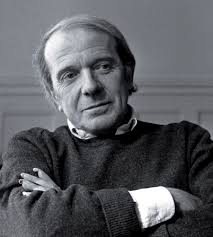
Deleuze was a French philosopher who, from the early 1950s until his death in 1995, wrote on philosophy, literature, film, and fine art…. An important part of Deleuze's oeuvre is devoted to the reading of other philosophers: the Stoics, Leibniz, Hume, Kant, Nietzsche, and Bergson, with particular influence derived from Spinoza…. Although he once characterized himself as a "pure metaphysician," his work has influenced a variety of disciplines across the humanities, including philosophy, art, and literary theory….
Introductory Comments
Deleuze set out to dismantle a habit of thought that had ruled Western philosophy since Aristotle: the assumption that reality is built from stable substances bearing fixed essences. In place of this furniture-store metaphysics, Deleuze proposed a world made not of things but of processes - of flows, forces, becomings, and ceaseless differentiation. Reality, in his view, is less like a marble statue than like a river forever changing its shape, less a warehouse of finished objects than a workshop of restless creation. Beneath what appears solid lies motion; beneath what seems settled lies a universe that is always quietly rewriting itself.
It follows that identity, too, loses its privileged seat at the table. What we treat as a self-identical "thing" is in truth a momentary knot in a wider web of differential relations - a temporary stabilization of processes that were already underway and will carry on without it. X is not X because it possesses some inner essence of X-ness; it is X because of a complex web of processes that have produced it and that continue to sustain it. Strip away those processes and relations and there is no essential X left to find. A face, a city, a species, a self: each is a passing eddy in a river that was never standing still. Identity, in short, is something the universe does, not something it has. Like- wise, a self-identity is something we experience, but do not possess.
Some of Deleuze's Key Positions
Despite what earlier philosophers claimed and what common sense and language itself seem to suggest, identity is not metaphysically fundamental. Rather, what is fundamental is difference. What we call identity is a series of differences - X is identified as X not through some essential selfsameness but through a web of differential relations.
Difference is "the virtual," because it is "real without being actual, ideal without being abstract." The virtual is not a cognitive faculty or set of categories imposed on experience from outside, as in Kant, but an immanent, genera- tive dimension of reality itself. It is the condi- tion not merely of recognizing identities but of the endless productive process by which actual spaces, times, bodies, and sensations are generated and individuated.
Difference is also more fundamental than that thing philosophers have traditionally consid- ered most fundamental: substance. The plane of immanence replaces transcendent substance, and what unfolds across it is not modification of some underlying unity but a ceaseless process of differentiation with no stable ground beneath it. Everything emerges and dissolves within this process - a cosmos that forever folds, unfolds, and refolds, driven not by any fixed being underneath, but by difference and repetition themselves.
Place in the History of Ideas
Deleuze's Place in History of Ideas
Jon Roffe: Deleuze is a key figure in postmod- ern French philosophy. Considering himself an empiricist and a vitalist, his body of work, which rests upon concepts such as multiplicity, constructivism, post-structuralism, difference and desire, stands at a substantial remove from the main traditions of 20th century Continental thought. His thought locates him as an influen- tial figure in present-day considerations of society, creativity, and subjectivity. Notably, within his metaphysics he favored a Spinozian concept of a plane of immanence with everything a mode of one substance, and thus on the same level of existence.
John Protevi: Deleuze also produced studies in the history of philosophy (on Hume, Nietzsche, Kant, Bergson, Spinoza, Foucault, and Leibniz), and on the arts ([books on] cinema,... Proust,... Sacher-Masoch,... the painter Francis Bacon, and... essays on literature.) Deleuze considered these latter works as pure philosophy, and not criticism, since he sought to create the concepts that correspond to the artistic practices of painters, filmmakers, and writers.
Daniel W. Smith: Deleuze’s influence reaches be- yond philosophy; his work is approvingly cited by, and his concepts put to use by, researchers in architecture, urban studies, geography, film studies, musicology, anthropology, gender studies, literary studies, and other fields.
Random Thoughts on Deleuze
It is easy to misread Deleuze. When he pro- posed a metaphysics of difference and process, he was not not offering a logician's trick for tell-ing things apart, nor the structuralist line that "X is X because it is not Y or Z." His claim is far more audacious: difference is ontological - wov-en into the fabric of being itself, not merely into our concepts or our grammar. And crucial-ly, this difference is positive and productive, not a polite shorthand for absence or contrast. Be - neath every actual thing lies what Deleuze calls the virtual: a real (though not yet actualized) genetic field of intensities and tendencies from which actual forms continually crystallize. The virtual is not the possible-in-waiting; it is the engine room of the real.
This generative power explains why Deleuze is the darling of architects, geographers, and film theorists alike. It offers concepts - rhizomes, assemblages, becoming, the fold - that are built for thinking about dynamic, open-ended phe- nomena. Architects use him to think about space as event rather than container; geogra- phers use him to rethink territory and move- ment; film theorists use him to analyze the image in motion. Researchers across the hu- manities and social sciences have found De- leuze's toolkit irresistible. Some have argued, though, that Deleuze's toolkit has a "fluidity" problem of its own - with concepts as unstable and elusive as the processes they describe.
Foucault (Truth is constructed through various personal & political processes.)
Hegel (Reality is not a static set of facts. It is an ongoing process, a becoming.)
Heraclitus (Constant change is a fundamental aspect of the world.)
Horkheimer (Popular culture encourages a passive & unquestioning worldview.)
Kant (Notions like space and time are unifying forms imposed by the subject.)
Lyotard (We've outgrown our need for universal theories & grand narratives.)
Marx (Capitalism homogenizes all human values to the aims of the market.)
Nagel (We can't view reality devoid of assumptions, perspectives, and biases.)
Rorty (The philosophic search for some objective basis of truth is fruitless.)
Spinoza (Everything that exists is a modification or mode of one substance.)
Whitehead (The world is a process and can't be reduced to mere matter.)
Thinkers with opposing positions:
Badiou (Though truth is real, it exists in the context of metaphysical pluralism.)
Cousin (Reason enables us to pass beyond the relative and subjective.)
James (Metaphyscial monism, in whatever guise it takes, is pure nonsense.)
Parmenides (Reality is one and changeless. Existence is timeless and uniform.)
Socrates (Intelligence is a speculative faculty that allows us to deduce truths.)
What others said about Deleuze
Edward Thornton: [Deleuze] argued instead that thought is not grounded in identity; rather, it is generated out of difference.
Jon Roffe: Deleuze’s influence reaches beyond philosophy; his... concepts [are] put to use by researchers in architecture, urban studies..., film studies, musicology, anthropology, gender studies, literary studies, and other fields.
Daniela Voss: Deleuze conceived of philosophy as the production of concepts, and he characterized himself as a "pure metaphysician." In his... "Difference and Repetition," he tries to develop a metaphysics adequate to contemporary mathematics and science - a metaphysics in which the concept of multiplicity replaces that of substance, event replaces essence….
Daniel W. Smith: [Deleuze said of] philosophy and science: both are approaches to "chaos" that attempt to bring order to it, both are creative modes of thought, and both are complementary to each other, [and to] art.
Adrian Parr: … Deleuze proposed that concepts are tools of analysis, not recognition.
Edward Thornton: [He claimed] what appears to us in experience as an individual - be it a single stone or an individual person - gains its identity only as an effect of diverse forces that are in constant tension with one another.
Richard Wolin: According to Deleuze, this bias [for sameness over difference], which [led to the] philosophical search for the abstract "essences" of things, falsifies the nature of experience, which consists of multiplicities rather than unities. In order to do justice to reality as multiplicity, therefore, a completely new set of philosophical concepts is required.
Adrian Parr: The relevance of Deleuze today lies not with a static conception of Deleuzean philosophy. If anything, anyone inspired by Deleuze has to tirelessly resist reducing him to a dogmatic image of thought.
Main interests: Alienation, Art and Aesthetics, Communication, Cultural Studies, Desire, Film Theory, Freedom, Habits, History of Philosophy, Language, Literature, Logic, Memory, Metaphilosophy, Metaphysics, Mind, Perception, Personal Identity, Popular Culture, Semiotics, Time, Universals