Existential despair, Knight of faith, Leap of faith
Influences: Aristotle, Augustine, Burke, Kant,
Descartes, Diogenes, Hamann, Hegel, Lessing,
Luther, Mozart, Olsen, Schelling, Socrates,
Schopenhauer, Shakespeare
Influenced: Adorno, Barth, Beauvoir, Shestov,
Buber, Camus, Derrida, Heidegger, Ibsen,
Jaspers, Lévinas, Marcel, Sartre, Schmitt, Wahl,
Tillich, Miguel de Unamuno, Wittgenstein
From Wikipedia
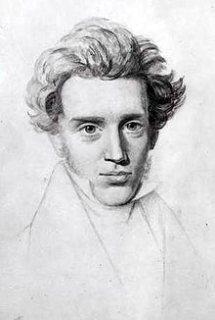
Kierkegaard was a Danish theologian, philosopher, poet, social critic, and religious author who is widely considered to be the first existentialist philosopher. He wrote critical texts on organized religion, Christianity, morality, ethics, psychology, and the philosophy of religion, displaying a fond- ness for metaphor, irony, and parables. Much of his philosophical work deals with the issues of how one lives as a "single individual" ..., highlighting the importance of personal choice and commitment.
Introductory Comments
According to tradition, Aristotle liked to teach while walking with his students, which helps explain why his school became known as the Peripatetic school - from the Greek peripatein, "to walk about." But the greatest philosophical walker may have been Kierkegaard. "Every day I walk myself into a state of well-being," he once wrote. "I have walked myself into my best thoughts." Indeed, Kierkegaard was a fixture on the streets of Copenhagen, particularly in the older quarters with their narrow, winding lanes. He might wander alone, apparently lost in thought, then suddenly stop to strike up a conversation with someone he met along the way. He valued these encounters so highly that he called his excursions "people baths."
Unfortunately, the baths did not stay warm. Thin, slightly stooped, with one shoulder higher than the other, Kierkegaard was easy to spot and easier to mock. In 1846 he picked a quarrel with The Corsair, a satirical weekly, and all but dared it to attack him. The paper obliged with caricatures of his spindly frame and, most memorably, his trousers of unequal length. Soon boys were jeering at him in the streets, and the people baths lost their pleasure. The streets that had supplied Kierkegaard with conversation, observation, and exercise, but his escape now became increasingly hostile territory. His beloved "people baths" became painful, sometimes impossible, and his already considerable sense of isolation deepened. Increasingly, Kierkegaard just stayed home.
Some of Kierkegaard's Key Positions
In the choices that matter most (what to live for, whom to love, what to believe), objective argument cannot decide for us. It can even become a way of dodging the decision. This is truest of religion, which demands a commitment that is total.
Faith cannot be reached by reasoning. Scholarship and proof yield at best probabilities, and no probability can bear the weight of an eternal happiness.
At Christianity's heart stands the Paradox: the eternal God become a particular human being in time. Faith is therefore not a conclusion drawn from evidence but a "leap," a passionate commitment held fast in objective uncertainty.
For the most fundamental matters of life, truth is subjectivity: We do not watch our lives from outside. We exist in them. This does not means that truth is whatever one feels but that the truths that matter must be lived. Hence we should scorn "the crowd," where people hide from the burden of being themselves.
Belief that stops at assent is empty; faith must be enacted. This is why a Christisn must avoid "Christendom," the comfortable state church where everyone was Christian by birth and almost no one by decision. To accept the doctrine while living as though it made no difference is not faith but its counterfeit.
Place in the History of Ideas
Kierkegaard's Place in History of Ideas
Robert C. Solomon: [Kierkegaard argued that] what counts in matters of religion and in all matters of life is personal passion, not knowledge or reason. It does not matter what others do; what matters is what one chooses for oneself, and then it is not what one chooses but how one chooses - passionately and personally, or just by way of "following the crowd" (here again we have the Kantian concept of autonomy, stripped of the demands of rationality). In matters of ultimate choice - the choice of an entire way of life or a specific decision - there are no authoritative rules, objective truths, categorical imperatives, of logic of the Zeitgeist. There are only feeling and personal needs, "subjective truths" for which there may be no rational defence of support.
Otto Pfleiderer: Kierkegaard can only find true Christianity in entire renunciation of the world, in the following of Christ in lowliness and suffering especially when met by hatred and persecution on the part of the world. Hence his passionate polemic against ecclesiastical Christianity, which he says has fallen away from Christ by coming to a peaceful understanding with the world and conforming itself to the world's life. True Christianity, on the contrary, is constant polemical pathos, a battle against reason, nature, and the world; its command- ment is enmity with the world; its way of life is the death of the naturally human.
Random Thoughts on Kierkegaard
"Christian existentialist" can sound like a contradiction in terms, rather like "cautious daredevil." If existentialism means owning one's freedom and refusing to hand it to anyone else, how can a person bow to God's will and embrace a creed? If God has already settled what humans are and what they ought to do, where is the radical freedom existentialists prize? And if the leap of faith has no rational justification, how can it count as a responsible choice?
Fair questions, but they run the calendar backward. "Existentialism" is a 20th-century label, and the radical freedom it names belongs chiefly to Sartre, who argued that because there is no God, there is no human nature fixed in advance. Kierkegaard died in 1855, long before anyone called him an existentialist. It is less that he was a Christian who somehow became an existentialist than that later existentialists borrowed his anxious, searching, tormented individual and quietly removed God from the picture.
Nor did Kierkegaard submit to an institution. He spent his last year savaging the Danish state church and urging readers to stay away from its services. His faith requires an individual to stand alone before God, with no priest or congregation to lean on - and no proof to hide behind. The one who leaps bears the whole weight alone. Kierkegaard's brand of faith is, then, anything but comfortable. Like a bed of nails, it is not meant for rest.
Barth (There is an infinite qualitative distinction between God and mankind.)
Bayle (The value of faith is directly proportional with its repugnancy to reason.)
Dostoyevsky (Without religion, we will drown in our own irrational impulses.)
Erasmus (True piety consists not in outward ceremonies but inward conversion)
Heidegger (Each individual's very Being involves engagement with the world.)
Jaspers (Philosophical claims are expressions of our mental dispositions.)
Pascal (God is infinitely incomprehensible. We can't reason our way to God.)
Thinkers with opposing positions:
Abelard (Reason, not faith, is the foundation of most Christian beliefs.)
Borges (Man's search for meaning in a seemingly infinite universe is fruitless.)
Bosanquet (The truth of religion is entirely consistent with reason.)
Brentano (Philosophy should use methods as rigorous and exact as science.)
Buber (No radical distinction exists between the individual & the community.)
Coleridge (Loving Christianity more than truth harms both us and Christianity.)
Cousin (Reason enables us to pass beyond the relative and subjective.)
Dennett (Evolution can account for the origin of morality in our species.)
Wilde (The aesthetic life is ultimately the most rich and fulfilling one.)
What others said about Kierkegaard
Wittgenstein: Kierkegaard was by far the most profound thinker of the last century. Kierkegaard was a saint.
Mortimer J. Adler: For Kierkegaard, man is essentially an individual, not a member of a species or race; and ethical and religious truth is known through individual existence and decision - through subjectivity, not objectivity.
Minor White: The great problem for Kierkegaard is to relate God’s is-ness, if I may use that term for the moment, to human existence, and this he tries to solve by appealing to the Incarnation. Christ’s person is the existent outgrowth of God who is. By what is admittedly a mysterious process the abstract God enters a concrete existent. We must accept this on faith….
Cassirer: Kierkegaard describes religious life as the great "paradox." To him an attempt to lessen this paradox meant the negation and destruction of religious life.
Neuhaus: There is hardly a page in his writings that does not prompt from the systematically minded reader a protest against... apparent contradictions.
Svere Norborg: Kierkegaard does not deny the fruitfulness or validity of abstract thinking (science, logic, and so on), but he does deny any [pretense] that abstract theorizing is a sufficient concluding argument for human existence.
Barth: If I have a system it is limited to a recognition of what Kierkegaard called the "infinite qualitative distinction" and to my regarding this as possessing negative as well as positive significance: "God is in heaven. And thou art on earth." The relation between such a God and such a man... is for me the theme of the Bible and the essence of philosophy.
H. J. Blackham: He made it the effort of his life to renew the meaning of Christianity by compelling recognition of the permanent cleavage between faith and reason, Christianity and culture.
Schools: Absurdism, Augustinianism, Christian Existentialism, Christian Humanism, Christian Theology, Continental Philosophy, Existentialism, Fideism, Mysticism, Personalism, Romanticism, Voluntarism
Main interests: Alienation, Art and Aesthetics, Communication, Community, Consciousness, Death, Desire, Epistemology, Ethics, Faith, Free/Unfree Will, Freedom, Friendship, Habits, Happiness, Health, Human Will, Love, Metaphilosophy, Metaphysics, Mind, Music, Personal Identity, Poetry, Psychology, Religion, Salvation, Spirituality, Time, Tragedy, Virtue, Will, Wisdom