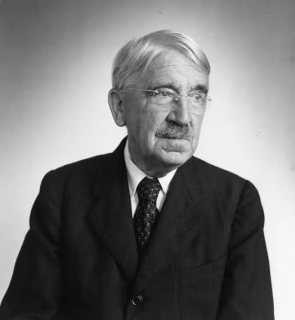
Dewey was an American philosopher, psycholo- gist, and educational reformer. He was one of the most prominent American scholars in the first half of the twentieth century. The overriding theme of Dewey's works was his profound belief in democracy, be it in politics, education, or communication and journalism. As Dewey himself stated in 1888, while still at the University of Michigan, "Democracy and the one, ultimate, ethical ideal of humanity are to my mind synonymous."
Introductory Comments
Ask most people what democracy is and they will describe a procedure: candidates campaign, citizens vote, the winner takes office, and everyone grumbles until the next election. To Dewey, this was a bit like describing a marriage by its wedding. Elections matter, but they are only the machinery. Democracy itself is a way of life, a habit of meeting as equals to share experience and solve common problems - at the dinner table, in the classroom, on the factory floor. It is both a means and an end. It frees individuals to develop their capacities, and individuals who develop them enrich the common life that freed them. Dewey had little patience for the lone individual of classical liberalism, guarding private interests against the public interest.
Yet Dewey was no starry-eyed idealist. He watched apathy, propaganda, and the bewildering scale of modern life reduce citizens to spectators, and he worried that the public could no longer find itself. His answer was characteristic. The old saying that the cure for democracy's ills is more democracy held true, he argued, only if "more" meant returning to democracy's root idea and pursuing it more thoroughly through education, participation, and communication. So understood, democracy is less a destination than an ongoing experiment, capable of diagnosing and correcting its own failures. Behind it lay what Dewey called a faith: not in any party or program, but in the capacity of ordinary people to think their way, together, toward solutions no one has yet imagined.
Some of Dewey's Key Positions
Philosophy has spent too long on a quest for certainty, seeking eternal truths behind the shifting world of experience. Its old dualisms of mind and body, theory and practice, fact and value dissolve once experience is seen as a living creature’s interaction with its surroundings.
Mind is not a spectator but an activity, set in motion when habit fails and a situation turns uncertain. Ideas are tools, or hypotheses, judged by how well they resolve the problem that prompted them. The experimental method of science is the best model of intelligence, in ethics and politics as much as in the laboratory.
Education should cultivate inquiry, not drill memory. Children learn by doing, and the school should be a small community that practices cooperative life rather than preaching it. Its aim is growth, and has no goal beyond further growth.
Democracy is a way of life, not merely a system of government. A genuine public needs free inquiry, open communication, and informed opinion. Experts should inform it, not rule it, since the one who wears the shoe knows best where it pinches. Liberalism, too, must be rebuilt. Laissez-faire has made freedom a privilege of the few, and real liberty now requires social control of economic forces. Democratic responsibility requires confronting economic and social inequalities that prevent people from realizing their potential.
Place in the History of Ideas
Dewey's Place in History of Ideas
Robert B. Talisse: The core of Deweyan political philosophy can be stated in the slogan that is popular among contemporary Deweyans: democracy is a way of life. This slogan is intended to convey two main commitments. First, democracy is not merely a kind of state or a procedure for collective decision, but a moral ideal of human life. Second, the moral ideal that is democracy can be pursued and fulfilled only under certain kinds of social arrangements. In short, democracy is a way of life in which each individual exercises and cultivates his unique capacities in a way which contributes to the flourishing of the whole society.
Russell Kirk: The school of Dewey has long been fond of capturing words and turning them to their own purposes: they tried hard to capture “humanism,” and even laid siege to “religion.” Now I am convinced that if, by “education,” the champions of this slogan mean merely recreation, socialization, and a kind of custodial jurisdiction over young people, then they are deliberately perverting a word with a reasonably distinct historical meaning and making it into what Mr. Richard Weaver, in his book, Ethics of Rhetoric, calls a "god-term" - that is, a charismatic expression drained dry of any objective significance, but remaining an empty symbol intended to win unthinking applause.
Random Thoughts on Dewey
Dewey never met a dualism he didn’t want to dissolve. Mind and body, theory and practice, means and ends - one by one, into the solvent they went. He picked up the habit from Hegel in his youth, and though he soon outgrew Hegel’s system, the habit stayed. In Art as Experience, he argued that aesthetic experience arises wherever human skill and imagination bring heightened meaning and feeling to ordinary life. A beautifully crafted chair, an elegant teapot, or even a sleek bicycle can stir aesthetic appreciation no less genuine than that inspired by a painting or symphony. What matters is not whether the object serves some practical purpose, but whether it enriches or benumbs the experience of living.
To be sure, a painting's practical uselessness may free it to pursue formal innovation and emotional complexity without compromise. Indeed, this very uselessness might seem a kind of liberation from the relentless demands of utility that govern so much of modern life. Yet Dewey would remind us that freedom from practical function is no guarantee of aesthetic value. A painting can be as lifeless as a poorly designed chair, while a well-designed chair can be a small triumph of human creativity. Worse, when art is elevated into something sacred, it risks becoming a museum specimen rather than a living experience. Perhaps the real hierarchy, then, is not between fine and applied art at all, but between things that awaken our senses and things that merely take up space.
Montaigne (Education should be an active, engaged & "hands-on" process.)
Newman (A liberal education develops a capacity to think deeply and broadly.)
Wollstonecraft (As rational beings, women must have same rights as men.)
Thinkers with opposing positions:
Bentham (Talk of natural rights is mere rhetoric - just "nonsense upon stilts.")
Bosanquet (Special insight is often needed to appreciate the beauty of art.)
Croce (The only real existence is mind and the work of art is a state of mind.)
Evola (Liberal democracy represents an ignoble trend towards mediocrity.)
Kant (Moral worth is not based on results, but on adherence to principles.)
Maistre (A strong government requires loyality to a strong monarch and church.)
Niebuhr (Man's innate sinfulness should temper our moral & political idealism.)
Skinner (Behavior is a matter of stimuli & responses, not psyche or inner states.)
What others said about Dewey
R. Field: [Dewey believed] that individual satisfaction and achievement can be realized only within the context of social habits and institutions....
James S. Gouinlock: [Dewey thought democracy is a] collaborative process in which individuals consult with each other to identify and address their common problems; indeed, Dewey spoke of democracy as “social intelligence.”
Robert B. Westbrook: [Dewey] insisted on the harmony between democracy and the scientific method: ever-expanding and self-critical communities of inquiry, operating on pragmatic principles and constantly revising their beliefs in light of new evidence, provided Dewey with a model for democratic decision making....
Russell: The main difference between Dr. Dewey and me is that he judges a belief by its effects, whereas I judge it by its causes where a past occurrence is concerned.
Kendra Cherry: ... he thought that education should consist of a journey of experiences, building upon each other to create and understand new ideas.
Richard Field: Dewey developed a broad body of work encompassing virtually all of the main areas of philosophical concern in his day. He also wrote extensively on social issues [and was] a leading social commentator of his time.
James S. Gouinlock: [In his version of pragmatism,] Dewey held that ideas are instruments, or tools, that humans use to make greater sense of the world. Specifically, ideas are plans of action and predictors of future events. People possess an idea when they are prepared to use a given object in a manner that will produce a predictable result.
Sidgwick: Dewey talks of natural and social goods, but does not appear to distiguish any as specifically moral values. There is no separate subject matter as moral knowledge, and hence no such thing as an isolated ethical science.
Schools: Atheism, Common Sense Realism, Empiricism, Holism, Humanism, Liberalism, Naturalism, Pluralism, Pragmatism, Process Philosophy, Secularism, Social Liberalism, Socialism
Main interests: Alienation, Art and Aesthetics, Causality, Communication, Community, Democracy, Desire, Education, Epistemology, Equality, Ethics, Evolution, Freedom of the press, Government, Habits, Health, Journalism, Justice, Labor, Law, Literary theory, Literature, Logic, Mind, Political Activism, Political Philosophy, Politics, Power, Progress, Psychology, Public Administration, Punishment, Science, Virtue, War, Welfare State