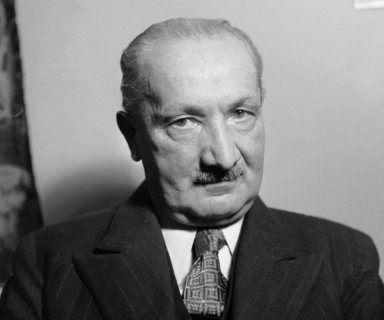
Martin Heidegger was a German philosopher who is best known for contributions to phenomenology, hermeneutics, and existentialism. He is among the most important and influential philosophers of the 20th century. In Heidegger's fundamental text Being and Time, "Dasein" is introduced as a term for the type of being that humans possess. Dasein has been translated as "being there." Heidegger believes that Dasein already has a "pre-ontological" and concrete understanding that shapes how it lives….
Introductory Comments
In 1924 Heidegger opened a lecture course on Aristotle by disposing of the philosopher’s biography in a single breath: he was born, he worked, he died. What mattered was the thinking. It seems fair to approach Heidegger the same way, starting with the thinkers who came first. Heraclitus and Parmenides fascinated him because, as he read them, they did not yet treat Being as one more feature of things. They met it as something astonishing: the upsurge of things into presence and their stepping out of "hiddenness." These early Greeks, he believed, stood closer than anyone since to the "clearing" in which beings show up at all.
Each later influence gave Heidegger something and, in his telling, fell short. Aristotle supplied the question itself, the observation that "being" is said in many ways, yet he also carried forward the "forgetfulness of Being" begun by Plato. Husserl, his teacher, handed him phenomenology, the discipline of describing things as they show themselves. Heidegger promptly turned it from consciousness toward human existence, to his mentor's dismay. Kierkegaard offered the individual set against "the crowd," and anxiety as the mood that lays our condition bare. Nietzsche set out to overcome Western metaphysics but, by Heidegger's reckoning, only completed it. None of this makes Heidegger easy. But it may begin to explain why someone would spend hundreds of pages asking what it means "to be."
Some of Heidegger's Key Positions
Western philosophy since Plato has forgotten the question of Being, of what it means for anything to be at all, and has fixed instead on particular beings. Descartes deepened the error by splitting reality into thinking mind and extended matter. The result was a "subject/object" model of detached minds peering out at a world of objects.
That gets things backward. We begin not as spectators but already absorbed in a world, hammering nails and catching buses. The starting point is therefore Dasein (German for "being-there"), the being for whom its own being is an issue: us. Our basic condition is "being-in-the-world," a single phenomenon the subject/object split chops into pieces.
That condition is structured by time. We are "thrown" into circumstances we never chose, press ahead into possibilities, and are caught up in present concerns. Time is not a container we live in but the structure of our existence.
Its farthest horizon is death: our "ownmost" possibility, which no one can face for us and none of us can outrun. Mostly we flee it into the anonymous "they" (das Man). Anxiety (Angst), which unlike fear has no object, confronts us with "the nothing" and with our own finitude. Only by owning up to this "being-toward-death" can we live authentically, as our own rather than as members of the crowd.
Place in the History of Ideas
Heidegger's Place in History of Ideas
Edward Skidelsky: It was not Heidegger's poli- tics that endeared him to thinkers such as Sartre and Arendt but his hatred, shared by them and countless others, of the outworn cliches of "bourgeouis" humanism. The totems of humanity and progress had lost their sheen in the eyes of a generation schooled on vio- lence and mistrust. The "thread of tradition," as Arendt called it, had been broken, the individ- ual thrust back, denuded, into his private existence. That was the "truth" to which Heidegger's philosophy gave voice. It was a truth prompting some toward fascism, others toward communism, and others still toward a liberalism shorn of the illusions of the nineteenth century.
A.J. Ayer: [Heidegger believes] that the most fundamental presuppositions are presupposi- tions about what there is, and consequently that the basic problem of phenomenology, as the first philosophy, is the search for the meaning of Being. What is sought is not a definition of Being but an insight into its essence. Though Existentialism acquired its name from the tenet that existence is prior to to essence, a proposition... that might amount to no more than the innocent claim that a thing cannot have properties unless it exists, the tables here appear to be turned. Heidgger is concerned not with what things there are, but with what it is for anything to be.
Random Thoughts on Heidegger
Most of us store death the way we store the fire extinguisher: we know roughly where it is, and we’d rather not look. For Heidegger, that is precisely the problem. "Being-toward-death" is his wake-up call and his acid test. Death is our "ownmost" possibility, the one thing no one else can do for us. To take it to heart is to be pulled out of the comfortable "they," with its ready-made opinions about what one does. The roles and routines don’t vanish, but we can no longer hide behind them. Each of us is thrown back on a life that is, inescapably, our own.
Powerful stuff. But is it compulsory? Heidegger would protest that he isn’t prescribing a mood, much less brooding over coffins. He is describing the structure of finite existence. Fair enough, yet the description gives anxiety pride of place, and nothing obviously requires that. Mortality can just as coherently summon gratitude: astonishment at the improbable fact of being here at all, in a vast and perhaps indifferent universe. Finitude sharpens joy as readily as dread. Spinoza went the other way entirely: the free man, he wrote, thinks of nothing less than death. And here is the twist. The later Heidegger drifted somewhere nearby, treating wonder as the founding mood of thought and hinting that thinking is a kind of thanking. Perhaps life can turn serious, even luminous, when met as a fragile miracle rather than a looming deadline. And perhaps Heidegger, in the end, half agreed.
Anaximander (Justice requires that all living things must inevitably die.)
Bolzano (Thought is intentional. It is by nature directed toward or about objects)
Borges (Time is a fire which consumes me, but I am the fire.)
Dilthey (Our understanding is linked to past worldviews and interpretations.)
Duns Scotus (Existence or being is the most basic & universal concept we have.)
Husserl (Philosophy should start with the objects of conscious experience.)
Marcel (Science & technology threaten to destroy the mystery of being.)
Ortega (Philosophy must focus on lived experience - the life of each individual.)
Sartre (Acknowledging one's mortality is a source of anxiety and authenticity.)
Thinkers with opposing positions:
Aristotle (The defining characteristic of a human being is rationality.)
Bacon, Francis (We should dominate nature through science and technology.)
Cousin (Reason enables us to pass beyond the relative and subjective.)
Descartes (We are fundamentally thinking beings. Our being rests in thought.)
Epicurus (Don't fear death. Death is nothingness & therefore nothing to us.)
Reid (When philosophy contradicts common sense, it should be dismissed.)
Smith, Adam (Humans are consistently rational and narrowly self-interested.)
What others said about Heidegger
Arendt: [Heidegger] lies notoriously always and everywhere, and whenever he can.
Stephen Hicks: Ask professional philosophers of today to name the five most significant philosophers of the twentieth century and, whether they love him or loathe him, most will include Heidegger on the list.
Ayer: For Heidegger there remains one metaphysical question: Why is there anything at all and not rather nothing? Perhaps this should be treated in Collingwood's way as the senseless querying of an absoute presupposition. At least, if it is treated as a question, there is no way of answering it.
Habermas: [When reading Heidegger’s] "Introduction to Metaphysics," the jargon, the choice of terminology and the style told me at once that the spirit of fascism was manifested in these motives, thoughts and phrases.
Popper: This man was a devil…. One has to read Heidegger in the original to see what a swindler he was.
Marjorie Grene: It seems to be for the greater glory of Heidegger that all thinkers of the past twenty-five hundred years are found to have been so tragically off the track.
Russell: Highly eccentric in its terminology, his philosophy is extremely obscure. One cannot help suspecting that language is here running riot. An interesting point in his speculations is the insistence that nothingness is something positive. As with much else in Existentialism, this is a psychological observation made to pass for logic.
Levinas: One can forgive many Germans [for their involvement with Nazism], but there are some Germans it is difficult to forgive. It is difficult to forgive Heidegger.
Main interests: Alienation, Architecture, Art and Aesthetics, Communication, Community, Consciousness, Death, Desire, Engineering, Fate, Geography, Habits, Human Will, Language, Literature, Metaphilosophy, Metaphysics, Mind, Nature, Personal Identity, Poetry, Religion, Salvation, Social Philosophy, Sublime Nature, Technology, Time, Will