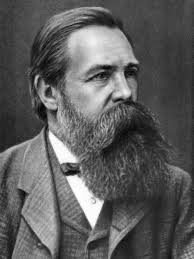
Engels was a German philosopher, political theorist, journalist, and revolutionary socialist. He was also a businessman and Karl Marx's lifelong friend and closest collaborator, serving as the co-founder of Marxism.... Engels was the son of a wealthy textile manufacturer. Despite his bourgeois background, he became a staunch critic of capitalism, influenced by his observations of industrial working conditions in Manchester, England, as published in his early work The Condition of the Working Class in England.
Introductory Comments
It would seem impossible to be a respectable businessman, a pleasure-loving bon vivant, and a revolutionary communist all at once. Friedrich Engels managed it, and seemed to enjoy every minute. By day he worked in the Manchester office of his family's cotton firm, eventually rising to partner. He was, in effect, accumulating the very capital he meant to abolish. Much of it went to support Karl Marx, whose household Engels kept afloat for decades. Meanwhile he wrote attacks on industrial capitalism scathing enough to make his fellow mill owners choke on their cigars. After hours he rode to hounds with the Cheshire gentry, kept an excellent wine cellar, and enjoyed a reputation with women that his letters to Marx did little to dispel.
And then there was Mary Burns, an Irish working-class woman who, by tradition, guided him through Manchester's grimmest slums. Engels kept two homes: respectable lodgings for business, and a second household, partly under assumed names, with Mary and her sister Lizzie. He never married Mary; marriage, he held, was a bourgeois institution. After Mary died in 1863, he lived with Lizzie, and he married her on her deathbed in 1878 because she asked him to. So there you have it: a capitalist communist, a revolutionary voluptuary, a roving eye devoted to one woman, all in one cheerful package. The contradictions never seem to have cost him any sleep. Given his schedule, he can't have had much to lose.
Some of Engels's Key Positions
Capitalism degrades the working class. In the factory towns of 1840s England, above all Manchester, workers endure child labor, starvation wages, punishing hours, dangerous machinery, and squalid housing, while factory owners amass fortunes. These miseries are not the vices of a few bad employers. They follow from a system in which one class owns the means of production and another must sell its labor to survive.
History is driven by material conditions and the class struggles they produce. Every economic order breeds the forces that will overturn it. By crowding workers into factories, capitalism organizes them; by lurching through crises of overproduction, it exposes its own irrationality. Socialism is thus not a utopian dream but predictable outcome of history.
The proletariat will take political power and place the means of production under common ownership. Where workers have the vote and a legal party, as in Germany, the ballot box may deliver power. Where the ruling class blocks that road, revolution will be necessary. Either way, the goal is not to reform capitalism but to replace it.
A transitional "dictatorship of the proletariat" will follow, meaning the rule of a class, not a strongman. Because the state has always been an instrument by which one class holds down another, it loses its purpose once classes disappear. It will not be abolished; it will "wither away."
Place in the History of Ideas
Engels's Place in History of Ideas
Paul Blackledge: Beyond Engels’s codiscovery of the working class as a potential revolutionary agent of change, he was the first socialist to recognize the importance of trade union struggle to the socialist project. He also laid the foundations for a historical understanding of the emergence of women’s oppression and a unitary theory of its capitalist form.... Perhaps most importantly, Engels also won generations of socialists over to Marxism through his popularization of the Marxist method. And along with his own and his collaborative works, he also prepared the second and third volumes of Marx’s Capital for publication - and though modern scholarship has picked holes in this project, he nonetheless performed a Herculean task in presenting these manuscripts as coherently as possible. The left has benefited enormously from his efforts.
Tristram Hunt: ... Marx’s life work soon looked in danger of falling victim to "the bourgeois conspiracy of silence," until Engels started or- ganizing much-needed publicity. It was Engels’s popularization of Marx’s central insights in his pamphlets Anti-Dühring and Socialism: Utopian and Scientific, that launched Marxism as a compelling global creed. "Most people are too lazy to read stout tomes like Das Kapital," Engels explained, as his own easily intelligible guides to Marxism garnered readers across France, Germany, America, Italy and Russia.
Random Thoughts on Engels
Engels liked to call himself a second fiddle, the modest partner who played along while Marx carried the melody. Many historians have taken him at his word. Others suspect the second fiddle quietly rewrote the score. After Marx died in 1883, Engels became the keeper of his legacy: editor of the unfinished volumes of Capital, interpreter-in-chief, and court of final appeal for a growing movement. The Marxism he handed on bore his stamp. He billed historical materialism as "scientific socialism," a theory of history as dependable as the laws of physics. In Engels's hands, critics argue, socialism began to sound as inevitable as the next sunrise, while Marx had dwelt on human agency and the messy unpredictability of struggle.
It's a tempting story, but the evidence is tangled. Marx read Engels's book on scientific socialism (Anti-Dühring) in manuscript and even wrote a chapter of it, which is hardly the behavior of a man watching his ideas being hijacked. Plus, Marx could at times sound every bit as deterministic, writing in Capital of tendencies working "with iron necessity." Then, to complicate matters further, Engels, late in life, complained that young disciples were turning the theory into a formula. Neither he nor Marx, he insisted, had ever claimed economics was the only force driving history. Perhaps, then, the Prufrock line belongs to Engels rather than Marx, addressed to the generations who would build a state doctrine on his writings: "That is not what I meant at all. / That is not it, at all."
Engels influenced: Childe, G., de Beauvoir, Debord, Guy, Guevara, Che, Kropotkin, Lenin, Luxemburg, Mao Zedong, Negri, Trotsky, West, Zizek
Similar and opposing positions
Thinkers with similar positions:
Chomsky (Workers must unite to influence the economy and greater society.)
Dewey (Democracy applies not just to politics, but also to industry & society.)
Fromm (We need a socialist humanism that fights both injustice & alienation.)
George, Henry (People should own the value produced through their own labor)
Goldman (Revolution is a violent process, but also at times a necessary one.)
Gramsci (Often the ruling class imposes its worldview on the entire culture.)
Hegel (God is the fullest reality, arising out of ourselves, the world, and nature.)
Lukács (Dialectical materialism, not dialectical reason, is the road to truth.)
Marx (From each according to his ability, to each according to his needs.)
Thinkers with opposing positions:
Adorno (Though capitalism is oppressive, it is also robust and adaptable.)
Bakunin (A communist vested with absolute power would soon become a tyrant.)
Bourdieu (Social, cultural, & symbolic capital are also at work in our world.)
Burke (The idea of the overthrowing government is horrible and dangerous.)
Carlyle (The history of the world is but the biography of great men.)
Fourier (What's needed to fix social injustice isn't revolution, but cooperation)
Hayek (Only free market capitalism is consistent with freedom & democracy.)
Weber (Cultural, not just economic, forces drive history and shape society.)
What others said about Engels
Oscar J. Hammen: [P]osterity has generally lumped him together with Marx without adequately clarifying Engels’s significant role.
Dwight Garner: This great lover of the good life, passionate advocate of individuality, and enthusiastic believer in literature, culture, art and music as an open forum could never have acceded to the Soviet Communism....
Lenin: After his friend Karl Marx (who died in 1883), Engels was the finest scholar and teacher of the modern proletariat in the whole civilized world.... In their scientific works, Marx and Engels were the first to explain that socialism is not the invention of dreamers, but the final aim and necessary result of the development of the productive forces in modern society.
Tristram Hunt: Engels believed in cascading the pleasures of life - food, sex, drink, culture, travel, even fox-hunting - across all classes. Socialism should not be a never-ending Labour party meeting, but a life of enjoyment.
Werner Plumpe: Without Friedrich Engels much of Karl Marx's writings would never have appeared.
Ellisabeth Engels: You have paid more heed to other people, to strangers, and have taken no account of your mother's pleasure.... I was trembling when I picked up the newspaper and saw that a warrant was out for my son's arrest.
Tristram Hunt: In his study of the history of family life, Engels laid the foundations for socialist feminism with his connection of capitalist exploitation to gender inequality. Similarly, Engels pioneered the Marxist vision of colonial liberation with his early analysis of imperialism as a core component of Western capitalism.
Galbraith: Engels always considered himself a junior partner, and so... he was. But that does not lessen his role. Had he not been the junior partner, much for which his senior partner is known would not have been done.