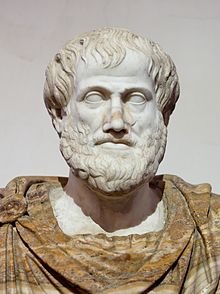
[Aristotle's] writings cover a broad range of subjects spanning the natural sciences, philosophy, linguistics, economics, politics, psychology and the arts. As the founder of the Peripatetic school of philosophy..., he began the wider Aristotelian tradition that followed, which set the groundwork for the development of mod ern science…. Aristotle's influence on logic continued well into the 19th century. In addition, his ethics... gained renewed interest with the modern advent of virtue ethics.
Introductory Comments
If there was ever a walking encyclopedia in the history of Western thought, that man was Aris-totle. Biology, physics, rhetoric, aesthetics, thea- ter, politics, psychology, logic, ethics.…. The list is staggering. One naturally wonders what kind of person pulls this off. The answer, perhaps unsurprisingly, is a very disciplined one. And his discipline, it must be said, shows. Aristotle's ethics is built on a principle that could only have been formulated by someone deeply suspicious of excess in any direction. Virtue, he argued, is the mean between two extremes: courage sits midway between cowardice and recklessness; generosity, between miserliness and profligacy. It's a sensible doctrine, admirably balanced, and about as likely to inflame the passions as a well-organized filing cabinet. It is difficult to imagine troops charging into battle under a banner that reads: "Moderation in all things!"
There is, however, one corner of Aristotle's thought where something warmer breaks through: his treatment of friendship. "Without friends," he wrote, "no one would choose to live, though he had all other goods." That's genuine feeling - or at least it sounds like it. The complication is that Aristotle's idea of true friendship turns out to be a rather demanding affair: True friendship requires a shared pursuit of virtue and a mutual commitment to moral improvement. As the saying goes: With friends like that, who needs a parole officer?
Some of Aristotle's Key Positions
Against Plato, Aristotle denied that forms inhabit a separate, higher realm. For him, form is found here, in the natural world, bound up with the matter of ordinary things. Every substance is a compound of matter and form.
A full account of anything requires its four causes. The material cause is the stuff from which it is made. The formal cause is its form, shape, or arrangement. The efficient cause is the agent or force that brings it into being or sets it changing. And the final cause is the purpose it serves or the end it strives to actualize.
The final cause matters most, for it names a thing's essential reason for being. Since human beings are rational animals, our final cause is to exercise reason - to understand ourselves and the world we inhabit.
Turned outward, reason opens a host of disciplines for study: physics, biology, zoology, medicine, metaphysics, and more. Each demands both rigorous logic and patient empirical observation.
Turned toward human life, reason invites still other inquiries: psychology, linguistics, rhetoric, poetics, aesthetics, politics - and, above all, ethics. Rational ethics, in turn, teaches the value of moderation, the famous "golden mean" that steers between excess and deficiency.
Place in the History of Ideas
Aristotle's Place in History of Ideas
Cassirer: Aristotle's criticism of the Platonic doctrine begins with his objection to this separation of the realm of existence and the realm of ideal "meaning." Reality is one. How is it possible to grasp it in two different ways of knowing, each the exact opposite of the other? We can emphasize the opposition between "matter" and "form," between "becoming" and "being," between "sensible" and "super-sensible" as much as we like; the fact remains that it can only be understood as opposition if there is some means of going from the one pole to the other. Thus, for Aristotle, the concept of development becomes the basic category and the general principle [explaining] the world.
Morton Kelsey: Aristotle had not been popular in the ancient world, but his ideas were picked up by the materialistically-minded Arabs as they were developing their culture, and from there his works were introduced into Western Europe. They became the rage, stimulating a whole intellectual revival.
Russell: [T]here is an emotional poverty in [Aristotle's two ethical treatises], which is not found in the earlier philosophers. There is something unduly smug and comfortable about Aristotle’s speculations on human affairs; everything that makes men feel a passionate interest in each other seems to be forgotten. Even his account of friendship is tepid.
Random Thoughts on Aristotle
Raphael's School of Athens famously depicts Plato pointing toward the heavens and Aristotle gesturing toward the earth. Ever since, the two have often been cast in familiar roles: Plato the otherworldly metaphysician, Aristotle the grounded philosopher and proto-scientist. Yet the contrast is not quite so stark. Aristotle rejected Plato's claim that Forms exist in a separate realm, but he hardly abandoned metaphysics. Forms, for Aristotle, inhabit particular things. And these forms - especially in living beings - are remarkably powerful and more than a little mysterious. They explain how an acorn becomes an oak, and a drooling infant gradually develops into a rational human being. Every living thing contains within itself a tenden-cy toward the fulfillment of its own nature.
Aristotle's forms are also deeply metaphysical because they help explain identity and change, potentiality and actuality. True, they are not Plato's eternal and transcendent Paradigms, floating in some celestial realm beyond space and time. Yet they are paradigms of a sort. They define what a thing is, what it can become, and what counts as its successful realization. Aristotle's universe is therefore not a collection of inert objects blindly colliding with one another. It is a world filled with developing forms, each striving toward its characteristic fulfillment. Metaphysical nonsense? Perhaps. But as poetry, what a nice way to explain the miracle of living things.
Al-Farabi (Humans are social creatures and need others to develop properly.)
Aquinas (Universals are "embedded" in particular objects as their "whatness.")
Aquinas (All change in the world springs from a changeless Unmoved Mover.)
Bacon, Francis (Knowledge springs from carefully observing the actual world.)
Locke (God's natural laws must form the basis of our moral and political systems.)
MacIntyre (Ethics should emphasize internal virtues, not external results.)
Thales (Knowledge of nature springs only from careful study and reasoning.)
Thinkers with opposing positions:
Albertus Mag. (The soul both governs & transcends the body. It's beyond nature.)
Dostoyevsky (Humans are full of irrational cravings and contradictions.)
Epicurus (Happiness comes from maximizing pleasure & minimizing pain.)
Hume (What we call causality is merely the constant conjunction of events.)
James (Mystical experiences can reveal truths beyond the realm of reason.)
Mill (Moral worth derives solely from the consequences of one's actions.)
Plato (Our concepts spring from the eternal realm of Forms or Ideas.)
Proclus (All truth is interior. The objects of knowledge are inside the soul itself.)
Shakespeare (Nature may guide us, but towards no rational purpose or end.)
What others said about Aristotle
Romanes: Aristotle stands forth, not only as the greatest figure in antiquity, but as the greatest intellect that has ever appeared upon... this earth.
Hegel: [Aristotle] penetrated into the whole universe of things, and subjected its scattered wealth to intelligence; and to him the greater number of the philosophical sciences owe their origin and distinction.
Will Durant: It is difficult to be enthusiastic about Aristotle, because it was difficult for him to be enthusiastic about anything.… He realized too completely the Delphic command to avoid excess: he is so anxious to pare away extremes that at last nothing is left…. [He] is so timid of uncertain change that he prefers a certain changelessness that near resembles death.
Russell: The errors of [Aristotle's] predecessors were the glorious errors of youth attempting the impossible; his errors are those of age which cannot free itself of habitual prejudices.
Luther: Aristotle, that histrionic mountebank, who from behind a Greek mask has so long bewitched the Church..., that most cunning juggler of souls….
Rand: Aristotle may be regarded as the cultural barometer of Western history. Whenever his influence dominated the scene, it paved the way for one of history's brilliant eras; whenever it fell, so did mankind.
George Henry Lewes: Aristotle... seems utterly destitute of any sense of the Ineffable. There is no quality more noticeable in him than his unhesitating confidence in the adequacy of the human mind to comprehend the universe.... He never seems to be visited by misgivings as to the compass of human faculty, because his unhesitating mind is destitute of awe.
Michael Ghiselin: [Aristotle's] attempt to reason in terms of essences almost forces one to ignore everything dynamic or transitory. One could hardly design a philosophy better suited to predispose one toward dogmatic reasoning….
Schools: Aristotelianism, Common Sense Realism, Deontological Ethics, Essentialism, Holism, Humanism, Intellectualism, Natural Law Theory, Naturalism, Rationalism, Virtue Ethics, Vitalism
Main interests: Art and Aesthetics, Astronomy, Beauty, Biology, Botany, Causality, Chain of Being, Communication, Community, Cosmology, Democracy, Desire, Dreams, Education, Equality, Ethics, Family, Free/Unfree Will, Friendship, Geography, Government, Habits, Happiness, Health, History, Human Will, Infinity, Jurisprudence, Justice, Language, Law, Literary criticism, Literary theory, Literature, Logic, Love, Mathematics, Memory, Metaphors, Metaphysics, Meteorology, Music, Perception, Physics, Poetry, Political Theory, Politics, Power, Property, Psychology, Rhetoric, Science, Social Theory, Theatre, Time, Tragedy, Universals, Virtue, War, Wealth, Will, Wisdom, Zoology