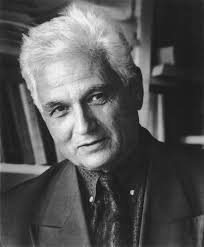
Derridadeveloped the philosophy of decon- struction, which he utilized in numerous texts, and which was developed through close readings of the linguistics of Ferdinand de Saussure and Husserlian and Heideggerian phenomenology. He is one of the major figures associated with post-structuralism and postmodern philosophy, although he has distanced himself from post-structuralism and "protest[ed] against the word postmodernity." … He had a significant influence on the humanities and social sciences….
Introductory Comments
For Derrida, Western philosophy has long been governed by what he called “logocentrism”: the belief that truth, reason, and meaning rest up- on some stable center that can anchor thought once and for all. From Plato onward, this tradi- tion has organized itself through hierarchical binary oppositions - speech over writing, mind over body, nature over culture, presence over absence - in which the first term is treated as pure, original, and authoritative while the sec- ond is cast as derivative or suspect. Philosophy, in this sense, resembles an old aristocratic household: one concept sits in the drawing room sipping sherry while its disreputable cousin is quietly sent to the servants’ entrance.
However, Derrida argues these hierarchical binaries are hopelessly unstable because each "superior" term is secretly contaminated by the very thing it tries to exclude. Speech shares all the instability it attributes to writing; presence is only recognizable against absence. Meaning is never a self-contained "nugget" of truth sitting inside a word; instead, it is produced through différance, a process where meaning is both dif- ferent from other signs and eternally deferred. Every sign carries a "trace" of its opposites, much like a "refined" gentleman who only knows he is civilized by constantly glancing nervously at the "barbarian" outside his window. Thus, meaning is a perpetual game of linguistic tag in which nobody is ever "it."
Some of Derrida's Key Positions
The premises and pursuits of the Enlighten- ment - indeed, of Western culture broadly - rest on a tendency called "logocentrism": an assum- ption, running from Plato through Rousseau to Heidegger, that meaning, truth, and being can be fully and stably present to consciousness. This tendency expresses itself through hierar-chized binary oppositions - speech over writing, presence over absence, truth over fiction.
To read texts deconstructively is to attend to how meaning is never simply present but al-ways produced through "différance" - the play of differences within language that perpetually defers any final, settled sense. The oppositions and hierarchies a text presents as natural or necessary are revealed, under this scrutiny, to be unstable: each term depends on what it ex-cludes, and that exclusion is never fully secured.
But to deconstruct is more than to debunk. Deconstruction also discloses what a text must suppress or push to its margins in order to sustain its apparent logic - the cultural, ethical, and political forces whose exclusion quietly shapes what the text can say. These forces are not irrational per se. Rather, they are a type of structural repression that makes a text's coher- ence possible. Deconstruction is therefore a patient, careful unweaving of those hidden threads - practiced from within the tradition itself, and never arriving at any final certainty.
Place in the History of Ideas
Derrida's Place in History of Ideas
Leonard Lawlor: Jacques Derrida was the founder of "deconstruction," a way of criticizing not only both literary and philosophical texts but also political institutions. Although Derrida at times expressed regret concerning the fate of the word "deconstruction," its popularity indicates the wide-ranging influence of his thought, in philosophy, in literary criticism and theory, in art and, in particular, architectural theory, and in political theory. Indeed, Derrida’s fame nearly reached the status of a media star, with hundreds of people filling auditoriums to hear him speak, with films and televisions programs devoted to him, with countless books and articles devoted to his thinking.
Norman N. Holland: [L]anguage for Derrida lacks the stability that Saussure found. Saussure's neat pairings of signifier and signified came from a finite system of distinctive features. By contrast, Derrida's signifier and signified go on and on in endless differencing or differing or deferring (all terms involved in Derrida's own word, différance). And since our minds only work in signs, and nothing is ever fully present in signs, everything becomes flickering and unstable, both present and absent, present and future. It follows therefore that human beings are not the master of language, since the forces of language cannot be mastered. I try to mean, but my meaning is dispersed, divided, at odds with itself.
Random Thoughts on Derrida
Derrida's deconstructionism is not a wrecking ball Derrida swings at texts from outside. It is something the text does to itself. Every text, in trying to establish its meaning, suppress its contradictions, and secure its hierarchies, simultaneously produces the tensions that unravel it. The reader's job is not to demolish but to trace - patiently, carefully - the places where the text's own logic turns against its stated claims, where the margins invade the center, where what was excluded returns to trouble the argument. It is as if the text is a sweater that, upon being pulled by a single loose string of logic, reveals it was never really a sweater but a very long, confused piece of yarn.
Analytic philosophers like Searle and Scruton have dismissed all this as obscurantist word- play, and the charge is not baseless: Derrida's prose can be maddening - a willful fog of puns and paradoxes masquerading as profundity. Derrida can sometimes write as though clarity itself were a bourgeois vice. And yet something genuine endures. His deepest insight may be that undecidability is not the enemy of ethical and political life but its precondition: Genuine decisions arise precisely where no rulebook can relieve us of judgment. In that sense, undecid-ability is not paralysis but the price of moral adulthood. Or, put differently: if life came with an instruction manual, conscience would be little more than customer support.
Foucault (Truth is constructed through various personal & political processes.)
Gadamer (Meaning of a text changes with each generation of interpreters.)
Habermas (We must not give up on Enlightenment ideals of reason & science.)
Nussbaum (Truth exists and reason is our best tool for finding it.)
Peirce (The truth about an event or thing is the totality of its consequences.)
Popper (The search for truth should be completely fact-based and objective.)
Searle (Understanding words often requires understanding intentions.)
Tarski (The meaning of a sentence is equivalent to its truth conditions.)
What others said about Derrida
Hugh Mellor: He is a mediocre, unoriginal philosopher - he is not even interestingly bad.
Derek Attridge: He argued that understanding something requires a grasp of the ways in which it relates to other things, and a capacity to recognize it on other occasions and in different contexts - which [can't be totally] predicted.
Roger Scruton: He's difficult to summarize because it's nonsense. He argues that the meaning of a sign is never revealed in the sign but deferred indefinitely and that a sign only means something by virtue of its difference from something else. For Derrida, there is no such thing as meaning - it always eludes us and therefore anything goes.
Peter Hommelhoff: Beyond the boundaries of philosophy as an academic discipline he was a leading intellectual figure not only for the humanities but for the cultural perception of a whole age.
Mark Goldblatt: Derrida’s special significance lies not in the fact that he was subversive, but in the fact that he was an outright intellectual fraud….
Searle: [Reading Derrida, I am surprised by] the low level of philosophical argumentation, the deliberate obscurantism of the prose, the wildly exaggerated claims, and the constant striving to give the appearance of profundity….
John D. Caputo: Contrary to the claims of Derrida’s more careless critics, the passion of deconstruction is deeply political, for deconstruction is a relentless, if sometimes indirect, discourse on democracy, on a democracy to come. Derrida’s democracy is a radically pluralistic polity that resists the terror of an organic, ethnic, spiritual unity….
Chomsky: I found the scholarship appalling, based on pathetic misreading; and the argument, such as it was, failed to come close to the kinds of standards I've been familiar with since virtually childhood.
Main interests: Anthropology, Art and Aesthetics, Classics, Communication, Consciousness, Cultural Studies, Death, Desire, Ethics, Friendship, Justice, Language, Law, Literary theory, Literature, Memory, Metaphilosophy, Metaphors, Philology, Political Theory, Politics, Psychoanalysis, Psychology, Religion, Rhetoric, Semiotics, Social Criticism, Social Theory