Alexander Herzen (1812 - 1870)
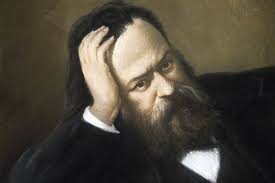
Open Herzen's interactive page (graphs of influences, similar and opposing positions, and quotes)
Background
Alexander Herzen
Born: April 6, 1812 in Moscow, Russia
Died: January 21, 1870 (aged 57) in Paris, France
Schools: Agrarian collectivism, Anarchism,
Populism, Socialism
Main interests: Politics, economics, class
struggle, social criticism, social activism
Notable ideas: Agrarianism, Collectivism,
Populism, Socialism
Influences: Pierre-Joseph Proudhon, Georg
Wilhelm Friedrich Hegel, Jean-Jacques
Rousseau, Charles Fourier, Vissarion Belinsky,
Kondraty Ryleyev, Ludwig Feuerbach, Friedrich
Schiller, Comte de Saint-Simon
Influenced: Peter Kropotkin, Mikhail Bakunin,
Vladimir Lenin, Leo Trotsky, Mao Zedong,
Che Guevara, Jean-Paul Sartre, Isaiah Berlin,
Dmitry Mamin-Sibiryak, Nikolay Dobrolyubov,
Frankfurt School, Tom Stoppard
From Wikipedia
Herzen was a Russian writer... known as the precursor of Russian socialism and one of the main precursors of agrarian populism (being an ideological ancestor of... Socialist-Revolutionaries, Trudoviks, and the agrarian American Populist Party). With his writings, many composed while exiled in London, he attempted to influence the situation in Russia, contributing to a political cli- mate that led to the emancipation of the serfs in 1861…. His autobiography, My Past and Thoughts, is... considered one of the best... in [Russia].
Introductory Comments
To live for a cause, or to live with one? Bakunin, Herzen's old friend, chose the first. So did Marx, whom Herzen disliked and who heartily returned the favor. Herzen chose the second. He valued life too much to sacrifice anyone's liberty, his own included, on the altar of some future utopia, or on what Isaiah Berlin called "some enormous metaphysical construction that itself rests upon sand." For Herzen, life was an end in itself, not a means to something else. Improving the lot of others is a fine thing, but it is not everything. Those who think it is everything are dangerous characters, prone to replacing an old injustice with a new one and calling it progress.
Herzen's own life embodied the principle. He loved conversation, witty and sprawling and running late into the night. Wherever he landed, whether Moscow, Paris, or at last London, his home filled with talk and with exiles from half the failed revolutions of Europe. He loved his freedom. And he deeply loved his wife, Natalie. But the Herzens moved in radical circles where love and freedom sometimes got tangled up together. In the late 1840s, Natalie fell in love with the German poet Georg Herwegh, a friend and fellow radical, and theory met practice. The episode nearly destroyed Herzen. Later, after Natalie's death, Herzen's personal life took an even more tangled turn when he bagan an affair with Natalia Tuchkova-Ogareva, the wife of his closest friend, Nikolai Ogarev. But that's a whole novel unto itself.
Some of Herzen's Key Positions
The serfs of Russia must be freed, and freed with land. An emancipation that turns peasants into landless wage laborers would only reproduce the misery of the Western factory worker under a new name. The land belongs with the peasant commune, which already holds it in common and periodically redistributes it among its members.
That commune is the seed of a distinctly Russian socialism. Western Europe, after the failed revolutions of 1848, has settled into a comfortable, money-minded middle-class conformity. Russia, for all its backwardness, may skip that stage and build socialism on its own communal foundations, provided the commune is joined to the individual liberty it has always lacked.
Change should come gradually and, if possible, peacefully. A violent revolution would most likely replace one despotism with another, and destruction by itself builds nothing. Reform from above, even from the tsar, deserves a welcome when it comes. New institutions must grow out of the country's real conditions, not out of a blueprint.
Human beings must not be sacrificed on the altar of abstractions. Radicals often grow so devoted to grand doctrines, such as History, Progress, or the Revolution, that they cannot see the suffering, violence, and tyranny those doctrines license. Each life and each age is an end in itself, not a down payment on some future paradise.
Place in the History of Ideas
Herzen's Place in History of Ideas
Edward Acton: One of the first members of the Russian intelligentsia to adopt socialism, he acknowledged a major debt to Fourier, the Saint-Simonians, Blanc and Proudhon. Initially he looked to the West to inaugurate an era of socialist justice and individual liberty. The failure of the Revolutions of 1848 affected him profoundly. His commentary on them, From the Other Shore (1850), ranks with those of Marx and Tocqueville. Its finest lines explored the tensions between an unqualified affirmation of the individual and the sacrifices demanded by the revolutionary cause.
Cathy Porter: In the 1830s writers like Belinsky, Bakunin, Herzen and Ogarev, all consumed by the desire for philosophical certainties, were tentatively exploring the ideas of socialism within a framework of romantic culture.... Herzen's quasi-religious desire for inner peace prompted him to mediate between the more extreme philosophies of his friends. On the other hand there was Bakunin, whose radical interpretation of the theories of Fourier, Saint-Simon and Owen were to lead him to a more doctrinaire violence.
Pavel Annenkov: I must own that I was... over- whelmed, when I first came to know Herzen - by this extraordinary mind which darted from one topic to another with unbelievable swiftness, with inexhaustible wit and brilliance....
Random Thoughts on Herzen
Every reformer eventually faces the surgeon's dilemma: operate now, or wait and see? The knife might cure the patient or kill him; waiting might let the body heal itself, or let the disease spread. Gradualists, Burke most famously and the later Herzen in rather unexpected company, argue that societies are staggeringly complex. Tug one thread and something unravels three rooms away. Go slowly, and you can correct course, spare the arrangements that work, and give people time to grow the habits that new institutions need. Gradual change also tends to win converts, while sudden change mostly wins enemies.
But try explaining all this to someone in chains. In 1831, William Lloyd Garrison opened his abolitionist paper, The Liberator, by asking whether one would tell a man whose house was on fire to raise only a moderate alarm. Seen from inside an injustice, gradualism looks less like prudence than a bill sent to the wrong address. The victims pay the costs of delay, while those who profit from it pay nothing. More than a century later, Martin Luther King Jr. made the same point from a Birmingham jail: to those who have waited long enough, "wait" has come to mean "never." The sharpest twist is that Herzen's own principle cuts both ways. If no life should be sacrificed to a future paradise, the revolutionary who spills blood today for tomorrow's utopia stands condemned. So does the gradualist who asks the serf to remain a serf a little longer, for the sake of orderly progress.
Influences
Herzen was influenced by: Belinsky, V., Feuerbach, Fourier, Hegel, Proudhon, Pushkin, Rousseau, Ryleyev, K., Saint-Simon, Schiller
Herzen influenced: Bakunin, Berlin, Dobrolyubov, Guevara, Che, Kropotkin, Lenin, Mamin-Sibiry., Mao, Sartre, Stoppard, Trotsky
Similar and opposing positions
Thinkers with similar positions:
- Bakunin (Law & the state are at times obstacles to freedom & human rights.)
- Berlin (Humans should never be sacrificed on an altar of glorious abstractions)
- Fourier (What's needed to fix social injustice isn't revolution, but cooperation)
- Godwin (Mankind is perfectible if freed from repressive social structures.)
- Kropotkin (The best economy is a decentralized one based on mutual aid.)
- Shaw (Socialism can cure many of the abuses found in our modern economies.)
- Thoreau (Citizens have a duty to peacefully protest governmental injustice.)
- Veblen (The leisure class is addicted to wasteful and conspicuous consumption.)
Thinkers with opposing positions:
- Bosanquet (The state has more reality than the individual persons within it.)
- Dostoyevsky (The cure to social ills is not socialism, but a true Christianity.)
- Goldman (Revolution is a violent process, but also at times a necessary one.)
- Hayek (Socialism requires central planning which in turns leads to oppression.)
- Hegel (There is a “rational” inevitability at work in the course of history.)
- Marx (History is a long dialectical process of thesis/antithesis/synthesis.)
- Proudhon (As we seek justice in equality, so society seeks order in anarchy.)
- Tolstoy (Our greatest hope is in following Christ's original & radical teachings.)
What others said about Herzen
- Tom Stoppard: Herzen had no time for [Marx's] mono-theory that bound history, progress and individual autonomy to some overarching abstraction....
- Edward Acton: Nineteenth-century Russia was overwhelmingly a peasant society, and it was to the peasantry that Herzen looked for revolutionary upheaval and socialist construction.
- Berlin: But this Rousseau-inspired faith, as [Herzen] grows older, grows less secure. For all his efforts, and the efforts of his socialist friends, he cannot deceieve himself entirely. He oscillates between pessimism and optimism, skepticism and suspicion of his own skepticim, and is kept morally alive only by his hatred of all injustice, all arbitrariness, all medioctity….
- Lenin: His "socialism" was one of the countless forms and varieties of bourgeois and petty-bourgeois socialism of the period of 1848, which were dealt their death-blow in the June days of that year.
- Tolstoy: Herzen is a man of scattered intellect, and morbid "amour propre," but his breadth, ability, goodness, elegance of mind are Russian.
- P. Annenkov: ... his listeners were sometimes exhausted by the inextinguishable fireworks of his speech, the inexhaustible fantasy and invention, a kind of prodigal opulence of intellect which astonished his audience.
- Martin Malia: This wavering position between socialism and liberalism, which characterized so much of his career, proved to be his political testament. The ambiguities of his position have made it possible ever since for both Russian liberals and socialists to claim his legacy with equal plausibility.
- Berlin: Herzen... dealt with anything that seemed to be of topical interest. He exposed, he denounced, he derided, he preached, he became a kind of Russian Voltaire of the mid-nineteenth century.
Schools: Socialism
Main interests: Class Struggle, Economics, Equality, Political Activism, Politics, Social Criticism
Herzen's answers to philosophical questions
Ethics
We cannot reason our way to a virtue: "Life has taught me to think, but thinking has not taught me to live."
"Man must respect and honor his freedom in himself no less than in his neighbor or in the people at large."
History
"Socialism and rationalism are... the touchstones of humanity, the rocks which lie in the course of revolution and science."
"A republic that would not lead to Socialism seems an absurdity to us - a transitional stage regarding itself as the goal. "
Beware great men: "It is possible to lead astray an entire generation…, to direct it towards a false goal. Napoleon proved this."
Metaphysics
"I believe in nothing here, except a handful of people, a few ideas, and the fact that one cannot arrest movement."
Nature
"Nature is perfectly indifferent to what happens... [But to] look at the end and not at the action itself is a cardinal error. "
Political Philosophy
Freedom is essential: "Personal freedom is a magnificent thing; by it and by it alone can a nation achieve its true freedom."
Psychology
"You can no more bridle passions with logic than you can justify them in the law courts. Passions are facts and not dogmas."
"We think the purpose of a child is to grow up because it does grow up. But its purpose is to play, to enjoy itself, to be a child."
Religion and Theology
"All religions have based morality on obedience, that is to say, on voluntary slavery." This is a "corruption of the will."