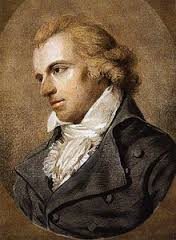
Schiller was a German playwright, poet, philoso- pher and historian. Schiller is considered by most Germans to be Germany's most important classical playwright…. After a brief stint as a regimental doctor, he left Stuttgart and eventually wound up in Weimar. In 1789, he became profes- sor of History and Philosophy at Jena, where he wrote historical works. During the last seventeen years of his life (1788–1805), Schiller developed a productive, if complicated, friendship with the already famous and influential… Goethe.
Introductory Comments
Play, for Schiller, is not a childish thing - not even in children. It is what being human finally comes to. The claims he makes for the "play drive" are enormous: it reconciles becoming with absolute being, variation with identity, and aims at nothing less than "the extinction of time in time." That is quite a load to hang on sand castles and finger paint, and read too quickly it makes play sound less like fun than like a second job. But Schiller means something precise. Two forces pull at us. The sensuous drive binds us to appetite and the passing moment; the formal drive binds us to law and the timeless. Each of them, left alone, compels. Play is the condition in which they hold each other in balance so that neither does - which is why he can say that a person "is only wholly human when he plays."
Schiller's own preferred form of play was, aptly enough, writing plays. In The Robbers (1781) Karl Moor - sick of a corrupt age - takes to the Bohemian forests at the head of a robber band, meaning to supply the justice the law refuses to. It goes badly. The band burns a town; Karl, bound by an oath to men he cannot control, ends by killing the woman he loves and handing himself over to the law he set out to overthrow. That is not the play drive at work. That is freedom seized before anyone is fit to hold it - Schiller's later verdict on the Revolution, delivered eight years before the Bastille. Karl is not a man at play. He is what happens when play is skipped.
Some of Schiller's Key Positions
The French Revolution rallied behind admirable ideals and ended in the Terror. The ideals weren't wrong; the people weren't ready. A state can be no better than the characters who compose it, so the reform of the state waits on the reform of the person. And the instrument of that reform is beauty - "for it is through beauty that we arrive at freedom."
Beauty and goodness share a root. Borrowing Kant's vocabulary, one can trace both to practical reason: turned toward our actions it yields moral judgments, turned toward objects, judgments of beauty. It looks for the same thing in each - self-determination. An object seems beautiful when its form follows from its own nature rather than from outside compulsion. Yet a thing of sense is not literally free; beauty is only "freedom in appearance."
Beauty is thus a moral paradigm. It shows the senses the very self-determination we exercise when we act from the law within us instead of being shoved about by circumstance.
But beauty makes no one virtuous. It holds sense and reason in balance so that neither compels; this is the "play" in which a person becomes whole. From that condition - and perhaps only from it - one can pass freely to morality. Beauty restores the wholeness that makes freedom possible. It does not do freedom's work.
Place in the History of Ideas
Schiller's Place in History of Ideas
Roger Scruton: While Kant had paid little attention to art, Schiller attempted to describe it as the highest of man’s activities. Art is the activity in which, being "disinterested," man is at once wholly free and wholly at rest. Art is a form of "play." It therefore has a privileged place, not only in human self-knowledge (of which it forms the highest example) but in the life of the state. It is through "aesthetic educa- tion" that the moral and cognitive faculties of man achieve their free expression, and so develop in accordance with their innate principles of harmony. The good state must therefore both encourage and embody that aesthetic understanding which brings the greatest intuition of unity between man and man and between man and nature.
W. Windelband: The synthesis of the theoretical and the practical in the aesthetic reason could perhaps find no more fortunate expression than in Schiller's definition of beauty as freedom in phenomenal appearance. It asserts that aes- thetic contemplation apprehends its object without subjecting it to the rules of the cogniz- ing understanding; it is not subsumed under conceptions, and we do not ask for the condi- tions which it has in other phenomena. It is perceived as if it were free.... Schiller later laid still more weight upon the point that the aesthetic process is as independent of the practical reason as of the theoretical.
Random Thoughts on Schiller
Modern advice says to follow your passion. Schiller appears to recommend the reverse: don't let passion destroy your composure. Eccentric as that sounds now, the thought runs like a thread through the history of ideas. Where these don't-follow-your-passion philosophers differ is on what reward waits on the other side. For Plotinus, a soul purified of its lower attachments can begin the ascent toward the One, the source from which everything flows. Eckhart pressed further, and colder. His detachment means releasing not only selfish desire but one's own will, and finally one's images of God - so that the emptiness left behind can be filled directly with the Word of God.
Spinoza offered a subtler bargain. He asked not that we crush the passions but that we understand them, since an emotion stops being a passion the moment we form a clear idea of it. What follows is the world seen under the aspect of eternity, and a blessedness that is not virtue's reward but virtue itself. Kant, predictably, made it a matter of duty. Passions are settled inclinations that take our freedom of choice hostage, and self-mastery is what keeps autonomy alive. Schopenhauer wanted out altogether: aesthetic contemplation frees us, at least momentarily, from the Will's terrible and incessant power over us. And Schiller's own answer to the tyranny of appetite is neither transcendence nor self-mastery but play - a liberating state where passion and reason can dance with one another without stepping on each other's toes.
Benjamin (At its best popular culture can help bring about social change.)
Borges (Writing fiction can be an engaging & effective way to do philosophy.)
Chalmers (Like time & space, consciousness may be a basic property of reality.)
Heidegger (Poetry, not philosophy, is best at unveiling the mysteries of Being)
Herder (Poetry helps to define, if not also create, the uniqueness of a nation.)
Humboldt, W. (Mind and body form a vital unity as seen in man's sensuality.)
Marcuse (Transforming labor into pleasure is a humane and worthy goal.)
Orwell (Literature at its best enlightens the reader, both morally & politically.)
Ruskin (Truth, beauty, and religion are inextricably bound together.)
Shakespeare (History's the story of how human passions play out on world stage)
Thinkers with opposing positions:
Bataille (Literature has no moral purpose. It's best when disrupting morals.)
Montesquieu (Great underlying causes, not individual men, shape history.)
Pater (Revealing beauty, not moral or social truth, is how art justifies itself.)
Proust (Art is justified by revealing to us the beauty and charm of everyday life.)
Santayana (Beauty is the harmony between our nature and our experience.)
Schopenhauer (Art exists in a realm free of the forces at work on and within us.)
What others said about Schiller
William Witte: One of the most striking features of Schiller’s oeuvre is its modernity, its startling relevance to the life of the 20th century.
Lydia Moland: Schiller's was, in short, a vision of the centrality of aesthetic experience to daily and political life that has resonated through the centuries since his death and continues to shape philosophical thought today.
Wilhelm Windelband: [For Schiller the aesthetic experience] lacks that quality of want or need which belongs to the life of empirical impulse, just as it lacks the earnestness of the practical reason. In the aesthetic life the play impulse unfolds itself; every stirring of the will is silent in disinterested contemplation.
Berlin: Schiller is constantly harping upon the fact that the only thing which makes man man is the fact the he is able to rise above nature and mould her, crush her, subjugate her to his beautiful, unfettered, morally directed will.
Windelband: ... for the transition from the sensuous to the ethical determination of the will [Kant] offered man, as an aid, religion; Schiller offered art.
Coleridge: Schiller's blank verse is bad. He moves it as a fly in a glue bottle. His thoughts have their connection and variety, it is true, but there is no sufficiently corresponding movement in the verse.
Goethe: The idea of freedom assumed a different form as Schiller advanced in his own development and became a different man. In his youth it was physical freedom that preoccupied him and found its way into his works; in later life it was spiritual freedom.
Cornelia Rabitz: By the end of the 19th century, the fascination for Schiller had all but disappeared…. Nietzsche claimed that pathos was passé, and that Germans should simply let go of their passion for Schiller.
Schools: Deism, German Idealism, German Romanticism, Romanticism, Sturm und Drang, Weimar Classicism
Main interests: Art and Aesthetics, Beauty, Classics, Desire, Ethics, Free/Unfree Will, Freedom, Friendship, History, Literature, Mind, Poetry, Sublime Nature, Theatre, Tragedy, Will