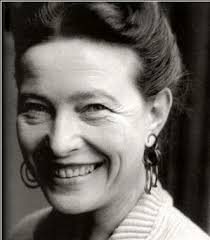
De Beauvoir was a French existentialist philoso- pher, writer, social theorist, and feminist activist. Though she did not consider herself a philoso- pher…., she had a significant influence on both feminist existentialism and feminist theory. Beauvoir wrote novels, essays, biographies, autobiographies, and monographs on philosophy, politics, and social issues. She was known for her 1949 treatise The Second Sex, a detailed analysis of women's oppression and a foundational tract of contemporary feminism….
Introductory Comments
De Beauvoir, like her lifelong intellectual sparring partner and on-again-off-again lover Sartre, held that human beings arrive in the world without a script. Existence precedes essence: we must fashion ourselves through our choices and actions. But where Sartre could make this sound like a lonely heroic affair, de Beauvoir gave it social texture. Becoming oneself is not a solitary project carried out in a Parisian café over black coffee and cigarettes; it is something we do in relation to others, within history, and against the grain of a world that would prefer we sit down and behave.
Moreover, de Beauvoir recognized that existen- tial freedom is more problematic for some than for others. In particular, women, she argued, face a rigged game. Men have cast themselves as the universal Subject - the default human - and relegated women to the status of the Other - alien, irrational, decorative, subordinate. She acknowledged that similar hierarchies of oppression plague race, class, and religion, but insisted that nowhere was this othering more pervasive or more deeply woven into the fabric of daily life than in the case of women. From cradle to grave, women must navigate an obstacle course of social expectation, cultural stereotype, economic dependency, and the quiet tyranny of being told - in a thousand ways, large and small - that their highest calling is to be pleasing, passive, and perpetually obliging.
Some of de Beauvoir's Key Positions
Whereas a man is naturally assertive, a woman "in order to realize her femininity... must make herself object and prey...." But this is a matter of psychology. Women are not merely sexual creatures, they are also moral and political beings. As such, women must refuse to be subordinate to men. They must fight against all forms of sexual discrimination.
To further consider the way women are pulled in different directions (sexually and culturally vs. morally and politically), it's important to acknowledge the absolute freedom of men and women. As existentialists, like Sartre, have in- sisted, we have no foreordained character, no predetermined destiny. We can choose, through our acts, to become our own creation.
This is not to say that it is easy to fight the forces set against us and stay true to the self residing deep within us. Political oppression, racial bias, economic struggle, class prejudice, cultural stereotype, family pressure - we all feel forces pushing us away from our true self. Women, in particular, feel the heavy weight of sexual stereotype and social expectation.
Women can be aided in such struggles by the realization that gender, unlike sex, is not some- thing we are born with. It is something we become. Gender develops through the inter- action between culture and individual choice.
Place in the History of Ideas
de Beauvoir's Place in History of Ideas
Shannon Mussett: At the time The Second Sex was written, very little serious philosophy on women from a feminist perspective had been done. With the exception of a handful of books, systematic treatments of the oppression of women both historically and in the modern age were almost unheard of. Striking for the breadth of research and the profundity of its central insights, The Second Sex remains to this day one of the foundational texts in philosophy, feminism, and women’s studies. The main thesis of The Second Sex revolves around the idea that woman has been held in a relationship of long-standing oppression to man through her relegation to being man’s "Other."
Debra Bergoffen: Some have argued that the belated admission of Beauvoir into the ranks of philosophers is a matter of sexism on two counts. The first concerns the fact that Beauvoir was a woman. Her philosophical writings were read as echoes of Sartre rather than explored for their own contributions because it was only "natural" to think of a woman as a disciple of her male companion. The second concerns the fact that she wrote about women. The Second Sex, recognized as one of the hundred most important works of the twentieth century, would not be counted as philosophy because it dealt with sex, hardly a burning philosophical issue (so it was said).... Long overdue, Beauvoir’s recognition as a philosopher is now secure.
Random Thoughts on de Beauvoir
De Beauvoir's most liberating insight is her fa- mous declaration that "one is not born but rather becomes a woman." Biology gives us a sex, but society builds a gender, and the two are not at all the same thing. Gender is assembled over time through culture, upbringing, and - cru- cially - individual choice. This means the cage has a door. If femininity is a construction, wom- en are free to pick up the tools and renovate. De Beauvoir insisted that women must not let men serve as their interior decorators, arranging their identities to suit masculine comfort. Women must define for themselves what it means to be a woman - not as a rebellion for its own sake, but as an act of authentic self-creation.
But is de Beauvoir entirely right? Contemporary science suggests that gender is neither pure social construction nor pure genetic destiny, but a complicated dance between the two. Prenatal hormones, brain structure, and genetic factors all influence gender identity - including in trans- gender and homosexual individuals, whose experiences appear to have significant biological underpinnings. De Beauvoir was no doubt cor- rect that society heaps arbitrary expectations onto biological sex, but she may have undere- stimated how much biology whispers its own suggestions. We are neither blank slates nor prisoners of our chromosomes - and de Beau- voir, one suspects, would have appreciated the complexity, even if it complicated her argument.
de Beauvoir influenced:Butler, Judith, Camus, Firestone, S., Friedan, Greer, Hoagland, Kim, Kristeva, Millett, Kate, Mitchell, J., Paglia, Rich, Sartre
Similar and opposing positions
Thinkers with similar positions:
Borges (Writing fiction can be an engaging & effective way to do philosophy.)
Butler, Judith (Gender is constituted by action and speech. It is performative.)
Camus (We seek clarity and meaning within a world that offers neither.)
Condorcet (Patriarchal norms that oppress and marginalize women must end.)
Emerson (The human self is always becoming, always partially in the future.)
Fromm (We must take responsibility for our individual actions and thoughts.)
Heidegger (Each individual's very Being involves engagement with the world.)
Lacan (Male and female sexual identities are largely based on fictions.)
Sartre (Identity is not a given. Our actions determine who we are.)
Thinkers with opposing positions:
Arendt (Politics doesn't include household relationships between the sexes.)
Evola (Women are by nature completely subordinate to men & must remain so.)
Freud (Lesbians model their behavior on men, the perceived norm or ideal.)
Hegel (Freedom springs not from within, but from our belonging to a state.)
Nussbaum (The claim that gender is just a cultural construct is not plausible.)
Paglia (Sex and gender are not social constructs. They are rooted in biology.)
Wollstonecraft (Men are not the ideal toward which women should aspire.)
What others said about de Beauvoir
Ariadne Nichol: ... de Beauvoir shows how women are labeled as the Other by being viewed as secondary, less perfect beings in relation to men.
Donna Haraway: … despite important differences, all the modern feminist meanings of gender have roots in Simone de Beauvoir's claim that "one is not born a woman [one becomes one]."
Shannon Mussett: [Beauvoir’ explains how various forces] contribute to the formulation of the myth of the "Eternal Feminine." This paradigmatic myth, which incorporates multiple myths of woman under it (such as the myth of the mother, the virgin, the motherland, nature, etc.) attempts to trap woman into an impossible ideal by denying the individuality… of women.
Felicity Joseph: By contrast [to Sartre's belief in our absolute freedom] de Beauvoir presents an ambiguous picture of human freedom, in which women struggle against the apparent disadvantages of the female body.
Kate Kirkpatrick: Beauvoir claimed women’s lives should not be reduced to erotic plots - as her life has persistently been reduced….
Betty Friedan: "The Second Sex" led me to whatever original analysis of women's existence I have been able to contribute to the Women's movement.... I looked to Simone de Beauvoir for a philosophical and intellectual authority.
Lisa Appignanesi: When I was growing up in the 60s, Simone de Beauvoir and Jean-Paul Sartre were a model couple, already legendary creatures, rebels with a great many causes, and leaders of what could be called the first postwar youth movement: existentialism - a philosophy that rejected all absolutes and talked of freedom, authenticity, and difficult choices.
Robert C. Solomon: Where de Beauvoir starts to move beyond Sartre is in her keen awareness of the importance of caring for others and respecting their freedom. For Sartre the freedom of others presents a threat…