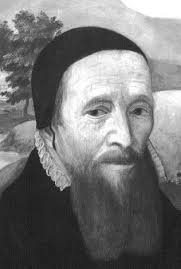
Richard Hooker (1554 - 1600)
Open Hooker's interactive page (graphs of influences, similar and opposing positions, and quotes)
Background
Richard Hooker
Born: March 1554 in Heavitree, Exeter, Devon,
England
Died: 3 November 1600 (aged 46) in
Bishopsbourne, Kent, England
Education: Corpus Christi College, Oxford
Church: Church of England
Main interests: Religion, theology, law, political
theory
School: Anglicanism
Influences: Aristotle, Aquinas, Martin Luther,
John Calvin, Thomas Cranmer, Matthew Parker,
Cicero, Seneca, Hermes Trismegistus, Pseudo-
Denys
Influenced: Locke, John Donne, George Herbert,
Samuel Taylor Coleridge, Izaak Walton, Edmund
Burke, Edwin Sandys
From Wikipedia
Hooker was an English priest in the Church of England and an influential theologian. He was one of the most important English theologians of the sixteenth century. His defence of the role of redeemed reason… later provided many members of the Church of England with a theological method which combined the claims of revelation, reason and tradition…. Traditionally, he has been regarded as the originator of the Anglican [compromise] between Protestantism and Catholicism.
Introductory Comments
Richard Hooker might have appreciated the old quip often attributed to Socrates: "By all means, marry. If you get a good wife, you'll become happy; if you get a bad one, you'll become a philosopher." If the story is true, Hooker certainly qualified for the latter distinction. His marriage to Joan Churchman, according to tradition, was less a partnership than a penance. While Hooker devoted himself to study and writing, Joan was said to devote herself to running the household and, whenever possible, running Hooker as well. She supposedly interrupted his theological labors with an endless stream of domestic demands, which the mild-mannered Hooker would dutifully, if reluctantly, fulfill.
Or so the story goes - a story that surely says as much about the prejudices of its tellers as about the marriage itself. (And a story that comes to us largely through Izaak Walton's 17th-century biography - a fishy source, given Walton's weakness for a good anecdote.) In any case, it cannot have been easy to live with a man whose mind was forever somewhere else. Nor should we assume Joan was a hindrance to his work. She may even have been an inspiration. Learning the art of compromise at home may have nudged Hooker toward his central theological stance - the via media, the Middle Way that skirts the excesses of both Rome and the Puritans. For if compromise was key to surviving marriage to Joan, then surely compromise could unlock any problem.
Some of Hooker's Key Positions
Though the Protestant break from Rome was, on the whole, a good thing, certain Protestant theologians have gone dangerously astray. Luther's doctrine of the priesthood of all believers and the Puritans' insistence that each congregation covenant separately with God both tend, in their different ways, to erode the orderly governance of the church.
Equally mistaken is the Puritan demand that, in religious matters, every belief rest on Scripture alone. Religion draws not only on revelation but also on reason and tradition. God gave us reason as a kind of "natural" revelation, and we may rightly use it to establish church doctrine. Tradition, too, has its place: it is the long-settled harvest of the reason and insight of those who came before us, and it deserves respect for having stood the test of time.
Reason and tradition matter no less in law. All human law must accord with natural law - that is, with reason - since natural law is rational through and through. Human laws are also properly shaped by scriptural revelation, which springs directly from God, and by ancient custom, which has survived the winnowing of the ages. As for the best framework for making and preserving such laws, a well-ordered constitutional government is preferable: answerable to the people, yet, unlike unchecked democracy, able to make room for the judgment of those with genuine expertise.
Place in the History of Ideas
Hooker's Place in History of Ideas
Peter Munz: Hooker was not an original thinker. His importance lies in the fact that he drew upon the various currents of medieval thought in order to explain the ecclesiastical and politi- cal institutions of Elizabethan England. Togeth- er with Francisco Suárez and Cardinal Robert Bellarmine he belonged to the first Counter-Reformation generation, and like the two Jesu- its he elaborated the final implications of Aris- totelianism and of Thomism in social and politi- cal philosophy. But unlike his two Jesuit con- temporaries, he did not live in the orbit of the Roman Catholic revival.... Hooker was an Eng- lishman who had grown up and lived through the turmoil occasioned by the attempt of radical Protestantism to force Queen Elizabeth from her conciliatory path.
Copleston: [Hooker insisted that] [t]he estab- lishment of civil government... rests upon con- sent, "without which consent there were no reason that one man should take upon him to be lord or judge over another." Government is necessary; but Nature has not settled the kind of government or the precise character of laws, provided that the laws enacted are for the com- mon good and in conformity with the natural law. If the ruler enforces laws without explicit authority from God or without authority de- rived... from the consent of the governed, he is a mere tyrant. Laws are not truly laws "which public approbation hath not made so."
Random Thoughts on Hooker
Because Henry VIII was so fond of Matrimonial Musical Chairs - and of playing the Vatican's version of Monopoly - he bid farewell to the Pope, hello to the Church of England, and "Till death do us part" to Anne Boleyn. Henry proved as good as his word with both the Pope and poor Anne. But what exactly was this Church of England? Nobody could quite say. It kept most of the rituals, sacraments, and hierarchy of the Catholic Church - minus the Pope, the monasteries, and most of the Latin - and so struck many as neither fish nor fowl: neither divinely established nor truly reformed.
Here is where Hooker steps in. What looks like a half-baked cake, he argues, is in fact fully baked - and mixed from exactly the right ingredients. The Church of England, he claimed, was the ideal compromise between Rome and the Puritans, keeping the best of each and discarding the dangerous excesses. (Granted, "keep the best, toss the rest" is the pre-mixed version of Hooker; the from-scratch recipe involves reason, natural law, and a few other things. But the pre-mix bakes up nicely enough.) From the Catholic side it took a love of ritual, vestments, and an ordered hierarchy that echoed the ranks of the nobility. From the Puritan side it took a serious regard for Scripture.
But wait - does this mean Hooker was claiming, in effect, that God used Henry VIII's very worst impulses to engineer a nearly perfect church? And, if so, what does this say about Hooker? Or God?
Influences
Hooker was influenced by: Aquinas, Aristotle, Calvin, Cicero, Cranmer, T., Luther, Parker, M., Pseudo-Denys, Seneca, Trismegistus
Hooker influenced: Burke, Coleridge, Donne, John, Herbert, G., Locke, Sandys, Edwin, Walton, Izaak
Similar and opposing positions
Thinkers with similar positions:
- Bayle (In the state of nature, each man's will is in perilous conflict with others.)
- Berlin (Certain values, like liberty, are universal and qualify as "natural laws.")
- Cicero (Natural laws are universal due to their rationality and moral worth.)
- Grotius (God's natural laws form the basis of our moral and political systems.)
- Locke (It's useful to see govt. as a social contract conceived in a state of nature.)
- MacIntyre (God is both the source and the pinnacle of justice and natural law.)
- Wolff (Human reason is able to reach moral truth by its own efforts.)
Thinkers with opposing positions:
- Bakunin (The state is an instrument of class rule of the rich over the masses.)
- Bentham (Natural laws are nothing more than "nonsense on stilts.")
- Freud (Much of religion is actually human projection and wish fulfillment.)
- Holmes (Natural law does not exist. Morality has nothing to do with law.)
- Jefferson (There should be a wall of separation between Church and State.)
- Luther (Reason cannot aid faith. It is the greatest enemy that faith has.)
- Paine (The only religion that's at all defensible is pure and simple deism.)
- Schmitt (A strong leader must at times be above the law for the general good.)
- Suarez (In metaphysics the individual remains the fundamental reality.)
What others said about Hooker
- Pope Clement VIII: [Hooker's book on justification] has in it such seeds of eternity that it will abide until the last fire shall consume all learning.
- Izaak Walton: ... Lord bless [Hooker's] brethren, the clergy of this nation, with... his remarkable Meekness, his godly Simplicity, and his Christian Moderation: for these will bring peace at the last!
- Duncan B. Forrester: [Hooker believed] political power belongs to the people and is entrusted to the government by contract and consent. This is by far the best form of power. Such power is limited either by the terms of the original "pact of submission," or, if these are not known or have fallen into desuetude, simply by what has become traditionally acceptable in the society.
- Roger Scruton: [Hooker] adopted and reworked the mediaeval idea of "natural law" in order to endow the Church with an authority which could transcend, regulate, and also take part in the practice of government.
- Duncan B. Forrester: [Hooker's "Of the Laws" is] probably the first great work of philosophy and theology to be written in English.
- Duncan B. Forrester: Church and state cannot be rigidly separated, thought Hooker. Religion assists and encourages both subjects and rulers in the exercise of their respective functions. It is the spring of justice and harmony.
- Copleston: [Hooker] did not propose his doctrine of consent or contract in order to justify rebellion against the sovereign.... Hooker writes for the most part with remarkable moderation of tone, if... one bears in mind the prevailing atmosphere of contemporary religious controversy. He was essentially a man of the "via media" and no fanatic.
- King James I: I observe there is in Mr. Hooker no affected language; but a grave, comprehensive, clear manifestation of reason, and that backed [by] the Scriptures, the fathers, and schoolmen, and with all law both sacred and civil.
Schools: Christian Theology, Humanism
Main interests: Law, Political Philosophy, Religion, Theology
Hooker's answers to philosophical questions
Epistemology
"The greatest assurance generally with all men is that which we have by plain aspect and intuitive beholding."
If we can't grasp something through "plain beholding," reason can at times teach us through "invincible demonstration."
"God is no captious sophister, eager to trip us up..., but a courteous tutor, ready to amend [our mistakes]."
Law
Laws are needed to prevent the dangers of each man acting only on his own individual will. No one is above the law.
Human law must agree with natural law, which is God's instrument for maintaining a just & rational order in the world.
Political Philosophy
Seeing the dangers of acting only on their individual wills, men consented to a legislative power that constrains all.
A republic is the best form of government since it is accountable to the people, yet allows for the expertise of agents.
A government founded merely on force, without the consent of the governed, is nothing more than a tyranny.
Church and state cannot be separated, since each relies on the other for support and both concern the good life of man.
Religion and Theology
Though we should believe what is revealed in Scripture, we may also use God's gift of reason to complement revelation.
Being perfectly rational, God created a world guided by reason. Everything is permeated with God's reason & goodness.
The doctrine of predestination is particularly grievous in that it contradicts scripture and undermines human dignity.
The church should be tolerant of certain religious differences so that it may embrace as many as possible in worship.