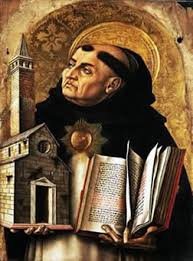
Aquinas was an Italian Dominican friar and priest, an influential philosopher and theologian, and a jurist in the tradition of scholasticism…. He argued that God is the source of the light of natural reason and the light of faith. He embraced several ideas put forward by Aristotle and attempted to synthesize Aristotelian philosophy with the principles of Christianity. He has been described as "the most influential thinker of the medieval period" and "the greatest of the medieval philosopher-theologians."
Introductory Comments
What is power? Aquinas's father - a formidable man from a wealthy and influential family - may never have pinned down a definition, but he knew, sure as hell, that it wasn't to be found in a Dominican friar tucked away in some remote monastery. So when his young son Thomas resolved to become exactly that, the old man dispatched his other sons to seize Thomas and haul him back to the family castle. An abbot or a bishop? Respectable - and arrangeable. But to don the black cloak of a mere friar was a stain on the whole family name.
And so Thomas sat prisoner in his own home for nearly a year, his resolve never once wavering. At one point his brothers smuggled a prostitute into the castle to seduce him - to awaken his dormant appetites and, with them, a proper respect for the perks of power. But Thomas was ready for the devil, even in so voluptuous a disguise. He snatched up a burning log, brandished it at the temptress, drove her from the room, and sank to the floor in mystical ecstasy. Soon after, his family gave up and let him slip away.
Then, to make a long story short, Thomas studied hard, became a professor, hopped from city to city, threw himself into debate after debate, wrote an astonishing number of works, revolutionized Christian theology, and bent the whole trajectory of Western thought. And that, Dad, is what we call power.
Some of Aquinas's Key Positions
Reason is not merely a human faculty but something that flows from God and abides in God himself - and can even establish God's existence through rational demonstration. It follows that Aristotelian philosophy - the most rational achievement of the pagans - is compatible with Christian principles. Indeed, a synthesis of the two enriches our grasp of both.
Yet Aristotle can be pushed too far, as the Averroists discovered. Should reason appear to contradict an article of faith, the "flaw" lies not in faith but in our faulty use of reason. Genuine truth cannot conflict with divine revelation.
Where revelation is silent, however, reason has too often been left idle. Our understanding of law, for instance, stays defective until it rests on law's rational foundation. Civil laws, to be legitimate, must derive from the natural law that reason discloses.
Reason shapes morality as well. The cardinal virtues - prudence, temperance, justice, and fortitude - are rational, and so naturally understood. The theological virtues - faith, hope, and charity - are in a sense supernatural, since their object is God Himself. Just as grace perfects nature, the theological virtues perfect and complete the cardinal virtues by ordering them toward the Supreme Reason that governs all things.
Place in the History of Ideas
Aquinas's Place in History of Ideas
Copleston: St. Thomas Aquinas's attitude was one of critical acceptance: he attempted to reconcile Aristotelianism and Christianity, not simply, of course, in order to avert the danger- ous influence of a pagan thinker or to render him innocuous by utilizing him for "apologetic" purposes, but also because he sincerely be- lieved that the Aristotelian philosophy was, in the main, true.... [And] in adopting a definite attitude towards Aristotelianism, a thirteenth century thinker was, to all intents and pur- poses, adopting an attitude towards philoso- phy....Distinctions had already been drawn, it is true, between theology and philosophy; but it was the full appearance of Aristotelianism on the scene which showed the medievals the power and scope, as it were, of philosophy.
Russell: [Aquinas] does not, like... Socrates, set out to follow wherever the argument may lead. He is not engaged in an inquiry, the result of which it is impossible to know in advance. Be- fore he begins to philosophize, he already knows the truth; it is declared in the Catholic faith. If he can find apparently rational argu- ments for some parts of the faith, so much the better; if he cannot, he need only fall back on revelation. The finding of arguments for a con- clusion given in advance is not philosophy, but special pleading. I cannot... feel that he de- serves to be put on a level with the best philos- ophers either of Greece or of modern times.
Random Thoughts on Aquinas
Sartre famously declared that existence precedes essence: we are flung into a world without built-in meaning, and it falls to us to supply it. Aquinas, some seven centuries earlier, seemed to say very nearly the reverse - that for created things, essence precedes existence. His meaning takes a little unpacking. Every existing thing, from the sand beneath our feet to the stars above our heads, is contingent. Each depended on something other than itself to come into being, and each may one day be snuffed out, whether by some flaw within or some force without.
But Aquinas insists on one glorious exception. The world could not exist at all if everything were contingent, borrowing its being from something else. There must be at least one thing whose existence is not borrowed but necessary - one thing that kicks the cosmic ball into play and keeps it, and everything on the field, rolling. Aristotle called it the First Cause, or Unmoved Mover. Christians call it God.
The odd thing is that Sartre and Aquinas end up staring at the same fact and drawing opposite conclusions. Both agree that things of this world, including ourselves, carry no meaning in their own right. Sartre finds in that a vacancy we must fill ourselves; Aquinas finds an arrow pointing past the creature to its source. Same contingency, same fragile borrowed being - but for one it opens onto freedom, and for the other, onto God.
Abelard (Universals don't exist independent of concrete, individual things.)
Albertus Mag. (Aristotle's philosophy is compatible with Christian beliefs.)
Al-Kindi (God's existence is revealed in our ordinary experience of nature.)
Augustine (Though faith is compatible with reason, faith remains primary.)
Cicero (Natural laws are universal due to their rationality and moral worth.)
Duns Scotus (Universals are real but are not independent of individual things.)
Ficino (All things in the great chain of being spring ultimately from God.)
Grotius (War is just if fought for a good cause and waged by a proper authority.)
Paul of Tarsus (Our faith must focus on the centrality of Christ as Redeemer.)
Thinkers with opposing positions:
Al-Farabi (The afterlife is not personal: All rational souls merge together.)
Bentham (Greatest happiness of greatest number determines right & wrong.)
Duns Scotus (In our concept of things, essence & existence are inseparable.)
Holmes (Natural law does not exist. Morality has nothing to do with law.)
Kierkegaard (Most Christian beliefs are irrational and require a leap of faith.)
Russell (No empricial evidence nor rational argument proves God's existence.)
Tolstoy (There has never been nor will ever be a just war. All war is evil.)
What others said about Aquinas
Albertus Mag.: You call him the dumb ox, but in his teaching he will one day produce such a bellowing that it will be heard throughout the world.
Cassirer: Thoams Aquinas calls both natural and divine law radiations of the divine being: the one law destined for earthly ends, the other ordained by revelation for super-terrestrial ends.
Alain de Botton: Aquinas read Averroes, and saw that he and the Muslim scholar were engaged on similar projects. He knew that the Muslim world’s increasingly radical rejection of reason was harming what had once been its thriving intellectual culture. It was partly thanks to Aquinas’s ideas that Christianity did not suffer the same process of stultification as Islam.
Copleston: [Aquinas believed that] if a philosopher arrives at a conclusion which contradicts, explicitly or implicitly, a Christian doctrine, that is a sign that his premisses are false or that there is a fallacy somewhere in his argument.
Anthony Kenny: [Aquinas is] one of the dozen greatest philosophers of the western world.
Cassirer: According to Thomas Aquinas religious truth is supra-natural and supra-rational; but it is not "irrational." By reason alone we cannot penetrate into the mysteries of faith. Yet these mysteries… complete and perfect reason.
Chesterton: St. Thomas exalted God without lowering Man; he exalted Man without lowering Nature. Therefore, he made a cosmos of common sense; "terra viventium"; a land of the living. His philosophy, like his theology, is that of common sense. He does not torture the brain with desperate attempts to explain existence by explaining it away.
Roger Scruton: [Aquinas's "Summa Theologica"] contains what is perhaps the most subtle and complete philosophical account of the nature of human emotion that has ever been produced.
Schools: Aristotelianism, Christian Theology, Essentialism, Intellectualism, Natural Law Theory, Neoplatonism, Platonism, Rationalism, Scholasticism, Thomism, Virtue Ethics
Main interests: Astrology, Causality, Chain of Being, Cosmology, Desire, Epistemology, Eschatology, Ethics, Faith, Fate, Free/Unfree Will, Friendship, Government, Habits, Happiness, Health, History of Philosophy, Human Will, Immortality, Jurisprudence, Just War, Justice, Law, Logic, Metaphysics, Mind, Political Philosophy, Property, Psychology, Punishment, Religion, Salvation, Spirituality, Theology, Time, Universals, Virtue, War, Will, Wisdom