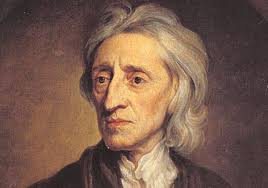
Locke was an English philosopher and physician, widely regarded as one of the most influential of Enlightenment thinkers and commonly known as the "father of liberalism." Considered one of the first of the British empiricists, following the tradi- tion of Francis Bacon, Locke is equally important to social contract theory. His work greatly affected the development of epistemology and political philosophy. His writings influenced... Voltaire.... Rousseau, and many Scottish Enlightenment think- ers, as well as the American Revolutionaries.
Introductory Comments
It's often been said that Locke's political theory helped shape the American founding. Less often asked: what shaped Locke's theory? It was forged in the political wreckage of 17th-century England: civil war, regicide, republican experiment, Restoration, and finally the Glorious Revolution. Locke was sixteen when Charles I was beheaded, a short walk from his classroom at Westminster School. The lesson he drew was not that kings are dangerous but that disorder is. His earliest political writings defend the magistrate's near-total authority over religious practice, on the grounds that liberty of that sort had lately soaked England in blood. He welcomed Charles II back.
The turn came in 1666, when he joined the household of the Earl of Shaftesbury as secretary, and eventually accomplice. Charles II leaned quietly toward Rome; his brother James leaned openly. When Shaftesbury's campaign to bar James from the succession collapsed, Locke fled to Holland a wanted man - having written the Two Treatises to justify a revolution that had not yet occurred. Then 1688. William of Orange landed with an army, and James abandoned his crown. Parliament handed the throne to William and to Mary, James's own daughter. Locke sailed home in 1689 and published his book, whereupon it was read as a defense of a new order it had preceded by nearly a decade: the Glorious Revolution he did not predict, did not lead, and did not witness - but had thorougly explained in advance.
Some of Locke's Key Positions
The mind at birth is blank paper - "void of all characters" - with no innate ideas stamped on it. Everything written there comes from experience, which has two springs: sensation, reporting the world outside, and reflection, the mind's notice of its own operations. Both deliver simple ideas, received passively. The mind then combines, compares, and abstracts them into the complex ideas that make experience intelligible.
This is a method as much as a theory of mind. Philosophy reflects on what experience contains; natural philosophy experiments and observes. In both, theory answers to experience and never the reverse. Much confusion dissolves once we ask of any grand word: what idea does it stand for, and where did that idea come from?
Common sense also explains the need for government: In the state of nature people already hold rights; the trouble is that they judge their own cases, and often in biased and selfish ways - ways that undermine peace and stability.
But people are also rational and understand that they need government to protect everyone's natural rights to life, liberty, and property. Beyond that, government should not interfere with the rights of people. Thus, the need for safeguards: political power must rest on the consent of the governed, operate by majority rule, and keep legislative and executive powers distinct.
Place in the History of Ideas
Locke's Place in History of Ideas
Will Durant: John Locke had proposed to apply to psychology the inductive tests and methods of Francis Bacon; in his great Essay on Human Understanding, [the mind], for the first time in modern thought, had turned in upon itself, and philosophy had begun to scrutinize the instrument which it so long had trusted.... The mind is at birth a clean sheet...; and sense experience writes upon it in a thousand ways, until sensation begets memory and memory begets ideas. All of which seemed to lead to the startling conclusion that since only material things can effect our sense, we know nothing but matter, and must accept a materialistic philosophy.
Russell: [Locke] is always sensible, and always willing to sacrifice logic rather than become paradoxical. He enunciates general principles which, as the reader can hardly fail to perceive, are capable of leading to strange consequences; but whenever the strange consequences seem about to appear, Locke blandly refrains from drawing them. To a logician this is irritating; to a practical man, it is a proof of sound judge- ment. Since the world is what it is, it is clear that valid reasoning from sound principles cannot lead to error; but a principle may be so nearly true as to deserve theoretical respect, and yet may lead to practical consequences which we feel to be absurd.
Random Thoughts on Locke
"Classical liberalism" is one of those terms that means something quite different from what it seems to. It has nothing to do with ancient Greece or Rome, and only a partial resemblance to what Americans today call liberalism. In fact, many of its core principles are now more commonly associated with conservatives than with liberals. Limited government, free markets, laissez-faire economics, civil liberties, and freedom of speech, religion, and assembly are all hallmarks of classical liberalism. The American Founding Fathers were classical liberals. And their ideological father was Locke.
Locke's liberalism answered the emergency in front of it: the political wreckage of 17th-century England. Modern liberalism answered the wreckage of the Industrial Revolution - child labor, grueling workdays, the slums - so it argued for a state that intervened. Would Locke have changed sides? He did write that labor explains how unowned things become mine -a concept that, on first reading, might sound a bit Marxist. But Locke did not say that labor determines how prices are set, and Marx did get his labor theory of value from Locke. We needn't speculate about the poverty question, in any case, because Locke faced it. In 1697, sitting on the Board of Trade, he proposed compulsory workhouses (or "working schools") for children of paupers from the ages 3 to 14, and hard labor for the able-bodied who begged. An expansive role for government, certainly. But not the expansion the question was hoping for.
Ayer (We only really know the immediate impressions of our senses.)
Bayle (The multiplicity of religions is not the problem, but rather intolerance.)
Berkeley (Abstract ideas are the source of all philosophical perplexity.)
Berlin (Certain values, like liberty, are universal and qualify as "natural laws.")
Gassendi (There is nothing in the mind which has not first been in the senses.)
Grotius (God's natural laws form the basis of our moral and political systems.)
Ibn Tufail (The mind at birth is a blank slate that experience will write upon.)
Quine (Most so-called analytic knowledge relies in part on empirical data.)
Thinkers with opposing positions:
Adorno (Rationality does not inevitably lead to progress in morality and justice.)
Althusser (Knowledge springs more from reflection than from experience.)
Butler, Joseph (Memory presupposes personal identity & so can't constitute it)
Chomsky (Certain ideas must be innate, since no empirical origin is possible.)
Fodor (The mind is inherently modular, with an interplay of distinct processes.)
Green (Strict empiricism not only undermines philosophy, but also practical life)
Leibniz (Humans are born with certain innate ideas already in their mind.)
Proudhon (Property is theft when it in effect steals the profits from laborers.)
Pythagoras (Ultimate truth is revealed to the intellect but not to the senses.)
What others said about Locke
Lord Acton: [Locke's] notion of liberty involves nothing more spiritual than the security of property, and is consistent with slavery and persecution....
Dilthey: No real blood flows in the veins of the knowing subject constructed by Locke, Hume, and Kant, but rather the diluted extract of reason as a mere activity of thought.
Berlin: [Locke] held that it was possible to create a society in which some of those rights which, according to him, men possessed before they entered into societies - while they were in the "state of nature" - were still retained by them in civil society; and allowed men a good many more individual rights than Hobbes did, [since] they were benevolent by nature….
Whitehead: Locke talks of "understanding" and "perception." He should have started with a more... neutral term to express the synthetic concrescence whereby the many things of the universe become the one actual entity.
Russell: John Locke invented common sense, and only Englishmen have had it ever since!
Cassirer: [For Locke] the mind must find its real task in holding a mirror up to nature - a mirror which can only reflect images, but cannot create or form them independently.
Rousseau: Locke would have us begin with the study of spirits and go on to that of bodies. This is the method of... prejudice, and error; it is not the method of nature, nor even that of well-ordered reason; it is to learn to see by shutting our eyes. We must have studied bodies long enough before we can form any true idea of spirits, or even suspect there are such beings.
James: [For Locke, personal identity springs from] the fact that at one moment of life we remember other moments, and feel them all as parts of one and the same personal history.
Schools: Christian Theology, Classical Liberalism, Empiricism, Enlightenment, Ethical Hedonism, Intellectualism, Liberalism, Libertarianism, Natural Law Theory, Republicanism, Secularism, Social Contract Theory
Main interests: Botany, Childhood, Civil Rights, Commerce, Community, Consciousness, Democracy, Economics, Education, Epistemology, Equality, Family, Free/Unfree Will, Freedom, Freedom of the press, Government, Habits, Happiness, Health, Human Will, Immortality, Jurisprudence, Justice, Law, Medicine, Memory, Metaphors, Metaphysics, Mind, Perception, Personal Identity, Political Philosophy, Political Theory, Politics, Power, Property, Public Administration, Punishment, Revolution, Science, Semiotics, Social Philosophy, Universals, Virtue, Wealth, Will