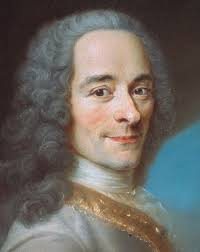
Voltaire was a French Enlightenment writer, philosopher, satirist, and historian. Famous for his wit and his criticism of Christianity (especially of the Roman Catholic Church) and of slavery, Voltaire was an advocate of freedom of speech, freedom of religion, and separation of church and state…. His polemics witheringly satirized intoler- ance and religious dogma, as well as the French institutions of his day. His best-known work..., Candide, is a novella that... ridicules many events, thinkers and philosophies of his time….
Introductory Comments
Voltaire's charm and his belligerence were not two sides of a contradiction. They were the same thing. His wit and his talk made him the most sought-after guest in Europe, but what drew the crowd was never politeness. It was the spectacle of a man saying aloud, and elegantly, what everyone had agreed not to say. He aimed at the Catholic Church above all, and past it at despotic kings, idle aristocrats (whose company he kept), system-building philosophers, quacks, and censors. (He aimed also at Jews and at Islam, but there the wit curdles into something harder to defend.)
Voltaire paid for his belligerence in installments. Eleven months in the Bastille for verses accusing the Regent of incest with his daughter. A beating by the footmen of the Chevalier de Rohan, who had come off worse in an exchange of insults and watched the correction from his carriage. A second spell in the Bastille for wanting to duel about it, then exile to England as the price of release, then a long career of strategic relocation ending at Ferney, chosen because a man could reach the Swiss border from it in a hurry. And the burning of his books - including, in 1766, a copy of his Dictionnaire philosophique which was thrown on the fire that consumed the body of the Chevalier de La Barre, beheaded at 19 for failing to remove his hat before a religious procession.
Candide, that battered hero, ends up abandoning his beliefs to tend his garden. Voltaire never could.
Some of Voltaire's Key Positions
The Church - the Catholic Church above all - has a long record of intolerance, persecution, censorship, and religious war. But the enemy is not belief in God. It is l'infâme, the "infamous thing": fanaticism, superstition, and the priestly power that feeds on both. Crush it.
God is another matter. A universe this orderly implies a designer, and a God who judges restrains men who fear nothing else. If he did not exist, it would be necessary to invent him.
The remedy is toleration, and the case is not abstract. Jean Calas was broken on the wheel in Toulouse in 1762, on the unproved suspicion that he had murdered his son to prevent a conversion. That is what certainty does once it reaches a magistrate. No church should have the power to punish, and no state should lend it one.
England shows the alternative: a king checked by law, a press that prints what it likes, thirty religions at peace because they meet as traders rather than as sects. Yet reform comes not from the multitude but from rulers with power enough to impose it and sense enough to want it.
Free expression is the condition of everything else. The open exchange of ideas is the surest remedy against superstition, fanaticism, and tyranny, and an indispensable condition of both peace and human progress.
Place in the History of Ideas
Voltaire's Place in History of Ideas
Will Durant: Italy had a Renaissance, and Germany had a Reformation, but France had Voltaire; he was for his country both Renais- sance and Reformation, and half the Revolu- tion. He was first and best in his time in his conception and writing of history, in the grace of his poetry, in the charm and wit of his prose, in the range of his thought and his influence. His spirit moved like a flame over the continent and the century, and stirs a million souls in every generation.... He and Rousseau were the two voices of a vast process of economic and political transition from feudal aristocracy to the rule of the middle class... He was happy in his garden, planting fruit trees which he did not expect to see flourish in his lifetime.
Heinrich Heine: Voltaire's keen laughter must be heard before Samson could strike with the headsman's axe. Yet Voltaire's laugh proved nothing; it produced only a brutal effect, just as did Samson's base axe. Voltaire could only wound the body of Christianity. All his sarcasms derived from ecclesiastical history; all his witti- cisms on dogma and worship, on the Bible, that most sacred book of humanity, on the Virgin Mary, that fairest flower of poetry; the whole dictionary of philosophical arrows which he discharged against the clergy and the priest- hood, could only wound the mortal body of Christianity, but were powerless against its inte- rior essence, its deeper spirit, its immortal soul.
Random Thoughts on Voltaire
No writer of the age went after the Catholic Church with Voltaire's stamina. The charges were old - greed, pride, cruelty dressed as piety, hypocrisy on a scale that beggars satire - and Catholic reformers had been making them for centuries. What was new was the vehemence, and behind it an argument. A belief resting on neither evidence nor reason is superstition, and superstition is not harmless: a mind that has agreed to accept one absurdity has surrendered the standard by which it might refuse the next. Whoever can make you absurd, Voltaire wrote, can make you unjust.
The interesting thing is that Paul had granted the premise. The preaching of the cross is foolishness; God chose the foolish things of the world to shame the wise. Paul conceded the absurdity and made it the point - the scandal is the proof. Voltaire accepted the description and reversed the verdict. Faith of that kind will not carry anyone to heaven, but it can make a fair imitation of hell on the way.
Which puts the Church's defenders in an awkward spot. They can point to Augustine and Aquinas, who showed that faith and reason illuminate one another - true, and beside Paul's point. To argue that faith is reasonable is to concede that it needs the support, that the miracle cannot stand unaided. Voltaire would have enjoyed the trap: the more ably the Church reasons on faith's behalf, the more Pauline faith it explains away.
Bruno (The multiplicity of religions is not the problem, but rather intolerance.)
Dante (The Church should not puruse political influence & material wealth.)
Grotius (Differences in religious doctrine are a purely private matter.)
Herder (Different cultures should not be measured against one another.)
Hus (The Catholic Church has become materialistic, avaricious and corrupt.)
Luther (The Catholic Church has often been guilty of oppression & corruption.)
Paine (The only religion that's at all defensible is pure and simple deism.)
Petrarch (We do God a disservice by belittling His gift to us of human life.)
Wolff (Human reason is able to reach moral truth by its own efforts.)
Thinkers with opposing positions:
Bakunin (If God really existed, it would be necessary to abolish Him.)
Holbach (The universe is simply matter in motion. It has no spiritual dimension.)
Maistre (A strong government requires loyality to a strong monarch and church.)
Rousseau (Liberty is self-rule & self-rule is obedience to the "general will.")
Schelling (Mythology & religion are true complements to speculative philosophy)
Schmitt (A strong leader must at times be above the law for the general good.)
Schopenhauer (Since desire leads to suffering, self-denial is our best path.)
What others said about Voltaire
Carlyle: Voltaire read history, not with the eye of devout seer or even critic, but through a pair of mere anti-Catholic spectacles.
Mozart: I must give you a piece of intelligence that you perhaps already know - namely, that the ungodly arch-villain Voltaire has died miserably like a dog - just like a brute. That is his reward!
Cassirer: Locke's proof that there are no innate ideas, Voltaire objects, by no means signifies that there can be no universal principles of morality. For the acceptance of such a principle does not imply that it is present and active from the first in every thinking being but that it can be found by everyone for himself.
Berlin: Voltaire was the first person who began no longer to write the history of individual kings and conquerors, captains and adventurers, but to take an interest in people's morals, their clothes, their habits, their judicial institutions.
Napolean: The more I read Voltaire the more I love him. He is a man always reasonable, never a charlatan, never a fanatic.
Charles Baudelaire: I grow bored in France - and the main reason is that everybody here resembles Voltaire… the king of nincompoops, the prince of the superficial, the anti-artist, the spokesman of janitresses....
Will Durant: Despite exile, imprisonment, and the suppression of almost everyone of his books by the minions of church and state, he forged fiercely a path for his truth, until at last kings, popes and emperors catered to him, thrones trembled before him, and half the world listened to catch his every word. It was an age in which many things called for a destroyer.
Huxley: There are some men who are counted great because they represent the actuality of their own age, and mirror it.... Such an one was Voltaire, of whom it was... said: "he expressed everybody's thoughts better than anyone."