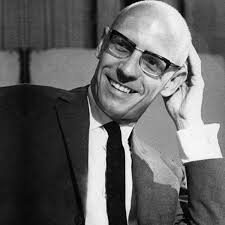
Foucault was a French philosopher, historian of ideas… and literary critic. Foucault's theories primarily address the relationship between power and knowledge, and how they are used as a form of social control through societal institutions. Though often cited as a structuralist and postmod- ernist, Foucault rejected these labels. His thought has influenced academics, especially those working in... anthropology, psychology, sociology, criminology, cultural studies, literary theory, feminism, Marxism and critical theory.
Introductory Comments
Michel Foucault spent his career rummaging through the basements of modern life - the asylum, the clinic, the prison, the school, the confessional, the bedroom. In Madness and Civilization, The Birth of the Clinic, Discipline and Punish, and the multi-volume History of Sexual- ity, he traced how each of these institutions invented its own way of looking at human beings: as mad or sane, sick or well, criminal or law-abiding, deviant or normal. His books read like intellectual detective stories, uncovering the subtle ways power organizes bodies, minds, and desires. What he found was not a story of steady progress toward enlightenment, but something very troubling - a recurring pattern of classification, confinement, and control.
What Foucault found was that power is not a blunt instrument held by kings or presidents, but a pervasive network of relations that pro- duces reality itself. Modern power operates through everyday practices - education, indoc- trination, normalization, hospitalization - quiet-ly manufacturing what counts as sane, criminal, educated, or sexually healthy. Power insinuates itself in the vocabulary of science, medicine, and reason. It doesn’t just repress; it creates the very categories we live by. And that is the ulti- mate power, for how can one fight against what seems a neutral reality? The prison guard is obvious; the psychiatrist's diagnostic manual is not - but both are, in their way, wardens.
Some of Foucault's Key Positions
Our social reality is shaped not by any single authority but by countless overlapping forces - political, institutional, religious, scientific, eco- nomic. What makes this unsettling is that pow-er does not merely repress or forbid. It actively produces what we take to be normal and true.
It does this through remarkably varied means. Courts and prisons define criminality. Schools and churches instill norms. Medicine and psy- chiatry draw the boundary between the health- y and the deviant. Sexual codes determine who we are allowed to be. In each case, power is not simply imposed from above - it is woven into the fabric of everyday life, shaping desire, behavior, and self-understanding from within.
Where, then, does truth stand? Following Nietz- sche, truth is not a free-floating reality waiting to be discovered. It is produced. Every society operates through a "regime of truth": a set of rules determining which statements count as true, which disciplines count as knowledge, which voices count as authoritative. Truth and power are deeply entangled.
This is not to say, however, that our efforts to find the truth are fruitless. If we can see that today's certainties have a history, that they were constructed and contested, then the present loosens its grip on us. Other ways of thinking - and living - become imaginable.
Place in the History of Ideas
Foucault's Place in History of Ideas
Philip Stokes: The theme that underlies all Foucault's work is the relationship between power and knowledge, and how the former is used to control and define the latter. What authorities claim as "scientific knowledge" are really just means of social control. Foucault shows how, for instance, in the eighteenth century "madness" was used to categorize and stigmatize not just the mentally ill but the poor, the sick, the homeless and, indeed, anyone whose expressions of individuality were unwelcome.
Richard Rorty: As far as I can see, all he has to offer are brilliant redescriptions of the past, supplemented by helpful hints on how to avoid being trapped by old historiographical assump- tions. These hints consist largely of saying: "do not look for progress or meaning in history; do not see the history of a given activity, of any segment of culture, as the development of rationality or of freedom; do not use any philosophical vocabulary to characterize the essence of such activity or the goal it serves; do not assume that the way this activity is presently conducted gives any clue to the goals it served in the past."
Gary Gutting: In the present climate of cynical disgust with the exercise of political power, Foucault's importance can hardly be exaggerated.
Random Thoughts on Foucault
Foucault's claim that power springs from a per- vasive network of relations that produces reali-ty itself (see Introductory Comments) had un-settling consequences for truth. If every age organizes knowledge through its own institu-tions and instruments, then truth isn't un- earthed so much as manufactured - each socie-ty running its own "regime of truth," complete with credentialed staff. What counts as mad- ness in 1650, illness in 1820, or perversion in 1890 tells us less about eternal reality than about who got to hold the clipboard. What a society accepts as scientific fact, moral certain- ty, or psychologial insight is always historically contingent. There is no God’s-eye view from which to escape our own time and its power-laden discourses; even the search for an au- thentic self is another move within the game.
Critics have lined up around the block. Foucault has been accused of historical sloppiness, ro- manticizing the mad and the criminal, and of-fering a politics with no compass. The sharpest jab, though, came from Habermas, who charged him with "crypto-normativity": if truth, reason, normality, and morality are all historically contingent products of power, then by what standard does Foucault denounce oppression? Why prefer liberation over domination - taste? It seems that Foucault has smugged in from the back door the very ideals (freedom, dignity, autonomy) he just threw them out the front.
Paglia (Sex and gender are not social constructs. They are rooted in biology.)
Schopenhauer (Art exists in a realm free of the forces at work on & within us.)
What others said about Foucault
Bourdieu: [Foucault was engaged in] a long exploration of transgression, of going beyond social limits, always inseparably linked to knowledge and power.
Camille Paglia: The elevation of Foucault to guru status by American and British academics is a tale that belongs to the history of cults. [...] The more you know, the less you are impressed by Foucault.
Gary Gutting: [Foucault] is our most brilliant philosopher of power. More originally than any other contemporary thinker, he has attempted to define the historical constraints under which we live, at the same time that he has been anxious to [locate] the points at which we might resist those constraints and counter some of the moves of power.
Chomsky: He struck me as completely amoral. I'd never met anyone who was so totally amoral…. I mean, I liked him personally, it's just that I couldn't make sense of him. It's as if he was from a different species, or something.
Didier Eribon: [Foucault was] a complex, many-sided character [and] under one mask there is always another.
Gary Wickham: The key to his success probably lies in the fact that he did not initially present his insights in abstract terms but instead allowed them to emerge from his painstaking histories of various knowledge endeavors….
Nussbaum: As a perceptive... student said to me, Why can't I use [Foucault's] ideas to resist the tax structure, or the antidiscrimination laws, or… even to join the militias? Others, less fond of liberty, might [rip] down the posters of the lesbian and gay law students' association…. Well, there are good answers to those questions, but you won't find them in Foucault.
Hans-Ulrich Wehler: [Foucault is,] because of the endless series of flaws in his so-called empirical studies…, an intellectually dishonest, empirically absolutely unreliable, crypto-normativist seducer of Postmodernism.
Main interests: Alienation, Anthropology, Art and Aesthetics, Beauty, Class Struggle, Communication, Consciousness, Cultural Criticism, Cultural Studies, Desire, Epistemology, Equality, Eroticism, Ethics, Free/Unfree Will, Freedom, Friendship, Government, Habits, Health, History, History of Ideas, History of Philosophy, Human Will, Ideology, Jurisprudence, Justice, Language, Literary theory, Literature, Metaphors, Mind, Personal Identity, Political Activism, Political Philosophy, Political Theory, Politics, Popular Culture, Power, Psychoanalysis, Psychology, Punishment, Rhetoric, Science, Semiotics, Sexuality, Social Criticism, Social Philosophy, Social Theory, Technology, War, Will