Claude Levi-Strauss (1908 - 2009)
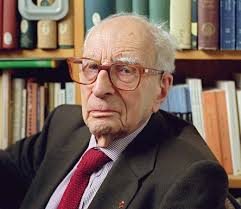
Open Levi-Strauss's interactive page (graphs of influences, similar and opposing positions, and quotes)
Background
Claude Lévi-Strauss
Born: 28 November 1908 in Brussels, Belgium
Died: 30 October 2009 (aged 100) Paris, France
Alma mater: University of Paris (DrE, 1948)
School: Structuralism
Main interests: Anthropology, Society,
Linguistics, Kinship, Culture, Mythology
Notable ideas: Structuralism, Mythography,
Culinary triangle, Bricolage
Influences: Lewis Henry Morgan, Ferdinand de
Saussure, Franz Boas, Émile Durkheim, Hegel,
Alfred Radcliffe-Brown, Kant, Rousseau, Marcel
Mauss, Roman Jakobson, Descartes, Husserl,
Nikolai Trubetzkoy, Maurice Merleau-Ponty,
Søren Kierkegaard
Influenced: Pierre Bourdieu, Edmund Leach,
Catherine Clément, Philippe Descola, Judith
Butler, Michel Foucault, Jacques Derrida,
Roland Barthes
From Wikipedia
Levi-Strauss was a French anthropologist and ethnologist whose work was key in the develop- ment of the theories of structuralism and structural anthropology…. Lévi-Strauss argued that the "savage" mind had the same structures as the "civilized" mind and that human characteristics are the same everywhere. These observations culminated in his famous book Tristes Tropiques that established his position as one of the central figures in the structuralist school of thought.
Introductory Comments
Levi-Strauss's structural anthropology sought to uncover the deep, unconscious mental struc- tures - binary oppositions like nature/culture, raw/cooked, self/other - that organize human thought across all societies, much as grammar organizes language beneath the surface of speech. He treated myths, kinship systems, and rituals not as isolated customs explained by their social utility but as elements meaningful only within a system of relations. This put him at odds with functionalists like Malinowski, who asked of any practice: what does it do for the society that performs it? Levi-Strauss found this rather like explaining a symphony by noting that it keeps the orchestra employed. For him, the question was never what does it do? but what does it mean within a system of thought?
By finding the same logical operations - inver- sion, mediation, transformation - recurring in myths from Amazonia to the Pacific Northwest, Levi-Strauss arrived at his most provocative claim: the so-called "savage mind" is every bit as rigorous and systematic as the "civilized" one, just applied to different materials. It was a powerful blow against the condescension of colonial-era anthropology. Yet critics argued that structuralism's pursuit of universal mental architecture risks becoming its own form of intellectual imperialism - a French-man in an armchair discovering that everyone thinks like a Frenchman in an armchair.
Some of Levi-Strauss's Key Positions
Though civilized man prides himself as being far superior to the so-called primitive man, basic human characteristics are the same every- where - whether we live in the "civilized" metropolis or the "savage" jungle village. Proof here is to be found in the systematic study of cultures. We need to overcome our biases and study all cultures objectively.
And structurally: As Ferdinand de Saussure showed that linguistics is best understood by searching for the underlying structures of language, so too is anthropology best approached by searching for the underlying structures of culture. Kinship relationships, for example, should be broken down into various types (uncle-nephew, mother-daughter, etc.) and each type should be analyzed according to their social status, functions, taboos, etc.
Though, of course, such structural analysis shows considerable variations between cultures, these variations have limits. The key kinship relationships are the same throughout all cultures, as are their key functions. This applies to all aspects of culture - foundational myths, social rules and expectations, religious and secular rituals, gender roles, leadership positions. All these aspects can vary between cultures, but the fundamental structures underlying culture remain the same, since the human mind remains the same.
Place in the History of Ideas
Levi-Strauss's Place in History of Ideas
Elizabeth Lewis: [Levi-Strauss's structural anthropology] used the analysis of cultural practices and beliefs... to identify the universal building blocks of human thought and culture. It offered a fundamentally unifying, egalitarian interpretation of people across the world and from all cultural backgrounds. At our core, Lévi-Strauss argued, all people use the same basic categories and systems of organization to make sense of the human experience.
Gilles Clément: He represents an extremely subversive vision with his interest in popula- tions that were disdained. He paid careful attention, not touristically but profoundly, to the human beings on the earth who think differently from us. It’s a respect for others, which is very strong and very moving. He knew that cultural diversity is necessary for cultural creativity, for the future.
Stanisław Andrzejewski: Apart from the advan- tages accruing from praying ardently to Marx, a facility for startling and often entertaining play upon words... account no doubt for much of Lévi-Strauss’s celebrity although… equally effective in this respect must be his highly original technique of persuasion (reminiscent of a sorcerer’s spell) based on threatening people with mathematics: muttering darkly about algebraic matrices and transformations without revealing their exact nature.
Random Thoughts on Levi-Strauss
In the final chapter of The Savage Mind (1962), Levi-Strauss accused Sartre of ethnocentrism in existentialist clothing. Sartre had argued that human beings make themselves through free, conscious action in history, implying that historically dynamic societies are more fully human than "primitive" ones oriented around myth and repetition. Lévi-Strauss countered that this was just Western parochialism: the so-called "savage mind" is every bit as human and as noble as Sartre's existential hero.
But the quarrel ran deeper than ethnographic generosity. Levi-Strauss's structuralism was an assault on everything Sartre held sacred: the free subject, conscious agency, and the primacy of lived experience. If human thought is gov- erned by unconscious structures we never chose and can't escape, then Sartre is pro- foundly self-deluded. We don't think myths, Lévi-Strauss argued; myths think themselves through us - making the "self" less an author than a venue. Sartre never formally replied, but his entire philosophy was the reply: existence precedes essence, and human freedom is not a structural illusion but the one thing we are "condemned" to. It remains one of the great unresolved standoffs in 20th-century thought - the philosopher of radical freedom versus the anthropologist of unconscious structure, each convinced the other had mistaken a particularly elegant fiction for the human condition.
Influences
Levi-Strauss was influenced by: Boas, Franz, Descartes, Durkheim, Hegel, Husserl, Jakobson, Kant, Kierkegaard, Mauss, Marcel, Merleau-Ponty, Morgan, L.H., Radcliffe-Brown, Rousseau, Saussure, Trubetzkoy
Levi-Strauss influenced: Agamben, Barthes, Bourdieu, Butler, Judith, Clement, C., Derrida, Descola, P., Foucault, Lacan, Leach, Edmund, Piaget
Similar and opposing positions
Thinkers with similar positions:
- Adorno (Civilization does not inevitably lead to progress in morality and justice.)
- Cassirer (Humans are symbolic animals. We comprehend with signs & symbols.)
- Durkheim (Collective consciousness produces a society & holds it together.)
- Hegel (Humans naturally think in terms of binary opposites & their unification.)
- Jung (Symbols and rituals shape a large part of our psychology and culture.)
- Radcliffe-Brown (Anthropology fundamentally deals with collective functions)
- Saussure (Linguistic signs only have meaning in relation to other signs.)
- Sorel (Social myths are powerful tools to mobilize a society for action.)
Thinkers with opposing positions:
- Adorno (Human civilization developed thru' the suppression of human nature.)
- Comte (The study of society should be scientific, quantifiable, and objective.)
- Freud (The social realm plays a minimal role in shaping human psychology.)
- Jaspers (Our freedom is absolute. An authentic life requires that we embrace it.)
- Kristeva (Cultures come into being by excluding the maternal & the feminine.)
- Malinowski (Anthropology deals funda-mentally with personal wants & needs.)
- Sartre (Our freedom is absolute & an authentic life requires that we embrace it.)
- Skinner (Our behavior can be reduced to matters of stimulus and response.)
What others said about Levi-Strauss
- Tanya Luhrmann: His fundamental lesson was that culture shapes the way we think far more fundamentally than we are aware.
- Paglia: When as a Yale graduate student I ransacked that great temple, Sterling Library, in search of paradigms for reintegrating literary criticism with history, I found literally nothing in Lévi-Strauss that I felt had scholarly solidity.
- Edmund Leach: The outstanding characteristic of his writing, whether in French or English, is that it is difficult to understand; his sociological theories combine baffling complexity with overwhelming erudition. Some readers even suspect that they are being treated to a confidence trick.
- Tanya Luhrmann: You think about the way you are created in a social [context] through interaction with other people in a way that doesn't occur to you really until you read his books. It's so brilliant, it's sui generis.
- Marshall Sahlins: He was the last of the greats, the last of the great anthropologists who had a worldwide view.
- Bernard Kouchner: At a time when we are trying to give meaning to globalization, to build a fairer and more humane world, I would like Claude Lévi-Strauss's universal echo to resonate more strongly.
- Stanley Grenz: Underlying Levi-Strauss's work is the assumption that each human being is completely embedded in a cultural and conceptual context. On this basis he contends that in order to discover what is truly important about humans, we have to explore not human consciousness as such but rather human cultural expressions.
- Robert C. Solomon: Levi-Strauss utterly rejects the idea of the Cartesian subjective self, and in its place imposes an ambitious and ominous theory of universal structures, not based in the self… but in… the structure of the human brain.
Schools: Continental Philosophy, Counter-Enlightenment, Structuralism
Main interests: Anthropology, Cultural Studies, Language, Mythology, Power, Semantics, Semiotics, Social Criticism
Levi-Strauss's answers to philosophical questions
Epistemology
"One must be very naïve or dishonest to imagine that men choose their beliefs independently of their situation."
History
"I am not far from believing that, in our own societies, history has replaced mythology and fulfills the same function...."
Political history focuses too much on individuals. The forces at work in history are largely economic and cultural.
Language
Writing "seems to have favored the exploitation of human beings rather than their enlightenment."
"Language is a form of human reason, which has its internal logic of which man knows nothing."
Law
"We treat the culprit both as a child, so as to have the right to punish him, and as an adult, in order to deny him consolation."
Mind
"I appear to myself as the place where something is going on, but there is no ‘I,’ no ‘me.’ "
Religion and Theology
"The field of myth, ritual, and religion seems... to be one of the more fruitful for the study of social structure."
Science
Science is more penetrating than the arts, since "it has been whetted on the stone of fact, but at… some loss of substance."
"The scientist is not a person who gives the right answers, he's one who asks the right questions."
"I can't help thinking that science would be more appealing if it had no practical use."
Society
Just as language gets meaning through structure, so also do societies. To know a society is to know how its structured.
We need our myths, rituals and taboos. "I think that a society cannot live without a certain number of irrational beliefs."
From the most primitive to the most advanced society, practices and customs rarely have a moral or rational basis.
Primitive people often have "a genius for invention or action that leaves the achievements of civilized people for behind."