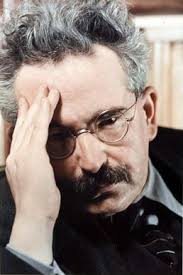
Benjamin was a German Jewish philosopher, cultural critic and essayist. An eclectic thinker, combining elements of German idealism, Romanticism, Western Marxism, and Jewish mysticism, Benjamin made enduring and influential contributions to aesthetic theory, literary criticism, and historical materialism. He was associated with the Frankfurt School, and also maintained formative friendships with thinkers such as playwright Bertolt Brecht and Kabbalah scholar Gershom Scholem.
Introductory Comments
In 1925 Walter Benjamin submitted a study of German baroque drama to the University of Frankfurt, hoping it would qualify him to teach. The examiners confessed they could make little sense of it. Advised to withdraw the work, Benjamin did, and his academic career ended before it began. The episode neatly sums up the trouble he poses: he did not fit any of the available boxes. He was a literary critic who wrote about children’s toys, hashish, and Parisian shopping arcades; a Marxist who wrote about the Messiah; a mystic fascinated by film and photography. His friends could not agree on what he was either. Gershom Scholem, the great scholar of Jewish mysticism, saw a theologian being led astray by Marxism. Bertolt Brecht, the Marxist playwright, saw a comrade still too fond of mysticism.
Perhaps the not-fitting was the point. Benjamin distrusted philosophical systems, which tidy the world by leaving most of it out. He preferred the fragment, the aphorism, and the quotation lifted from its context and set beside another, a technique he called literary montage. Ideas, he argued, relate to things the way constellations relate to stars. The truth is not the last link in a chain of reasoning but a figure that appears when scattered points are seen together. Writing of this kind does not lead the reader by the hand. It sets out the stars and trusts the reader to see the shape. But, of course, the method carries a serious risk: one person's Big Dipper is another's Plough.
Some of Benjamin's Key Positions
What we call progress is not the engine of history but its alibi. The faith that humanity advances steadily through empty, uniform time, has disarmed the very people who should have resisted catastrophe. To be astonished that fascism is still possible in the 20th century is to have learned nothing. Seen through the eyes of its victims, history is not a chain of advances but a single, continuing catastrophe that piles wreckage upon wreckage.
Every monument of civilization is also a monument of barbarism, owed not only to the genius that created it but to the anonymous toil of those whose labor made it possible. The historian's task is, then, not to reconstruct the past "as it really was," but to brush history against the grain, recovering the struggles and aspirations buried beneath official accounts.
Every generation inherits a "weak messianic power" through which it might answer the unfulfilled hopes of those who came before. The dead, especially history's forgotten and defeated, have claims upon the living. The past and present are not merely successive chapters in a finished story. At moments of crisis, an earlier struggle can suddenly illuminate the present, revealing possibilities for resistance and transformation. But revelation is not enough. Progress, if it comes at all, must be wrested from history, not awaited as its inevitable reward.
Place in the History of Ideas
Benjamin's Place in History of Ideas
Peter Osborne: Walter Benjamin’s importance as a philosopher and critical theorist can be gauged by the diversity of his intellectual influence and the continuing productivity of his thought. Primarily regarded as a literary critic and essayist, the philosophical basis of Benja- min’s writings is increasingly acknowledged. They were a decisive influence upon Theodor W. Adorno’s conception of philosophy’s actuality or adequacy to the present. In the 1930s, Benjamin’s efforts to develop a politically oriented, materialist aesthetic theory proved an important stimulus for both the Frankfurt School of Critical Theory and the Marxist poet and dramatist Bertolt Brecht.
Howard Eiland and Michael W. Jennings: But Benjamin was not only a surpassing critic and revolutionary theorist: he also left a substantial body of writing on the border between fiction, reportage, cultural analysis, and memoir. His “montage book” One Way Streetof 1928, andespecially Berlin Childhood around 1900, which remained unpublished in his lifetime, are mod- ern masterpieces. In the end, many of Benja- min’s works defy simple generic classification. Among the prose works long and short are monographs, essays, reviews, collections of philosophical, historiographical, and autobio- graphical vignettes, radio scripts, editions of letters and of other literary-historical documents, short stories, dialogues, and diaries.
Random Thoughts on Benjamin
In 1921 Benjamin bought a small watercolor by Paul Klee, Angelus Novus. It shows a wide-eyed creature with an open mouth and outspread wings, looking less like a messenger of heaven than a bystander at an accident. Nearly 20 years later, in Paris, Benjamin made it the angel of history in his essay "On the Concept of History." The angel faces the past. Where we see a sequence of events, he sees one single catastrophe, flinging wreckage at his feet. He would like to stay, wake the dead, and make whole what has been smashed. But a storm blowing from Paradise drives him backward into the future. That storm, Benjamin says, is what we call progress. His target was less the Nazis than a left confident that history was on its side.
Within months, the angel's predicament became Benjamin's own. In September 1940, fleeing the German occupation, he crossed the Pyrenees on foot with a small group of refugees. At Portbou they were told they would be sent back to France. That night he took a fatal dose of morphine. The next day the others were let through; why, no one knows. Perhaps the suicide. In Marseille he had given a copy of his essay on history to Hannah Arendt, who carried it to New York. In it he had argued that the hopes of the defeated survive as fragments, waiting for a later generation to redeem them. His last words on history reached us in just that way. The angel cannot stay to make things whole. But for Benjamin, that job was never the angel's alone.
Agamben (In going beyond the law, the "state of exception" breeds violence.)
Brecht (Popular media can be made to serve revolutionary ends.)
Foucault (Though conceptually distinct, power & violence are often connected.)
Frost (Poetry is that which is lost out of both prose and verse in translation.)
Goethe (The true artist strives after a higher truth, not a mere naturalness.)
Nietzsche (We need the illusions of art to cope with the truth about this world.)
Schiller (Works of art are both aesthetic experiences and moral statements.)
Schlegel (The individual work of art should create its own criterion.)
Steiner (Culture, politics & the economy must work together to improve society.)
Wittgenstein (Understanding relies less on words than on "seeing connections.")
Thinkers with opposing positions:
Adorno (Popular culture encourages a passive and unquestioning worldview.)
Hayek (Only free market capitalism is consistent with freedom & democracy.)
Hegel (History follows the dictates of reason and the dialectics of ideas.)
Kant (The distinction between reason and sense perception is fundamental.)
Marx (Economic, rather than cultural, forces drive history and shape society.)
Schmitt (In "exceptional" situations the ruler must be above the law.)
What others said about Benjamin
Howard Eiland: Like [his] many-sided œuvre itself, his personal convictions make up what he himself called a “contradictory and mobile whole.”
Jessica Kraft: Benjamin’s chief contributions to twentieth century intellectual history are likely his work on the aesthetic significance of image reproduction (like photography) and the character of modern urban spaces....
Peter Osborne: Benjamin’s messianic understanding of history has been an enduring source of theoretical fascination and frustration for a diverse range of philosophical thinkers, including Jacques Derrida, Giorgio Agamben and, in a critical context, Jürgen Habermas.... Aspects of Benjamin’s thought have also been associated with a revival of political theology....
Joseph Epstein: [Benjamin] must surely be among the 20th century's most overrated writers. Paris, Berlin, Moscow, Karl Kraus - Benjamin could render the juiciest of subjects arid.
Adorno: Everything which fell under the scrutiny of his words was transformed, as though it had become radioactive.
Ray Monk: Benjamin’s concern with the visual and his associated favoring of allusive, poetic writing over leaden theorizing is a good way into a body of work that would otherwise be dauntingly unfamiliar.
David Sinor: Walter Benjamin witnessed the wide-scale implementation of mass production and distribution in all aspects of society. He saw the rise of ads and film and newspapers, as well as the rise of mechanical industries.... This mass distribution of goods and commodities to more people than ever was revolutionary and beneficial in the eyes of Walter Benjamin.
Terry Eagleton: [Benjamin's "mechanical reproduction"] seeks to dismantle the intimidating aura of high-modernist culture with a more demotic, user-friendly art, suspecting all hierarchies of value as privileged and elitist.
Main interests: Alienation, Architecture, Art and Aesthetics, Biography, Childhood, Communication, Cultural Criticism, Cultural Studies, Epistemology, Fate, Film Theory, History, Industrialism, Journalism, Justice, Language, Literary theory, Literature, Mass Media, Memory, Metaphors, Philology, Poetry, Politics, Popular Culture, Semiotics, Social Criticism, Social Philosophy, Technology, Theatre, Tragedy