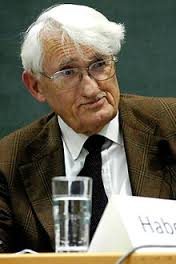
Died: 14 March 2026 (96) in Starnberg, Germany Schools: Critical Theory, Pragmatism
Main interests: Social theory, Epistemology,
Political theory, Pragmatics
Notable ideas: Communicative rationality, Post-
metaphysical philosophy, Discourse ethics,
Deliberative democracy, Universal pragmatics,
Communicative action, The structural
transformation of the public sphere
Influences: Weber, Durkheim, Mead, Marx,
Dilthey, Parsons, Kant, Hegel, Heidegger,
Piaget, Horkheimer, Adorno, Marcuse,
Wittgenstein, Peirce, Austin, Wolfgang
Abendroth, Dewey, Arendt, Rawls, Nietzsche
Influenced: Offe, Honneth, T.A. McCarthy,
Hoppe, Benhabib, Nancy Fraser
From Wikipedia
Habermas is a German social theorist in the tradition of critical theory and pragmatism. His work addresses communicative rationality and the public sphere…. Habermas's theoretical system is devoted to revealing the possibility of... rational-critical communication latent in modern institu- tions and in the human capacity to deliberate and pursue rational interests. Habermas was known for his work on the concept of modernity, particularly with respect to the discussions of rationalization originally set forth by Max Weber.
Introductory Comments
For Habermas, as for Austin and Searle before him, language is never merely a mirror held up to the world - it is a tool we wield, a move we make, a deed we do. To speak is to act: to promise, warn, request, accuse, console, or con- vince. But Habermas adds a fork in the linguistic road. When I speak in order to manipulate you - to nudge, spin, flatter, or deceive - I am engaged in strategic action, treating you as an obstacle or instrument. When I speak in order to reach an understanding with you - offering reasons you are free to accept or reject - I am engaged in communicative action, treating you as a fellow rational agent. The difference is be- tween talking at and talking with.
The Enlightenment project - that grand, sprawl-ing, still-unfinished renovation of human af- fairs - advances precisely to the degree that communicative action prevails over strategic action. Habermas believed that representative government, scientific inquiry, civil rights, pub- lic education: each is the result of countless conversations in which the better argument, not the louder voice or the fatter wallet, carr-ied the day. Strategic action, by contrast, is the Enlightenment's termite - quietly hollowing out institutions while leaving the façade intact. Propaganda, demagoguery, advertising mas- querading as journalism: each chips away at the public's capacity to think creatively together - indeed, even to be civil to one another.
Some of Habermas's Key Positions
Reason must be taken down from the cosmic pedestal philosophers have traditionally placed it on - as some sort of "Absolute" existing above the merely human realm - and placed where it in fact does belong: in the earthly realm of hu- man discourse. Rationality is found in the give and take of linguistic communication, in the idealizing presuppositions we cannot help but make whenever we speak to one another.
Being social animals with the gift of language, we do things with words - as J. L. Austin and John Searle have pointed out. But there is a crucial distinction: speech aimed at manipulat-ing others (strategic action) must be separated from speech aimed at reaching understanding with them (communicative action). It is the latter that sustains our democratic institutions, where the unforced force of the better argu- ment - not power dressed up as persuasion - is the coin of the realm..
That coin is especially valuable in the unfinished project called the Age of Enlightenment: more representative government, a more inclusive economy, and a freer, more just democratic society. These ideals have advanced fitfully through the dialogue of the public sphere. Indeed, at times the public sphere has suffered an almost total collapse. Yet somehow it reap- pears, so that the unfinished project can be taken up - and inched forward - once again.
Place in the History of Ideas
Habermas's Place in History of Ideas
Jack Mezirow: Jurgen Habermas is widely considered as the most influential thinker in Germany over the past decade. As a philoso- pher and sociologist he has mastered and creatively articulated an extraordinary range of specialized literature in the social sciences, social theory and the history of ideas in the development of a comprehensive and provocative critical theory of knowledge and human interests. His roots are in the tradition of German thought from Kant to Marx, and he has been associated with the Frankfurt School of critical theorists which pioneered in the study of the relationship of the ideas of Marx and Freud.
Martin Beck Matustik: [Habermas] argued that human interaction in one of its fundamental forms is "communicative" rather than "strategic" in nature, insofar as it is aimed at mutual understanding and agreement rather than at the achievement of the self-interested goals of individuals. Such understanding and agreement, however, are possible only to the extent that the communicative interaction in which individuals take part resists all forms of nonrational coercion…. Although the ideal communication community is never perfectly realized…, the projected horizon of uncon- strained communicative action within it can serve as a model of free and open public discussion within liberal-democratic societies.
Random Thoughts on Habermas
The Age of Enlightenment: The story begins in the coffeehouses, salons, and pamphlet wars of the late 17th and 18th centuries, where a liter-ate bourgeoisie first discovered that arguments could topple thrones. The American and French Revolutions were the public sphere's exuberant adolescence; the 19th century brought the slow, contested expansion of suffrage, aboli- tion, and the labor movement. Then came the catastrophe: the early 20th century saw mass media weaponized into mass manipulation, culminating in the Third Reich, where strategic action achieved something like total victory.
The postwar decades brought partial recovery: democratic reconstruction in Europe, the civil rights movement, the gradual expansion of rights across the globe - all hard-won victories of communicative action over entrenched pow-er. But early 21st century presents a uniquely paradoxical landscape. The internet, in principle the greatest expansion of the public sphere in history, has in practice become a theater of algorithmic manipulation, tribal echo chambers, and industrial-scale disinformation - strategic action wearing communicative clothing. And yet genuine democratic movements, global sci- entific cooperation, and cross-cultural dialogue continue to flicker and sometimes blaze. Haber- mas's unfinished project remains, stubbornly, unfinished - which is either the most depressing or the most hopeful thing one can say about it.
Dewey (Democracy and science rely on communicatve rationality of the group.)
Dilthey (Our understanding depends on past worldviews and interpretations.)
Erasmus (Honest speech is not only a virture, but also the basis of society.)
Foot (Moral judgments, though linked to human nature, can be true and rational.)
Mead (Rationality has ethical implications. It's not merely instrumental.)
Orwell (The abuse of language in political discourse undermines democracy.)
Piaget (Rational development in humans involves a long and gradual process.)
Weber (Modern society lacks cohesion and is fragmented into unrelated parts.)
Thinkers with opposing positions:
Comte (The study of society should be scientific, quantifiable, and objective.)
Derrida (A word's meaning is never nonlinguistic: Nothing's outside the text.)
Evola (Liberal democracy represents an ignoble trend towards mediocrity.)
Freud (Human civilization developed thru' the suppression of human nature.)
Gentile (The state is the source of all authority and the object of all loyalty.)
Rousseau ("Progress" in science & reason has not benefitted humankind.)
Russell (Language that is not verifiable is not true or untrue but meaningless.)
Schudson (The public sphere as a place of purely rational debate never existed.)
What others said about Habermas
W. Rehg: For Habermas, rationality consists not so much in the possession of particular knowledge, but rather in "how [speakers] acquire... knowledge."
Max Cherem: We can perhaps understand not only [Habermas's] political theory, but several other theoretical projects in this spirit of a public intellectual putting forth a theory for testing and debate….
Peter Beilharz: The second generation of critical theory became associated especially with the work and figure of Jürgen Habermas, who turned back to the inspiration of Kantian universalism. Where Marcuse saw systemic closure and frustration, Habermas saw possibilities for change, reform, and democratization.
William Rehg: … and his ideas have significantly influenced not only philosophy but also political-legal thought, sociology, communication studies, argumentation theory and rhetoric, developmental psychology, and theology.
Max Cherem: … Habermas defends the "unfinished" emancipatory project of the Enlightenment against various critiques.
Lyotard: [Since social thinkers play such different "language games,"] it seems neither possible, nor even prudent, to [expect] universal consensus through what [Habermas] calls Diskurs, [that is], a dialogue of argumentation.
J. Zapatero: The strength of a culture depends on its capacity to open itself up to other cultures, to integrate itself into them and to integrate them into it. It doesn't matter how many differences there may be, Habermas pointed out, everyone shares some principles. No culture tolerates the exploitation of human beings…. No civilization accepts violence or terror.
Martin Beck Matustik: Habermas was criticized by both the postmodern left and the neoconservative right for his trust in the power of rational discussion to resolve major domestic and international conflicts.
Main interests: Alienation, Class Struggle, Commerce, Communication, Democracy, Epistemology, Equality, Fact–value distinction, Freedom, Freedom of the press, Government, History, Ideology, International Law, Justice, Literary theory, Literature, Mass Media, Political Philosophy, Political Theory, Politics, Popular Culture, Power, Progress, Public Administration, Religion, Social Criticism, Social Philosophy, Social Theory, Technology, War, Welfare State, Will